
From Kant’s Antinomies to Hegelian Contradiction
The Parallax ViewThis thread traces the book’s reinterpretation of the passage from Kantian limits to Hegelian negativity and concrete universality.
increasing Bearing strength in each event
 decreasing
Bearing strength in each eventdecreasingKant Changes the Question

The Transcendental Turn
Neither side wins
Against empiricism and rationalism, Kant does not simply choose a victor or offer a higher synthesis. He changes the terms by locating knowledge within finite conditions.
The gap matters
The subject cannot directly reach the thing in itself. That limitation opens a new dimension instead of merely blocking access to reality.
Freedom Between Two Orders

A Place Between Necessities
Phenomenal and noumenal limits
Kant imagines that direct access to the noumenal would turn people into mechanisms. Neither the phenomenal nor the noumenal realm alone secures freedom.
The interval as freedom
Freedom persists in the gap between them. The book reads this as a clue that the transcendental subject is a formal opening, not a hidden substance.
Hegel Repositions the Gap

The Division Moves Inward
No external beyond
Hegel does not simply abolish Kant’s division. He relocates it inside reality, treating incompleteness as a positive condition rather than a defect in knowledge.
Negativity becomes constitutive
The obstacle to knowing the whole reveals that the whole itself is not complete. The book presents this move as the key to dialectical materialism.
Two Maps of One Village
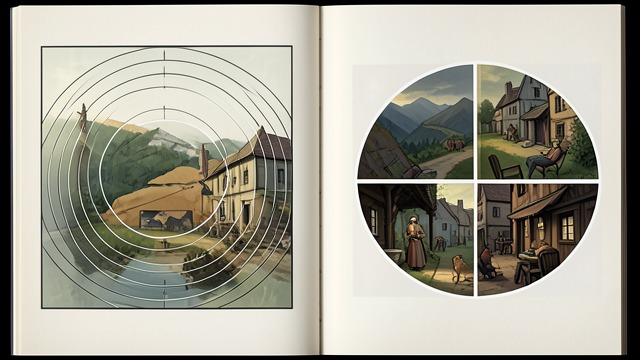
A Community Seen Twice
Conflicting village plans
Members of the Winnebago tribe draw their village either as concentric circles or as two divided halves. Neither diagram neutrally records the settlement.
Antagonism behind the views
Their incompatible maps register a social wound that the community cannot symbolize directly. The Real lies in the shift between the maps.
Concrete Universality

The Universal in Its Exception
Particulars do not simply fit
A universal becomes concrete where an excluded or exceptional element exposes its limits. The exception is not an incidental case but a revelation of the structure.
A political consequence
The excluded part can speak as the universal because its lack of a place divides the whole from within. Universality is therefore a struggle, not a container.
Chapter 1, early sections
Chapter 1, discussion of practical reason
Chapter 1, after the Kant discussion
Chapter 1, Lévi-Strauss example
Chapter 1, later argument
