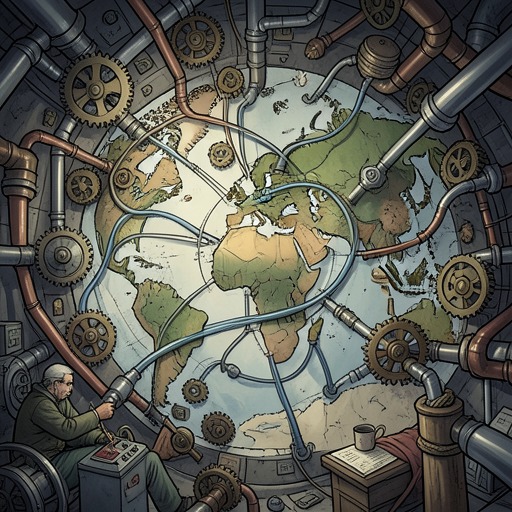
Capitalist globalization as the Real
The Parallax ViewCapitalist globalization as the Real describes a world-spanning economic order whose unity does not take the form of a shared worldview. Capitalism can operate within sharply different cultural and religious settings; what makes it global is the market mechanism itself, a force that exceeds the meanings societies give it. The concept therefore shifts attention from a global culture to a structural truth that shapes social life even when it cannot be gathered into one common account of what that life means.
Globality Without a Shared Meaning
Capitalism is global without constituting a single global civilization. It can accommodate Christian, Hindu, and Buddhist societies without requiring them to adopt a common capitalist worldview. The worldwide dimension is instead located in the Real of the global market mechanism: a system whose effects cross cultural boundaries but are not themselves organized by a universal set of values. In this sense, capitalist globalization joins global reach to a de-totalization of meaning.
That distinction makes the concept more than a description of economic expansion. It identifies a gap between meaning and truth: local institutions and beliefs may give events significance, while the market’s global operation does not depend on any one of those systems of significance. Capitalism’s unity is consequently structural rather than cultural. It is apprehended through the relations and pressures it generates, not through a coherent global creed.
Commodity Form and the Parallax of Value
The account draws on Kojin Karatani’s reading of Karl Marx, in which Marx’s analysis of value refuses to choose between production and circulation as the one true location of value. The opposing positions resemble a Kantian antinomy: value has to be considered in production and in circulation, although neither perspective can be reduced to the other. Later Marxist traditions often privileged production as the underlying truth and treated exchange and consumption as merely deceptive appearances. That move loses the parallax between the two domains.
The dispute over money clarifies what is at stake. Mercantilists treat money as a special thing in itself. David Ricardo’s classical political economy rejects that direct money fetishism, but still locates value as a substantial property inherent in the commodity, expressed by money as a sign of socially useful labor. Neoclassical economics rejects this substantial account and treats price as relational, arising through the interplay of supply and demand and the usefulness of commodities in relation to one another. Marx’s engagement with the relational account associated with Bailey helps him move beyond Ricardo: value is not a natural property sealed inside an object but a relation expressed through the object’s structural place among other commodities.
The commodity therefore cannot be understood by separating its form from its supposed essence. Marx’s example is a wooden table: its material remains ordinary wood, but when it enters the commodity relation it takes on a social form that makes it appear as something more than its use-value. The point is not simply that exchange disguises an already complete truth located in production. The commodity form is itself essential to how value appears and operates. Reducing form to a superficial disguise would miss the structure through which the economic relation becomes effective.
Capital as Self-Expanding Value
The transformation from money into capital intensifies this structural account. In ordinary commodity circulation, money can appear as a means for obtaining goods that meet particular needs. In the circuit of capital, value instead passes through money and commodities while increasing its own magnitude. Money and commodities become forms assumed and discarded by a process whose aim is the generation of additional value.
This reversal makes the means appear as an end in itself. The production of useful goods remains part of the circuit, but it is subordinated to the continuing movement from money to commodities and back to more money. Capital consequently presents itself as an independent substance with a motion of its own, seemingly able to generate value spontaneously. The appearance of self-generation is powerful, but it is not an account of an autonomous economic subject: the book describes capital’s self-engendering movement as a fantasy that depends on proletarian labor and is limited by the conditions it produces.
The same analysis cautions against opposing speculative finance to a supposedly healthy, substantial productive economy. Production can function as a detour within the speculative movement of money generating more money; speculation is not simply an external corruption of an otherwise grounded system. The global market’s force lies in this capacity to make accumulation its own end, even as the circulation of value continues to pass through material production and useful things.
Meaning, Religion, and the Real
The distinction between global meaning and global truth also frames the contrast between religious responses to modernity and a materialist critique. One response tries to contain the unsettling effects of scientific knowledge within a protective field of shared values, human nature, and communal meaning. Such a strategy gives the scientific Real an interpretation and sets limits around it. It addresses the threat at the level of meaning rather than challenging the economic or scientific mechanism that produces it.
The difficulty of this response becomes especially clear when religious thought confronts catastrophic suffering. The existence of mass suffering among innocents strains the link between a meaningful world and the claim that it is governed by an omnipotent, good God. Attempts to restore that link through explanations such as punishment, moral testing, or divine mystery show how interpretation can be recruited to make trauma intelligible. Against the assumption that every truth must be secured by an encompassing meaning, the account distinguishes local truths from a global truth that may not admit of such a frame.
A materialist response, associated here with Karl Marx, takes another route: rather than fitting capitalism back into a moral or communal whole, it examines the market mechanism as a truth that operates beyond shared meaning. This does not make cultural interpretation irrelevant. It marks the difference between contesting capitalism by supplying it with a more reassuring social meaning and questioning the Real of its economic operation.
Networks, Concentration, and the Urban Margins
The social consequences of this order appear in the uneven distribution of work, influence, and connection. The 80/20 rule describes recurring concentrations in which a minority accounts for a disproportionate share: the cited examples range from land and profits to decisions made during meetings and links on the Web. In a scale-free network, a few highly connected nodes coexist with many nodes that have relatively few links. Competition can continue while the leading nodes change, but at a threshold a network can tip toward winner-take-all concentration. Microsoft is offered as an example of a privileged node that others must connect through to communicate with a wide range of entities.
The same concentration appears in the account of future employment. If a much smaller share of the workforce can perform the work needed to reproduce the economy, the unemployed are not simply an excess of workers relative to an otherwise sound system; the argument turns the diagnosis around and asks whether capital itself is excessive. This structural question opens onto the search for political sites where excluded populations might become more than a statistical remainder.
The inhabitants of expanding urban slums are presented as a particularly important case. Lagos illustrates the scale: the shantytown corridor extending from Abidjan to Ibadan is described as containing 70 million people, while about two-thirds of Lagos State’s 3,577 square kilometers could be classified as slums or shantytowns. The state’s official population figure is 6 million, though estimates cited in the account place it at 10 million. The discrepancy itself conveys how difficult these populations are to count and govern.
These residents are not outside the global economy. They include marginalized laborers, redundant civil servants, and former peasants; many work informally for wages or as self-employed entrepreneurs, often without adequate health or social-security coverage. Their condition is linked to the incorporation of poorer countries into the global economy, including cheap food imports from wealthier countries that undermine local agriculture. Slum growth is thus framed not as an accidental failure at the edges of modernization, but as a symptom produced by its underlying economic logic. Because these populations are numerous, economically entangled, and in need of forms of self-organization, their marginalization also identifies a possible political site within the global order.