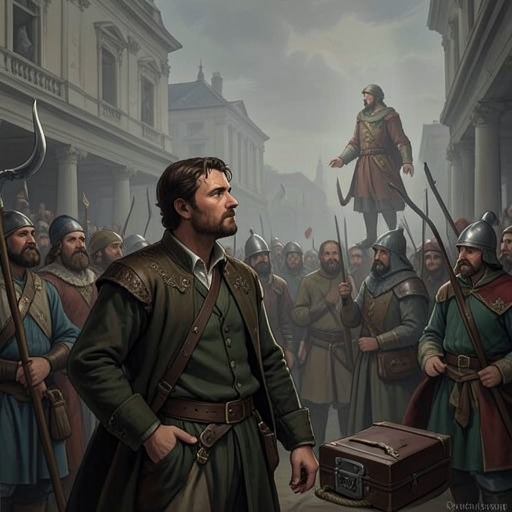
European modernity–the Balkans
The Parallax ViewEuropean modernity–the Balkans names a reversal of the familiar story in which a violent, intolerant Balkans stands as Europe’s opposite. The account argues that this image took shape as the region was exposed to European modernization, and that the traits Western observers condemn there reflect a history Europe itself helped introduce. The Balkans thus becomes not simply an external other, but a screen on which Europe encounters its own disowned legacy.
From coexistence to the Balkan image
The account locates the emergence of the Balkans as an ideological image in the middle of the nineteenth century, when the region was increasingly subject to the political, economic, military, and ideological effects of European modernization. This is a distinction between a geographical region and the meaning attached to it: the territory existed, but its familiar association with intolerance, ethnic violence, and fixation on historical trauma was not timeless. The image acquired its force in a specific historical encounter with modern Europe.
Earlier accounts complicate the assumption that Muslim rule was inherently intolerant. Abu Hanita, an eighth-century Muslim intellectual, treated differences of opinion within the community as a sign of divine mercy. In the sixteenth century, the French natural scientist Pierre Belon observed that Turks did not compel people to live according to Turkish customs. These examples do not establish an unchanging or uniform history of tolerance; they challenge the idea that the region’s later reputation simply expresses a perennial Muslim character.
The account also points to the reception of Jews expelled from Spain by Ferdinand and Isabella in 1492. Many found asylum in Muslim countries and were allowed to practice their religion. The resulting presence of Jews in major Turkish cities unsettled some Western travelers. That reaction reverses the later claim to moral superiority: religious plurality, celebrated in modern Europe as evidence of multicultural tolerance, had earlier appeared to some Western observers as a sign of Muslim decline.
Istanbul and the reversal of judgment
N. Bisani’s report from Istanbul in 1788 gives the contrast a concrete setting. A visitor accustomed to the intolerance of London and Paris, he reported, might be surprised to find a church between a mosque and a synagogue, or people of different religions conversing harmoniously. Yet Bisani interpreted this coexistence not as evidence of the government’s generosity or the population’s tolerance, but as a degeneration of Islam. The detail exposes the instability of the standard by which cultures are judged: a practice that later serves as proof of European superiority could once be dismissed when it appeared under Muslim rule.
The fate of the French Trappist monastery called Star Mary extends the contrast beyond an observer’s report. Expelled from France under the Napoleonic regime, its monks first found refuge in Germany. Driven out of Germany in 1868, they received no welcome from a Christian state. They then sought and obtained the sultan’s permission to buy land near Banja Luka, in the Serb part of present-day Bosnia, where the monastery continued to flourish until the monks were caught up in conflicts among Christians. In this account, a Christian community’s refuge in a Muslim-dominated part of Europe makes the conventional division between tolerant Christian Europe and intolerant Balkan other especially difficult to sustain.
Modernization and Europe’s disowned history
The argument does not present the Balkans’ later violence as imaginary. It asks instead where the features attached to the word Balkan came from, and answers that they came from Western Europe itself. Through what Hegel calls reflexive determination, Western Europeans encounter in the Balkans a legacy they have introduced and then disavowed. The region appears as Europe’s opposite while displaying, in intensified form, elements of Europe’s own history.
The account supports this claim by distinguishing between traditionalist Muslim political forces and the military modernizers who sought to transform Turkey into a European nation-state. It attributes the Armenian genocide and the oppression of the Kurds in the twentieth century not to those traditionalist forces, but to these modernizers. The distinction matters to the larger argument: violence associated with the region cannot be explained simply as the survival of a premodern Muslim order when it was also carried out in the name of modernization and European national models.
Mladen Dolar’s observation about Freud’s references to the Balkan area provides a final formulation: the European unconscious is structured like the Balkans. The analogy makes the region’s otherness a form of recognition. What Europe treats as foreign and condemns in the Balkans is also a stranger within Europe, a repressed part of its own historical inheritance. The relation is therefore not a simple opposition between a modern, tolerant Europe and a backward, violent region; it is a reflexive relation in which Europe projects its own contradictions outward and encounters them there.