Infinite resignation
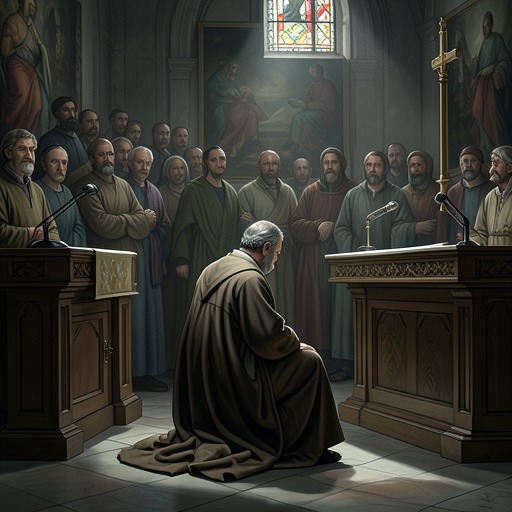
The Parallax ViewInfinite resignation names Søren Kierkegaard’s account of a sacrifice that cannot be justified by a promised return. It is not simply the loss of particular aims: the person renounces temporal goods and the expectation that life’s meaning can be secured by a final measure. The act makes unconditional commitment possible, but offers no guarantee that the sacrifice will restore meaning. In the book’s account, this paradox connects religious devotion to a broader philosophical question: whether meaning depends on a transcendent foundation or can emerge from life’s open-ended becoming.
Definition and Practical Decision
The discussion presents infinite resignation as a concrete, practico-ethical commitment rather than a conclusion reached by theory. Søren Kierkegaard’s position belongs to a wider anti-philosophical insistence that an existential choice precedes and grounds the theoretical account given of it. The decisive question is not which system can explain a life from outside, but what kind of life a person commits to living. On this view, the choice remains contingent: it cannot be derived from a complete theory that would remove the need to choose.
This emphasis does not mean that resignation is mere defeat or passive withdrawal. The renunciation is an act of commitment precisely because it gives up the security of finite purposes without replacing them with a humanly manageable equivalent. The book connects this structure to the sacrifice of Julia Flyte’s happy marital life and Mrs. Robinson’s renunciation of any authentic emotional link. It cautions against reducing either prohibition to a positive psychological explanation. In these examples, God names the negative gesture of sacrifice, rather than supplying a practical reason that would make the loss worthwhile.
Devotion Without a Guarantee
For Søren Kierkegaard, God is not a supreme object or substantial ground standing outside reality. God is correlated with reality’s openness and its unfinished condition: the divine is approached through the way a person relates to it, not grasped as a thing with independent properties. The book describes this as a desubstantialization of God. In its account of Christian love, the divine individual passes into the nonsubstantial link between individuals; devotion is expressed through self-renunciation, in which the person recognizes their inability to master or possess the absolute.
That devotion cannot operate as an exchange. The sacrifice encompasses an entire life, yet there is no assured reward that will compensate for what has been given up. The example of Abraham’s readiness to kill Isaac makes the stakes clear: viewed from outside, the leap of faith can appear irrational because it offers no calculable benefit. Even eternal happiness cannot function as a reward already available to human capacities. If it is treated as a present possession promised in return for sacrifice, the unconditional commitment has been converted back into a transaction and the venture has ceased to be unconditional.
Negative Meaning and the Loss of the Cause
The Good, in this account, is negatively determined. A person may turn away from worldly goods because they are judged false in comparison with the Good, but the Good itself cannot be positively described or possessed. Its name can mark the certainty that finite things are not ultimate goods without providing a complete description of what the ultimate good is. The absence of a positive definition is not an accidental gap to be filled with a more satisfying object; it is central to the structure of resignation.
The book relates this structure to Jacques Lacan’s concept of Versagung, understood as a radical, self-relating loss. First the person gives up what they have for a Cause-Thing that matters more than life. What follows is more severe than the loss of its material price: the sacrifice also entails losing the Cause-Thing itself. Infinite resignation thus does not secure its object through sacrifice. It reveals how a commitment can remain absolute while the object that seemed to guarantee it is absent. Meaning survives not as a possession with determinate content, but as a relation marked by its own lack of guarantee.
Becoming and the Challenge of Nietzsche
The book sets this account beside Friedrich Nietzsche’s affirmation of the innocence of becoming. If no positive value or object can give meaning to a person’s life as a whole, one response is to abandon the demand for a transcendent measure and affirm the creative process through which new meanings and values are made. This answer appears to turn Søren Kierkegaard’s despair into an open, affirmative becoming: life need not receive its meaning from beyond itself.
The discussion nevertheless questions whether this move proceeds too quickly. Resignation can be distinguished from nihilism: it does not merely register the defeat of a desire for humanly possible significance, but presents significance as something life may take on through surrendering that desire. Friedrich Nietzsche’s answer goes further by surrendering the desire for total significance itself. The book asks whether that answer overlooks a deadlock within becoming, the gap that propels the process rather than allowing it to settle into an ungrounded sequence of new meanings.
Philosophical Significance
Infinite resignation leaves behind pure Meaning after finite meanings have been renounced. Because this pure Meaning has no positive content available to experience, it can appear only as nonsense: its content is the void, the absence of meaning. The book compares this limit to Kazimir Malevich’s Black Square on White Background and to Claude Lévi-Strauss’s account of mana as a zero-signifier. In each case, what remains is a minimal difference between presence and absence, with form itself carrying the weight that determinate content can no longer bear.
This paradox also resonates with the book’s account of philosophical division more broadly. In its reading of Hegel’s response to Kant, a gap need not be overcome by appeal to a higher realm or a final reconciliation; the gap may instead be understood as a positive feature of reality itself. Infinite resignation gives this problem an ethical and religious form: it insists on unconditional meaning while refusing to make that meaning into a secure object. Its force lies in holding together devotion and the absence of assurance, and in leaving open whether the resulting void is the limit of meaning or the condition from which another account of life must begin.