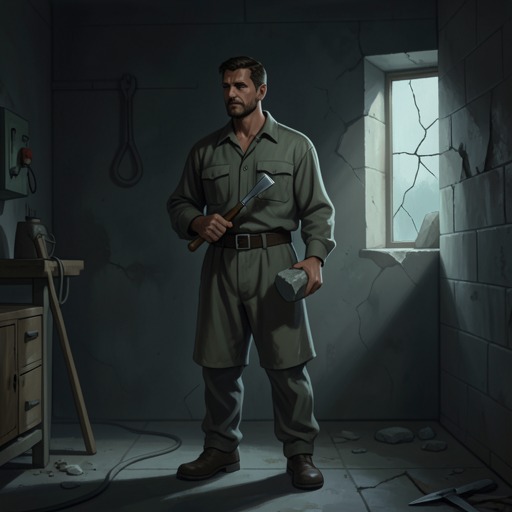
Joe Jurani
The Parallax ViewJoe Jurani’s life embodies a defining contradiction of Stalinism: a revolutionary who helped overthrow the old order is later imprisoned by the new one and compelled to commemorate his own act of resistance. In 1943 he led a revolt by prisoners on Rab Island; after the war, imprisoned on Goli Otok, he was mobilized to build a monument celebrating the rebellion. The book treats this reversal not as an isolated misfortune but as a compressed image of a regime haunted by the revolutionary inheritance it betrayed.
Wartime Leadership
Jurani is identified as an old Slovene Communist revolutionary. In 1943, after Italy capitulated, he led a rebellion by Yugoslav prisoners held in a concentration camp on Rab Island in the Adriatic. Under his leadership, 2,000 starving prisoners disarmed 2,200 Italian soldiers. The account emphasizes the scale of the reversal: prisoners who had been deprived of power acted collectively and overcame a larger armed force.
This revolt establishes Jurani as a participant in the revolutionary history that the later regime claims to inherit. His leadership is central to the episode: the prisoners’ achievement is attributed to their action under his direction, and the later monument is specifically built to mark the rebellion he led.
Imprisonment and the Monument
After the war, Jurani was arrested and imprisoned on nearby Goli Otok, a notorious Communist concentration camp. In 1953, while still a prisoner, he and other inmates were mobilized to build a monument commemorating the tenth anniversary of the 1943 rebellion on Rab Island. The work forced a stark conjunction: Jurani was made to help memorialize his own act of resistance while held captive by the political order that had imprisoned him.
The irony is sharper than simple defeat. The monument publicly preserves the memory of the rebellion, but its construction turns that memory into labor imposed on one of its leading participants. Jurani’s revolutionary past is neither erased nor allowed to remain his own; it is retained by the regime in a form that makes the former revolutionary serve the state’s commemoration of his achievement.
A Universal Singular
The book presents Jurani’s fate as a universal singular: one person’s history that stands for the experience of a much larger population. Millions who had helped overthrow the old regime were later subordinated to the new rules and made to build monuments to their own revolutionary past. Jurani makes that historical reversal concrete: the same man who led prisoners in revolt is now a prisoner helping to erect its memorial.
The account describes this as a second, reflexive betrayal. First, a person gives everything to the Communist cause; then the representatives of that cause reject him, leaving him without a secure point of identification. Jurani’s predicament is thus not only that he has lost his freedom. The political cause to which his revolutionary action belonged has become the authority that confines him, while the public celebration of that action offers no restoration of his place within it.
The Revolutionary Inheritance under Stalinism
Jurani’s story belongs to the book’s broader account of Stalinism as a regime shaped by tension between a stable new nomenklatura and the repeated purges through which the repressed revolutionary inheritance returns. The purges, in this analysis, are not simply episodes of repression: they are also the form in which the revolution’s betrayed legacy continues to haunt the regime. Jurani’s forced work on the monument gives that contradiction an individual face.
The book also resists treating Stalinism as merely an accidental departure from the October Revolution or as proof that the Communist project was inherently totalitarian. It argues that the failure of revolution to expand beyond the Soviet Union turned revolutionary energy inward, where forced collectivization and industrialization violently reshaped Soviet society. Jurani’s biography does not itself explain that transformation, but it illuminates its paradoxical legacy: revolutionary action survives in the official memory of the state even as the revolutionaries who carried it out are subjected to the new order. His monument therefore signifies both remembrance and dispossession—the past is honored, while its makers are denied the freedom and political belonging that the past had promised.