Meaningless sacrifice
The Parallax ViewMeaningless sacrifice names a renunciation that cannot be secured by a promised return. Its decisive significance is the paradox that an act may affirm an unconditional commitment only by giving up the expectation that the commitment will be rewarded or made intelligible. The book develops this idea through Søren Kierkegaard’s theology, Jacques Lacan’s account of renunciation, the choices of Sygne de Coufontaine and Isabel Archer, and the films of Andrei Tarkovsky. Across these examples, sacrifice is not simply costly devotion: it becomes meaningful at the point where no calculation can guarantee what it means.
Definition and theological logic
For Kierkegaard, God is not a supreme object or substance that belongs to the world and supplies it with a secure foundation. God names an absolute Other against which reality appears contingent and unfinished, and is understood through the mode of a person’s relation to the divine. In this account, the how of devotion is inseparable from what God is: a relation of absolute commitment, rather than a transaction with an entity that can be possessed or measured.
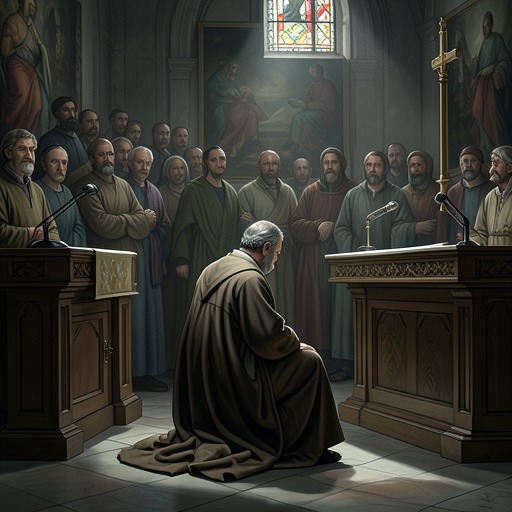
That relation takes the form of self-renunciation. A person dedicates an entire life without a sufficient reason that could make the act proportionate to a result. The sacrifice cannot be justified by asking what it will produce or what the sacrificer will receive. Even eternal happiness cannot function as a reward in the ordinary sense: if it is treated as a good that can be secured in advance, the person is no longer venturing everything. The commitment therefore requires a leap of faith that may appear irrational from outside it, because no worldly calculation can establish its payoff.
The Good, in this framework, is negatively determined. The person who turns away from temporal goods does so in the name of a good whose content cannot be positively specified. The renunciation does not disclose a clear alternative object waiting to replace what has been surrendered. Likewise, divine infallibility has a negative implication in the book’s reading of Kierkegaard: human beings cannot claim that their own position is infallible. Meaningless sacrifice thus unsettles the confidence that a moral or theological account can fully explain the act.
Renunciation without compensation
The book connects Kierkegaard’s infinite resignation to Jacques Lacan’s concept of Versagung, a radical loss that turns back upon the subject. The sequence is deliberately more severe than a sacrifice followed by compensation: a person gives up everything for a Cause that matters more than life, and what follows is the loss of the Cause itself. Renunciation does not preserve its object as a prize, nor does it secure a stable identity for the person who made the sacrifice. The act’s force lies in the failure of exchange.
This distinction helps explain the book’s account of Sygne de Coufontaine in Paul Claudel’s play The Hostage. Sygne agrees to marry Toussaint Turelure, whom she despises, in order to save the Pope hiding in her house. The marriage costs her the attachments that had shaped her life, including her love and her family name and estate. Later, when Georges aims a bullet at Turelure, Sygne intercepts it and saves the life of the husband she had been forced by circumstance to marry.
Her final refusal does not offer a hidden explanation that would make the rescue easier to assimilate. As she lies dying, Turelure asks for a sign that would make sense of her action; she responds through a compulsive tic rather than speech. The book argues that this refusal is not simply a withheld private motive, or a last objection to one particular demand. It refuses to let her act be recovered as marital duty, love, natural goodness, or another familiar account of motivation. Her rescue of Turelure remains an act that cannot be entered into a sacrificial economy; the refusal preserves that lack of justification rather than revealing a secret reward behind it.
Ethical acts without a secure explanation
Sygne’s refusal is presented alongside Isabel Archer’s decision at the end of Henry James’s The Portrait of a Lady. Isabel remains with Osmond although she does not love him, knows that he has manipulated her, and is free to leave. The book rejects the explanation that social convention simply compels her to stay. Isabel has shown that she can override convention, and her decision is connected instead to her commitment to her word and to a choice she regards as having been made out of her independence.
That commitment makes Isabel, in Jacques Lacan’s formulation discussed by the book, a hostage to her word. Leaving would not merely escape an oppressive marriage; it would also mean repudiating a decision that she understands as her own. The act is therefore neither a straightforward endorsement of the marriage nor an instance of feminine masochism. Its difficulty is that autonomy appears through a decision whose consequences are painful and whose meaning cannot be reduced to obedience. The comparison with Sygne clarifies the book’s distinction between sacrifice for a recognizable cause and sacrifice without a redeeming cause: these women’s acts cannot be secured by a clear account of what they gain.
The book draws a broader contrast between men who are conventionally imagined as sacrificing themselves for an identifiable object, such as country, freedom, or honor, and women whose sacrifices may be made for nothing. This is not treated as a claim that the women’s acts are morally superior because they are more painful. Rather, the contrast identifies a problem of interpretation: when an act has no publicly legible object or payoff, familiar moral explanations struggle to contain it. Meaningless sacrifice makes that interpretive failure central to the act’s significance.
Tarkovsky and the destruction of the cherished object
In Andrei Tarkovsky’s Sacrifice, the idea takes cinematic form through Alexander, who lives with his large family in a remote cottage in the Swedish countryside. On his birthday, low-flying jet planes bring news of a nuclear war between the superpowers. In despair, Alexander prays to God and offers what is most precious to him in the hope that the war will not happen. The war is undone; at the film’s end, Alexander burns down the cottage and is taken to a lunatic asylum.
The result does not turn his offering into an ordinary bargain whose terms can be verified. The film places the apparent restoration of the world beside the loss of Alexander’s home and his removal from ordinary life. The cottage is not an interchangeable possession: it represents the safety of Home and an attachment to rural roots. Its destruction means that the sacrifice reaches the very object that had held together Alexander’s cherished world, rather than sparing that object in exchange for a benefit.
The book places Sacrifice beside Tarkovsky’s Nostalgia. In both films, the corresponding sacrificial figure is played by Erland Josephson: in Nostalgia he is the old fool Domenico, who sets himself alight in public; in Sacrifice he is Alexander, who burns his home. The films also make irrational, apparently useless gestures central, including traversing an empty pool with a lit candle and destroying one’s own house. Such acts resist justification through practical utility. Their function is not to provide a rational proof that sacrifice works, but to show how a senseless expenditure may be imagined as restoring immediate faith amid modern spiritual malaise.
This structure is deliberately ambivalent. Sacrifice can restore meaning in the films, yet the gesture does so by relinquishing the very expectation that meaning can be secured through a sensible exchange. The book captures this reversal by describing sacrifice’s ultimate meaning as the sacrifice of Meaning itself. In Alexander’s case, the cherished cottage is destroyed rather than preserved as evidence of a successful bargain. Meaningless sacrifice therefore remains suspended between restoration and loss: it may answer a crisis, but it cannot turn the act into a guaranteed, rationally rewarded investment.