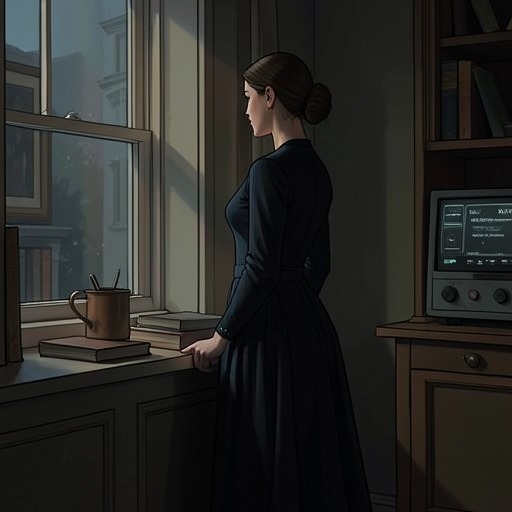
Milly Theale
The Parallax ViewMilly Theale is the mortally ill American heiress whose bequest to Merton Densher turns an apparent act of selfless kindness into the novel’s most difficult ethical test. Once she learns that Densher and Kate Croy are linked and that his display of love belongs to a plan involving her, Milly does not expose or retaliate against them. Instead, she leaves her wealth to Densher. The gesture gives her a form of agency, but it also binds the couple to her death and makes every response to her gift morally charged.
Identity and Position
Milly’s defining circumstances in this account are her wealth, her illness, and the knowledge that she has become the object of other people’s intentions. She is described as a mortally ill American heiress, and her fortune gives her the power to act even when her illness places her life beyond her control. The novel’s ethical question is not simply whether the others have treated her well. It is what Milly will do when knowledge changes the meaning of their actions—and what that knowledge permits her to make of her own.
The disclosure is layered: Milly learns not only of the link between Densher and Kate, but of the plot in which his apparent love for her has a part. This knowledge arrives as an imposition, not as a plan she has initiated. Yet her response is not passive in the straightforward sense. She decides to play along to the end, and the bequest becomes the means by which she acts within circumstances she did not choose. Her agency lies less in escaping the situation than in giving it a conclusion of her own devising.
The Bequest and Its Double Edge
After learning about the plot, Milly leaves her fortune to Densher. On its face, this is an extraordinarily altruistic act: she appears to give the couple the wealth they might need to live happily together. But the gift is not ethically neutral. Milly’s aim, in the interpretation presented here, is to break the bond between Kate and Densher by making the money impossible for them to accept without guilt. The bequest offers material benefit while making that benefit carry the weight of Milly’s sacrifice.
The dilemma is cruel because neither choice restores the couple to innocence. If Densher and Kate accept the money, they appear to profit from Milly’s death and to confirm the moral corruption her generosity seems to forgive. If they reject it, the refusal does not simply establish their righteousness: it can be read as a retrospective admission that they were guilty of exploiting her. Milly’s gift thus differs from an ordinary polite offer intended to be turned down. Its recipient cannot perform the expected rejection and emerge with the original relationship intact. The choice itself becomes an accusation, whatever answer is given.
Milly’s death, in this reading, is therefore not presented merely as an unfortunate consequence of illness. She assumes and stages that inevitable death as part of the meaning of her sacrifice, intending that her fortune and her self-erasure together will enable Densher and Kate to be happy. The gesture’s apparent generosity and its destructive effect remain inseparable: it offers a future while undermining the possibility of living that future without guilt. The account calls the sacrifice fake not because its effects are unreal, but because its altruistic appearance conceals a more complex intervention in the couple’s lives.
Desire, Fantasy, and Ethical Death
Milly’s decision is also interpreted through desire. Rather than waking into a full confrontation with the truth, she dies in order to keep sustaining the fantasy that has made her a desiring subject. The comparison is to Freud’s dream of a father who wakes after his child cries that he is burning: waking protects the father from the traumatic encounter expressed by the child’s cry and allows the dream to continue. Milly’s case reverses that structure. She dies, in the book’s formulation, rather than waking from the fantasy that supports her desire.
This interpretation calls Milly’s solution hysterical: she clings to the barrier that keeps desire from reaching its full realization. In the precise Lacanian sense invoked here, her death is an ethical death, a death in accordance with desire. But the ethical status of this act is not settled by naming it. The discussion challenges the simplified idea that fidelity to desire must mean sustaining desire’s unfulfillment and continuing to dream. It asks whether the ethical act might instead require traversing the fantasy. Milly’s choice consequently remains both an exercise of agency and a possible refusal of a more painful encounter with what she knows.
What Her Gesture Does to Densher and Kate
Milly’s bequest becomes a test for Densher as well as for herself. After her death, a thick envelope containing the money is sent from her lawyers in New York. Densher sends it to Kate unopened, but its arrival does not settle the question of what he owes Milly. His refusal of the gift can look like moral growth, yet the interpretation here treats that refusal as another false ethical gesture. The money circulates as a tainted object: possession threatens to implicate its recipient, while rejection cannot cancel the circumstances that gave it meaning.
Kate’s account of Densher’s feelings sharpens the betrayal. She tells him that he did not love Milly while she was alive, but that his change came on the day he last saw her: Milly died for him, so that he might understand her. Kate concludes that he loves Milly after her death, specifically the sacrificial gesture by which her illness and death have been made to appear a gift to the couple. In this reading, the love is false not because it has no emotional force, but because it attaches to Milly as the figure of a sacrifice rather than meeting her as she lived. The account connects this response to Freud’s concept of moral masochism.
Milly is consequently neither reduced to a helpless victim nor made into an uncomplicated saint. Her knowledge gives her a way to act, and her bequest decisively alters the choices left to Densher and Kate. At the same time, the gift’s power depends on the fantasy of sacrifice that it perpetuates. Her place in the novel rests on that unresolved tension: she can manipulate the bond she has discovered, but the form of her intervention may also preserve the very fantasy from which she cannot awaken.