Walter Benjamin
The Parallax ViewWalter Benjamin is presented as a thinker of concealed forces: the theological element hidden inside historical materialism, the historical charge lodged in discarded things, and the possibility of redemption that survives without making suffering meaningful. Rather than recounting his life, the book returns to Benjamin’s arguments as a way to challenge reductions of history to progress, of commodities to useful objects, and of political change to a purely economic mechanism.
Historical materialism and the hidden theological force
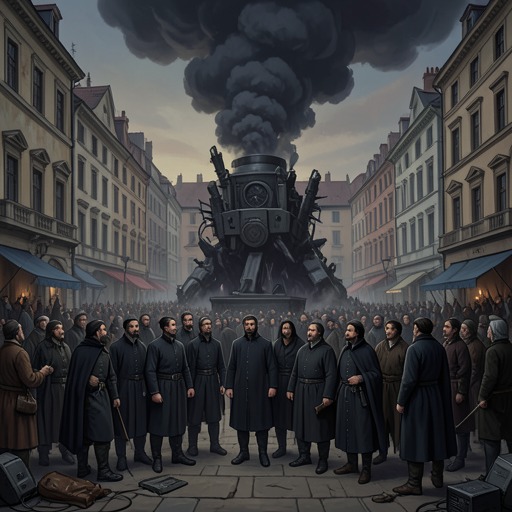
Benjamin’s chess automaton gives a striking image of the relationship between historical materialism and theology. In the account of the machine, a mechanical figure plays chess from inside an apparently empty cabinet, while the hidden player who directs it remains out of sight. Benjamin uses this arrangement to figure historical materialism as the visible puppet and theology, in the form of messianic redemption, as the concealed force that enables it to win. The image makes the relation neither a simple opposition nor an easy synthesis: the materialist account seems self-sufficient, but Benjamin’s parable insists that its apparent autonomy conceals something it cannot explain away.
The book extends the automaton image into a debate about mind and agency. The chess figure can suggest that what looks like intelligent action is produced by impersonal machinery; the hidden player, by contrast, marks the appeal to a power beyond the visible mechanism. Benjamin’s historical analogy holds these possibilities in tension. The question of what happens if the cabinet contains no hidden player is left open, and that uncertainty matters: the parable does not simply reassure readers that theology will rescue materialism. It exposes the problem of whether a wholly mechanical account can account for history’s capacity to break with what already exists.
Commodities, form, and capitalist religion
Benjamin’s account of capitalism as a religion sharpens the book’s treatment of commodity life. Capitalism is not described merely as a system of production whose products can be explained by their practical use. Its power also lies in the way money and commodities seem to acquire a life of their own. The book connects this spectral quality to the figure of the undead: capitalism appears as an obscene religion of life that persists beyond ordinary limits, celebrated in the financial market’s rituals. This is not a claim that alien monsters literally represent capital. The proposed connection is metonymic: capital exploits and parasitizes the drive of life, rather than simply standing for it in disguise.
The discussion of Marx helps specify the force of this argument. A wooden table remains an everyday useful object until it enters the commodity relation, where its social form makes it seem transcendent and strange. The change is not in the wood’s physical nature. It lies in the position the object occupies in a network of exchange and in the way human labor assumes a social form. Benjamin’s account of capitalism’s religious character resonates with this analysis: the apparently self-moving world of commodities is a social relation rendered mysterious, not an independent supernatural power.
This emphasis on form also distinguishes Marx’s critical method from a simple movement behind appearances toward an essence located only in production. The book argues that the form is not a disposable veil: the hidden structure depends on the form through which it appears. Money, accordingly, cannot be explained either as a special substance or as a neutral sign of value inherent in goods. Its status depends on its place as the general equivalent among commodities. Benjamin’s importance in this discussion is part of a broader insistence that historical and social forces are often legible precisely in forms that a reductive account would dismiss as secondary.
Ruins and the perception of history
Benjamin’s attention to cultural artifacts in decay gives the book another way to think about historical time. History becomes perceptible not only in triumphs or in an orderly story of progress, but in things breaking down and being reclaimed by nature. The example of industrial waste makes this perspective concrete: heaps of used cars and discarded computers appear as the inert residue of capitalism’s relentless production of new objects. Their uselessness does not make them historically empty. In their decay, the drive to produce and replace becomes visible at rest.
The postindustrial landscape of Łódź embodies this insight. After visiting Poland in November 2003, David Lynch was drawn to the city’s failing factories, crumbling gray housing developments, and polluted air and water. The book treats this ruined industrial environment not as a blank left behind by history, but as a potential evental site: a place from which the apparent totality of global capitalism might be challenged. Benjamin’s way of reading decay makes the wasteland more than a symbol of decline. Its material remains preserve a history threatened with erasure between the posthistorical First World and the prehistorical Third World.
Redemption, suffering, and repetition
Benjamin’s second thesis on the philosophy of history supplies the book with a difficult question about past suffering and present responsibility. The past, in his formulation, carries a temporal index referring it to redemption, and the living inherit a secret agreement with earlier generations. The book tests this weak messianic power against the Shoah: can the victims’ suffering point toward redemption without being accounted for, justified, or given a meaning that would redeem it after the fact? Benjamin’s idea does not resolve that contradiction. It allows the demand for redemption to remain while refusing the consoling claim that the horror can be made good through a later historical reconciliation.
The account of God’s suffering intensifies that refusal. The raw fact of suffering cannot be absorbed into a successful historical resolution. Instead, the theological frame registers the failure of any such reconciliation and the humiliation that interrupts a direct passage from dependence to freedom. Benjamin’s relevance here is not that he supplies an answer to catastrophe, but that his language keeps open the relation between the unredeemed past and the present that inherits it.
The book also returns to Benjamin in its reconsideration of eternal return. If the past is treated only as the fixed reality of what happened, the Holocaust becomes a decisive objection to willing history’s repetition. But a different reading distinguishes past actuality from the unrealized possibilities lost within it. On that reading, repetition would not mean willing the atrocity to recur; it would mean willing the unrealized potential whose failure helped leave room for it. Benjamin’s thought of redemption thus alters what the past can be: not a closed sequence of facts, but a field whose defeated possibilities still press upon the present.
Authority, creatureliness, and excess
Benjamin’s reading of Kafka gives the book a precise image of power in the hunched figure at the Door of the Law. The man from the country stands upright, while the guardian of the law is hunched. That reversal complicates the tempting image of the distorted body as simply the victimized outsider, and it prevents readers from treating bodily deformation as an uncomplicated badge of marginalization. The guardian is an agent of authority, yet his posture also marks him as a creaturely, subordinated figure. Power and abasement meet in the same body.
The book connects that creatureliness to a broader account of the inhuman excess inherent in being human. A wound or distortion can register the pressure of symbolic order on the body, but it is not merely a cultural correction imposed on an otherwise balanced animal being. The excess is part of the human condition itself. In this framework, Benjamin’s theological dimension becomes inseparable from drive: the revolutionary possibility he associates with theology may depend on confronting an unruly surplus rather than smoothing it into a stable order. The recurring movement across these discussions is from what appears powerless, discarded, or merely formal toward the force concealed within it—without pretending that this force guarantees redemption.