Flight to the mountains
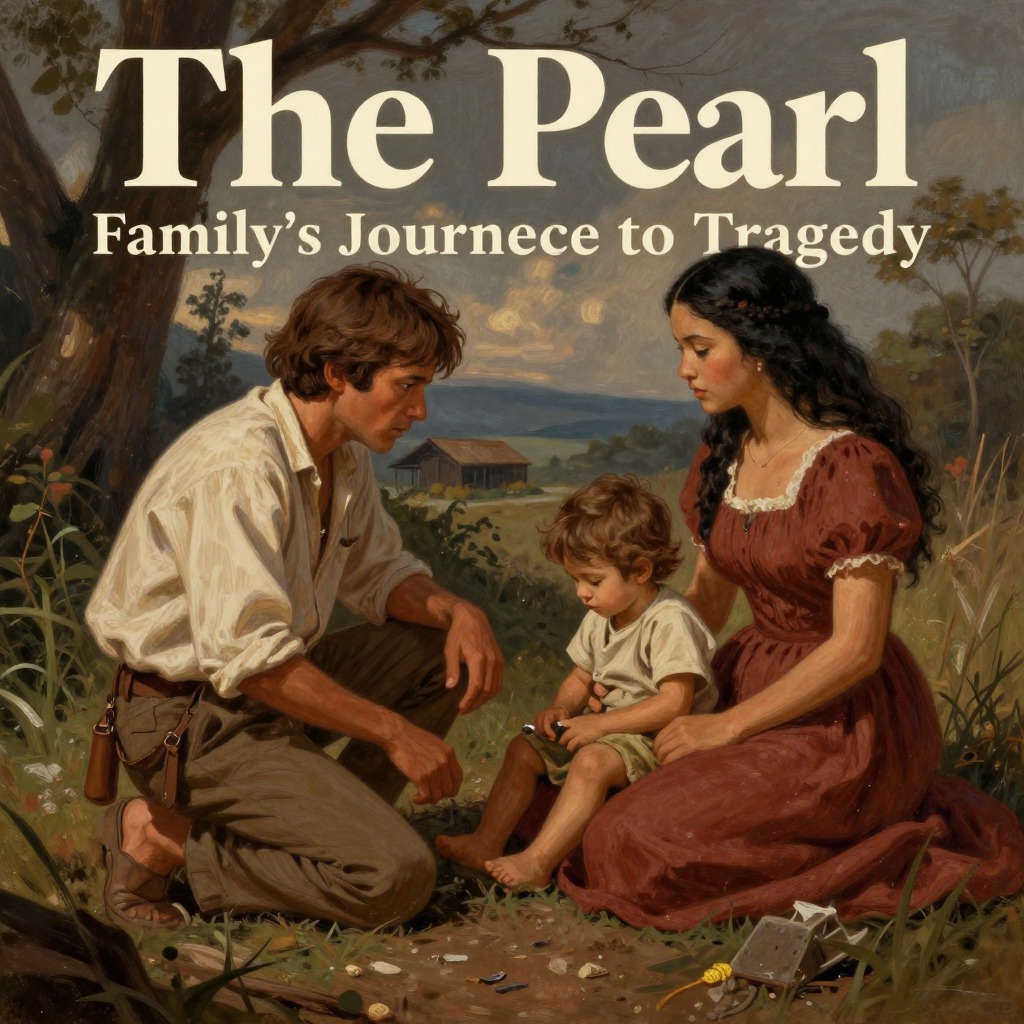
The PearlThe Flight to the Mountains is the pivotal event in which Kino, Juana, and their infant son Coyotito flee La Paz after a night of violence destroys their home and their former existence. The killing of an unknown attacker, the burning of their brush house, and the smashing of Kino's canoe—the family's only means of livelihood—leave them with no choice but to escape. This flight transforms the family from hopeful participants in the town's life into hunted fugitives, carrying with them the great pearl that has become both their sole possession and their curse.
Causes and Immediate Circumstances
The flight is precipitated by a chain of violent events that unfold in a single night. After Kino refuses the pearl buyers' collusive offer and declares his intention to travel to the capital, he is attacked in the darkness outside his house. In the struggle, Kino kills a man with his knife. Juana, who had earlier attempted to throw the pearl back into the sea and was struck and kicked by Kino for it, finds the pearl glinting on the path and retrieves it. She then discovers Kino dazed beside the dead man and realizes that the old life is gone forever. "A dead man in the path and Kino's knife, dark bladed beside him, convinced her," and she abandons the past instantly. Kino, recovering, tells her to bring Coyotito and all the corn they have, intending to escape by sea. But when he reaches the beach, he finds his canoe—the one thing of value he owned, passed down from his grandfather—smashed with a great hole knocked in its bottom. The destruction of the boat, which Kino considers an evil beyond thinking, tightens him beyond breaking. He becomes an animal now, for hiding and attacking, living only to preserve himself and his family. Returning to his house, he finds it in flames, torn up and set afire by "the dark ones." With every escape cut off, Kino and Juana take refuge in the house of his brother, Juan Tomás, who hides them through the day while the wind rises and the neighbors search the ashes for bones.
The Night Journey
Under cover of the late moon and the fierce wind that pelted them with bits of sticks, sand, and little rocks, Kino and Juana leave Juan Tomás's house. They avoid the center of town, where any movement in the darkness would be noticeable, and Kino threads his way around the edge of the city, turning north by the stars onto a rutted sandy road that leads through brushy country toward Loreto. Kino is glad for the blown sand against his ankles, knowing there will be no tracks. An ancient thing stirs in him: through his fear of dark and the devils that haunt the night, a rush of exhilaration comes, some animal thing moving in him so that he is cautious, wary, and dangerous. The wind is at his back and the stars guide him. All night they walk, never changing their pace. Once Coyotito awakens, and Juana shifts him in front of her and soothes him until he sleeps again. The evils of the night surround them: coyotes cry and laugh in the brush, owls screech and hiss overhead, and once some large animal lumbers away, crackling the undergrowth. Kino grips the handle of the big working knife Juan Tomás gave him and takes a sense of protection from it. The music of the pearl is triumphant in Kino's head, and the quiet melody of the family underlies it, weaving themselves into the soft padding of sandaled feet in the dust.
Hiding and the Pursuit
In the first dawn, Kino searches for a covert to lie in during the day. He finds a little clearing where deer might have lain, curtained thickly with dry brittle trees. He carefully sweeps their footprints where they turned from the roadway, and when a heavy two-wheeled cart drawn by oxen passes, he checks the rut and finds the footprints are gone. Juana gives him the soft corncakes Apolonia packed for them, and after a while she sleeps a little. But Kino sits on the ground, staring at the earth in front of him, watching a column of ants climb over his foot. When the sun is high, Juana awakens and asks if they will be followed. Kino knows they will: "Whoever finds us will take the pearl." He looks into the pearl to find his vision of a rifle and a church wedding, but instead sees a huddled dark body on the ground with shining blood dripping from its throat, Juana with her beaten face crawling home through the night, and Coyotito's face thick and feverish from the medicine. The music of the pearl has become sinister, interwoven with the music of evil. Later, Kino stirs from a dream, crying out in a guttural voice, and his hand moves in symbolic fighting. He listens and hears only the cricking heat and the hiss of distance, but he is restless and nervous. He creeps to the road and sees three figures in the distance: two trackers on foot, bent low to the ground, and a dark man on horseback with a rifle gleaming across his saddle. Kino knows these inland hunters: they can follow the trail of a bighorn sheep in the stone mountains, as sensitive as hounds. He lies rigid, barely breathing, and slowly draws his big knife, knowing he must leap for the horseman, kill him quickly, and take the rifle. But the trackers stop at the swept place, study it, and then move on. Kino knows they will be back. A panic of flight seizes him. He returns to Juana and tells her, "Trackers. Come!" When he says, "Perhaps I should let them take me," Juana instantly replies, "Do you think they would take you back alive to say they had stolen it?" Her goading strikes into his brain; his lips snarl and his eyes are fierce again. They flee toward the high stone mountains, Kino no longer trying to conceal his passage, kicking stones and knocking telltale leaves from the little trees.
The Ascent and the Cave
As the country rises toward the mountains, Kino walks on bare unmarkable stone when he can, leaping from ledge to ledge, moving in zigzags to lose the trackers. The sun moves downward toward the bare stone teeth of the mountains, and Kino sets his direction for a dark and shadowy cleft in the range where there might be water. They struggle wearily up the steep slope and come at last to a little spring that bubbles out of a rupture in the stone, feeding a series of pools. From this step they can look out over the sunbeaten desert to the blue Gulf in the distance. Juana slumps to her knees, washes Coyotito's face, fills her bottle, and gives him a drink. Kino drinks long and thirstily, then searches the distance and sees the two trackers as little more than dots, with a larger ant behind them. He knows they will be there by evening. He finds a series of little erosion caves thirty feet up on the gray stone shoulder, wind-hollowed scoops that slope slightly downward and back. He helps Juana up to the largest cave and brings up the packages of food. Then he climbs the brush cliff beside the water, clawing and tearing at the ferns and wild grape, to create a false trail, and comes down again, careful to leave no trace of passage to the cave. He creeps in beside Juana and tells her that when the trackers go up, they will slip away down to the lowlands again. He is afraid only that the baby may cry. Juana says, "He will not cry," and raises the baby's face to her own, looking into his eyes; he stares solemnly back at her. "He knows," she says.
The Watchers Below
Kino lies in the cave entrance, his chin braced on his crossed arms, watching the blue shadow of the mountain move out across the brushy desert until it reaches the Gulf. The trackers are long in coming, arriving at dusk. All three are on foot now, for a horse could not climb the last steep slope. The two trackers scurry about on the little beach, see Kino's progress up the cliff, and then squat near the man with the rifle. In the evening, the points of their cigarettes glow and recede. Kino hears them eating, and the soft murmur of their voices comes to him. Darkness falls, deep and black in the mountain cleft. The animals that use the pool come near, smell the men, and drift away. Kino hears Juana whispering to Coyotito, begging him to be quiet. A match flares below, and in its momentary light Kino sees two of the men sleeping, curled up like dogs, while the third watches, the rifle glinting between his knees. Kino moves silently back into the cave. He tells Juana there is a way: he must get to the one with the rifle first, while two are sleeping. She warns that his white clothes will show in the starlight. He says he must go before moonrise. "If they kill me," he says, "lie quietly. And when they are gone away, go to Loreto." Her hand shakes, holding his wrist. "There is no choice," he says. "It is the only way. They will find us in the morning." She whispers, "Go with God." Kino takes off his white clothes, for they would show up against the dark night; his own brown skin is a better protection. He hooks his amulet neck-string about the horn handle of his great knife so that it hangs down in front of him, leaving both hands free. For a moment his body is black in the cave entrance, crouched and silent, and then he is gone.
Consequences and Thematic Significance
The flight to the mountains is the final, irreversible step in Kino's transformation from a simple fisherman into a hunted killer. It strips away every vestige of his former life—his home, his canoe, his place in the community—and leaves him with only the pearl and his family. The journey itself becomes a descent into a more primitive state, where Kino's senses sharpen and an "ancient thing" stirs in him, making him cautious, wary, and dangerous. The flight also exposes the complete inversion of the pearl's meaning: what was once a symbol of hope and a future for Coyotito now draws death toward the child. The trackers' pursuit, the hiding in the cave, and Kino's final, desperate plan to attack the armed men all lead directly to the tragedy that follows—the gunshot that kills Coyotito. The flight thus serves as the narrative's dark corridor, through which Kino and Juana pass from the world of human community into a realm of pure survival, and from which they will emerge carrying their dead son and the pearl that has become a symbol of utter loss.