Gulf of California
The PearlThe Gulf of California, also called the Sea of Cortez, is the vast body of water that defines the physical world of The Pearl. It is the source of the town of La Paz's livelihood, the site of Kino's daily labor, and the origin of the great pearl that sets the tragedy in motion. More than a mere geographic setting, the Gulf functions as a pervasive symbolic presence, its characteristic haziness and optical illusions establishing a world where appearances cannot be trusted—a condition that prefigures the deceptive promise of the pearl itself.
Geography and Atmosphere
The Gulf of California is described as a place of profound visual uncertainty. A "hazy mirage" hangs over the water, magnifying some things and blotting out others, so that "all sights were unreal and vision could not be trusted; so that sea and land had the sharp clarities and the vagueness of a dream." This pervasive atmospheric condition leads the people of the Gulf to trust "things of the spirit and things of the imagination" rather than their eyes, for there is "no certainty in seeing, no proof that what you saw was there or was not there." The water itself is "oily smooth" on the surface, while below, the sea bottom is rich with life—brown algae waving in gentle currents, green eel grass swaying, and creatures like the spotted botete, the poison fish, lying in the eel-grass beds. The town of La Paz lies on a broad estuary, its old yellow plastered buildings hugging the beach, where the white and blue canoes from Nayarit are drawn up.
Economic and Historical Significance
The Gulf is the foundation of the local economy, particularly through its pearl oyster beds. These beds, where "frilly pearl oysters lay fastened to the rubbly bottom," had historically raised "the King of Spain to be a great power in Europe," helping to pay for his wars and decorate the churches. For centuries, men have dived down to tear the oysters from the beds, searching for the "coated grains of sand" that are pearls. The finding of a pearl is described as an "accident," a matter of "luck, a little pat on the back by God or the gods or both." Kino's own canoe, inherited from his grandfather who brought it from Nayarit, is both property and source of food, "the bulwark against starvation." The Gulf is thus the arena where the fundamental struggle for survival takes place, and where the promise of transcending that struggle—through the pearl—first appears.
The Gulf as a Symbolic Mirror
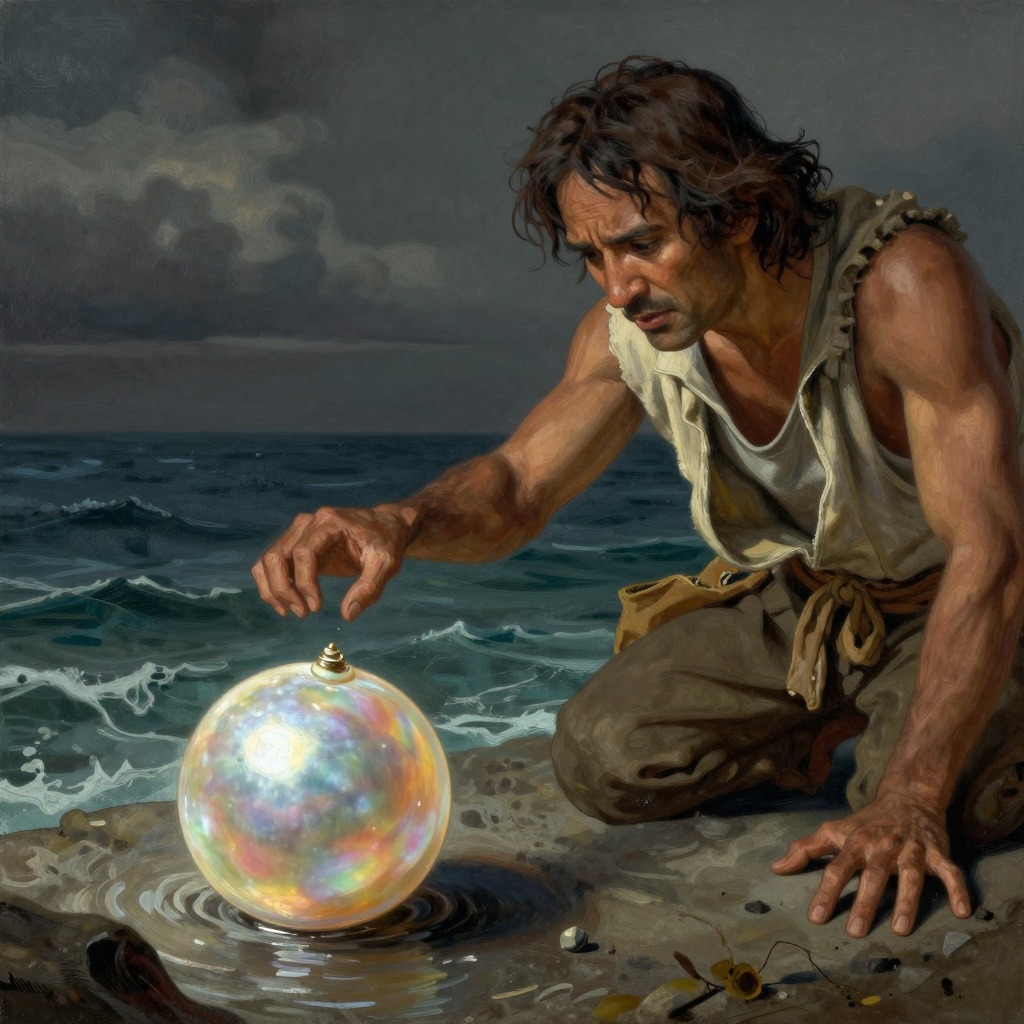
The Gulf's deceptive light and the illusory nature of its visions directly parallel the central theme of the pearl's false promise. The same uncertain air that makes a distant mangrove clump appear as a "hazy black-green blob" while another stands "clear and telescopically defined" creates the conditions under which Kino, in the water, sees a "ghostly gleam" inside an oyster—a vision that may be a reflection, a piece of flat shell, or "a complete illusion." The narrator explicitly states that "in this Gulf of uncertain light there were more illusions than realities." This fundamental ambiguity of perception is the very ground from which the pearl's tragedy grows. The Gulf is also the site of the story's final, decisive act of renunciation. After the death of Coyotito, Kino and Juana return to the shore, and Kino flings the great pearl back into the Gulf. The pearl settles into the "lovely green water," dropping toward the sand bottom among the fern-like plants, and a crab scampering over the bottom raises a little cloud of sand that covers it. The music of the pearl drifts to a whisper and disappears. The Gulf, which gave the pearl, ultimately reclaims it.
Narrative and Thematic Role
The Gulf of California is not merely a backdrop but an active participant in the story's moral and psychological landscape. It is the source of the "Song of the Pearl That Might Be," the secret inner melody that Kino hears while diving, and it is the place where Juana attempts to throw the pearl back into the sea, only to be stopped by Kino's violence. The Gulf's waters witness the family's greatest hope and their final, devastating loss. The journey into the mountains, away from the Gulf, represents a flight into a harsher, waterless world, but it is also a flight from the deceptive promise of the sea. The return to the Gulf at the story's end is a return to the source, a place of both origin and ending, where the pearl is finally surrendered. The Gulf thus embodies the cyclical nature of the story: the pearl comes from the sea, brings destruction, and is returned to the sea, leaving Kino and Juana to face a world stripped of illusion.