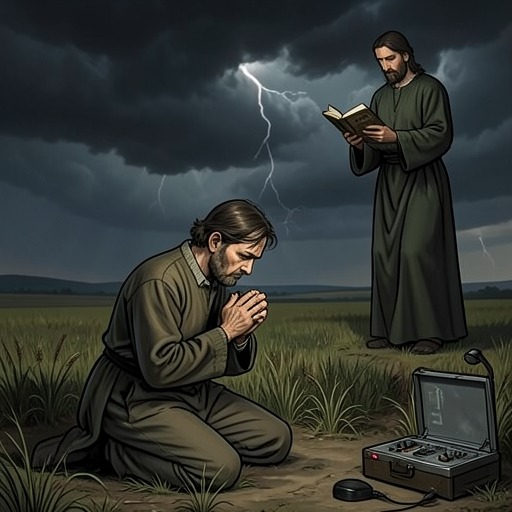
“A farmhand is not a farmer”
The Peasants“A farmhand is not a farmer” condenses a social rule into a sentence that sounds both practical and divinely ordained. Boryna uses it to tell Kuba that a hired worker’s place is distinct from a farmer’s, but the novel repeatedly shows the human costs of treating that division as settled: those with little land or income are expected to accept exclusion, even when their labor and survival depend on the decisions of the powerful.
The phrase as a rule of rank
The phrase occurs when Boryna rebukes Kuba for pushing toward the front at church. He says that elders must be respected and that everyone has a place allotted by the Lord; Kuba must not cross the line or raise himself above others. The warning turns a dispute over where a worker may stand into a lesson about the whole social order. Boryna invokes the reverend’s teaching to make the hierarchy seem not merely customary but religiously sanctioned.
Kuba answers that he is not a beast and has a mind of his own. He explains that he wanted to be closer to the altar, while Boryna insists that Jesus hears him from any corner. Kuba then imagines the status he lacks: if he were a farmer, he says, he could carry the baldachin, lead the priest by the arm, sit in the pews, and sing from the prayer book. As a farmhand, though he is the son of a farmer, he must stand in the vestibule or by the door, “like the dogs.” The exchange makes the distinction visible in bodies and space: rank determines not only ownership or wages, but also who may occupy the honored places of communal worship.
Boryna closes the lesson by asserting, “That’s how the world is ordered, it is, and your head won’t change it.” The phrase therefore does more than describe an occupational difference. It polices aspiration, presenting the existing arrangement as beyond an individual’s power to alter. The scene’s tension lies in Kuba’s insistence that he has a mind of his own: the doctrine of assigned place meets a person who can recognize, and resent, the limits imposed on him.
Work, hunger, and exclusion
The boundary between farmer and hired hand becomes more consequential when employment disappears. During a hard winter, at least twenty hired workers in Lipce are desperate for work. Snow and frost have ruined some people’s potatoes; cash is scarce, and some households eat a hot meal only once a day and go to bed hungry. They had expected that the Squire’s felling at Wolf’s Hollow would provide work, but he refuses to hire anyone from Lipce, reportedly angered by a complaint made against him. The worker’s assigned place now means dependence on work controlled by others, while exclusion from that work threatens immediate subsistence.
The villagers’ dispute with the manor is not simply a contest over employment. One speaker insists that the Squire must reach an agreement and give the people what is theirs before he cuts a single fir. That demand links livelihood to customary claims over the forest and to the community’s sense of justice. The phrase’s settled hierarchy is thus set against a collective claim: people who are expected to remain in their place insist that the powerful cannot decide unilaterally who may work or benefit from the wood.
Jagustynka’s account of poverty makes the social consequences more intimate. Filipka’s cottage is cold, its windows stuffed with straw; the household has one bed, no potatoes, and has sold its quilt. Her eldest daughter is gravely ill from hunger, while the family must beg the miller for groats because no one will lend until harvest. In another household, Florka gives birth while sick and without savings or help; her fields stand fallow because Adam is imprisoned, and the newborn’s survival is uncertain. These details show how poverty multiplies when laborers are absent, credit is withheld, and a household cannot rely on its own land or labor.
Jagustynka contrasts this deprivation with farmers who worry about filling their own stomachs or lending at the highest interest, while the poor live nearby and receive no aid. They leave the poor to Jesus and call their indifference divine order, she argues, while protecting themselves from the sound of suffering. The religious language that Boryna uses to defend hierarchy is therefore exposed as morally compromised when it excuses avoidable neglect. Jagustynka’s answer is that help is possible where there is willingness, naming the miller, the priest, the organist, and others as people who could act.
From assigned place to collective resistance
At the forest meeting, Antek addresses farmers and hired hands together as Christian people and honest Poles who have suffered injustice. He recalls the manor’s felling of their forest, its refusal to employ them, and the injuries and complaints that have brought no remedy. The gathering’s language shifts the frame from separate ranks to shared grievance: both farmers and workers are invited to understand themselves as members of a community harmed by the manor.
The crowd answers that they will not accept the situation, and a hundred fists rise. When the manor’s men attack, Boryna urges people to stick together, takes up a wooden stake, and charges first. The peasants form shoulder to shoulder, carrying flails and pitchforks, and drive into the manor’s men. The violence does not erase the distinctions between landowner and laborer, but it sharply contradicts the command that each remain in a fixed place. In this moment, those who were separately ranked act together against the authority that controls the forest and the work.
The expression also acquires force through its contrast with the family’s land conflict. During the quarrel between Boryna and Antek, Antek repeatedly grabs his father by the arm or collar and is close to striking him, while Boryna holds himself back to avoid a public brawl. Hanka’s anguished account of the six morgs transferred to Jagna joins land, inheritance, and household security to the dispute. The conflict is not identical to Kuba’s exclusion at church, but both scenes reveal how control of property and standing determines who may claim a place—and how fiercely that place is defended.
The phrase’s moral counterargument
Later, Jagustynka condemns the unequal judgment of men and women through another challenge to the village’s declared order. A man may leave his partner for years and escape blame, she says, while a woman is cursed if anything happens to her; if both sinned together, both should answer. Her complaint that the arrangement is stupid and unjust echoes the earlier dispute over who is permitted to stand, work, own, or speak without punishment. Social rules are shown not as neutral descriptions of place, but as protections that can favor some people while exposing others to hardship and censure.
The phrase’s significance rests on this gap between the certainty of its wording and the instability of the world it claims to explain. Boryna presents rank as allotted and immutable; Kuba names the intelligence and longing that the rule cannot extinguish; hungry workers and forest protesters reveal the material stakes of exclusion; and Jagustynka exposes the moral evasions hidden beneath appeals to divine order. The saying gives hierarchy a memorable voice, while the novel’s episodes make that hierarchy answer for what it does.