“That’s how the world is ordered”
The Peasants“That’s how the world is ordered” is more than a resignation to hardship in The Peasants: it is a formula through which inequality is explained, accepted, and passed on. Repeated across disputes about poverty, class, and power, the saying makes a social arrangement sound as fixed as nature or divine law. Yet the novel also sets its apparent certainty against people who remember other ways of living, describe preventable suffering, and demand that the powerful answer for their choices.
A formula for accepting hierarchy
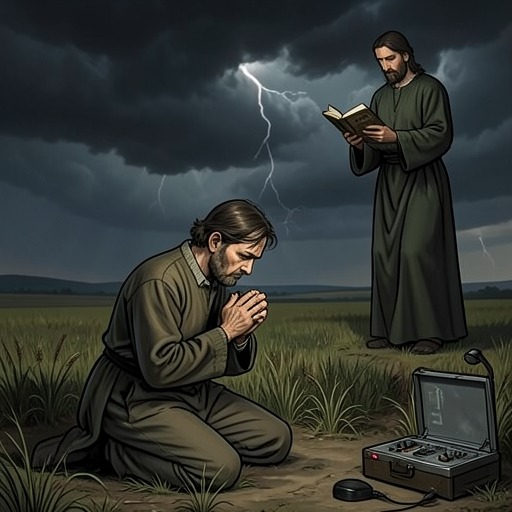
The expression first becomes explicit when Kuba, a poor farmhand, is rebuked for stepping out of his customary place at church. The Parish Priest of Lipce has rewarded him with a zloty for hunting a partridge, and Kuba, moved by the priest’s kindness, has gone to the front among the farmers. Boryna explains the boundary he has crossed: “That’s how the world is ordered, it is, and your head won’t change it.” The saying does not simply describe where Kuba stands. It tells him that his position is part of an order no individual can alter, making a small act of dignity appear presumptuous.
Boryna uses the same reasoning to refuse responsibility for other people’s deprivation. When Rocho proposes mutual assistance, Boryna argues that one person cannot do everything and that the priest, rather than he, should concern himself with hungry villagers. He compares trying to relieve poverty to “carrying water in a sieve,” then attributes the division between those who have enough and those who have nothing to God’s ordering. The proverb-like certainty closes down the practical question Rocho has raised: what neighbors might do for one another. Its force lies in converting a choice not to help into an apparent recognition of necessity.
Poverty made to seem inevitable
The expression’s logic is tested against concrete hardship. During a winter when the Squire refuses to employ Lipce men for the felling at Wolf’s Hollow, hired hands face frozen potatoes, empty stomachs, and a long wait until spring. Some can afford a hot meal only once a day. The expected work had offered a means of survival; its withdrawal turns the Squire’s decision into immediate hunger. The dispute is therefore not only over the forest, but over who bears the cost when those with power deny work to people who need it.
Jagustynka gives that cost a human scale when she describes going to impoverished households during the men’s imprisonment. At Filipka’s cottage, straw stuffs the windows; the family has one bed, no potatoes, and has sold its quilt. Elsewhere, Florka has given birth while ill and without milk, with no money put aside and no one available to cook or work the fields. Jagustynka refuses the comfortable idea that the poor can simply be left to God. Farmers, she observes, attend to their own food and money while their poorer neighbors suffer nearby; divine order becomes an excuse for not hearing them. The saying’s abstraction is broken open by the details of cold rooms, hunger, and unmet need.
Jagustynka’s counterargument
When Boryna invokes the familiar order to defend the treatment of Magda, who is expelled while pregnant and nearly dies after giving birth in winter, Jagustynka challenges the premise rather than merely condemning one cruel act. She recalls that, before the war, the village had a poorhouse in the building now occupied by the organist, supported by contributions measured by the morgen. Her memory makes the present arrangement historical rather than universal: the village once organized care differently, so abandonment cannot be treated as an eternal law.
That contrast gives the expression its political significance. If poverty is simply the way the world has always been ordered, no one need take responsibility for changing it. If the community’s practices have changed, however, the current order is neither inevitable nor beyond judgment. Jagustynka’s account does not erase hardship or supply an easy remedy; it establishes that collective choices have consequences, and that different choices have existed.
From resignation to collective protest
The same conflict appears when the villagers gather over the manor’s felling of the forest. Antek addresses farmers and hired hands together, naming the manor’s refusal to employ local men alongside its logging and the grievances that earlier complaints and lawsuits failed to resolve. The crowd answers with anger and calls to drive the workers off and stop the felling. Here deprivation is not treated as an impersonal fact: the loss of work, the forest dispute, and the community’s sense of injury are presented as linked consequences of the manor’s actions.
The contrast does not mean that the expression disappears when people resist. Rather, it clarifies what is at stake in repeating it. Boryna’s appeals to an unalterable order discourage solidarity, while the villagers’ protest turns accumulated grievances into a shared claim. Their anger answers the fatalism of the saying with a collective assertion of rights, even as the surrounding conflicts show how difficult it is to secure redress.
An inheritance of fatalism
After his imprisonment, Antek returns to the farm and explains the supposed permanence of the world to his little son: “even a hawk’s got to eat, even the lowliest worm. That’s the way the world is ordered!” The image makes the lesson sound like a fact of animal life. It also marks a reversal in Antek’s trajectory: the man who had challenged his father and stood at the center of resistance now passes on the logic of submission. The expression reaches beyond a single dispute, becoming an inheritance of thought from one generation to the next.
Across these uses, the saying holds together divine providence, social rank, and material scarcity as if they were one fixed system. Its recurrence invites the reader to hear the difference between naming hardship and explaining it away. Kuba’s exclusion, the hungry laborers’ need for work, the poor households Jagustynka visits, and the villagers’ challenge to the manor all reveal the human relations beneath the supposedly natural order. Jagustynka’s memory supplies the sharpest answer: what people have made, or allowed to persist, may also be changed.