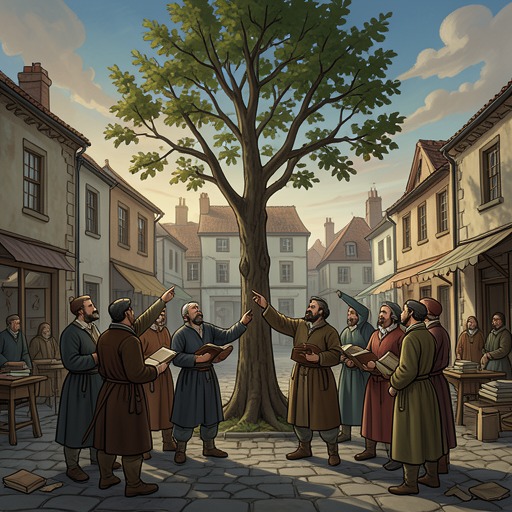
1863 peasant land reform in Russian Poland
The PeasantsThe 1863 peasant land reform in Russian Poland is presented as a remembered precedent that gave land distribution lasting importance in village life. Rather than narrating the reform itself, the novel invokes its legacy: villagers continued to invest former manor estates with practical and communal significance, while disputes over who could use or claim land exposed the limits of that remembered settlement.
Historical Memory and Land Distribution
A note on village distributions of former manor estates links their importance in the second half of the nineteenth century to memory of the tsar’s 1863 ukase. The reference establishes the reform as a historical point of orientation, not as a fully described process: the narrative does not detail the measure’s provisions, its implementation, or how particular plots were assigned. Its emphasis is on the persistence of land distribution as a matter villagers watched and remembered.
That memory helps explain why claims to land are voiced as more than private preferences. In the village’s later conflicts, ownership, access, and the possibility of acquiring a plot carry material consequences, but also determine who can assert a recognized place in the community. The reform thus stands behind disputes without resolving them once and for all.
Claims, Registers, and Customary Use
The narrative sets formal records against contested practice. In a dispute over pasturage, a speaker insists that the grazing land belongs to the villagers and is clearly recorded in the register, yet complains that they are repeatedly driven away by those who claim it for themselves. The immediate grievance is concrete: a cow has died after being chased, other animals have also been driven off, and the loss is reckoned at three hundred zlotys. The episode shows how a written claim could coexist with uncertainty and force in everyday use of land.
Forest claims reveal the same tension. Boryna counts four morgen as his in the forest and adds the one morgen associated with Jagusia, reckoning the totals as he rides through the trees. His calculation joins personal property to a larger claim against the manor, which he believes is taking too much while the villagers ask too little. During the later confrontation with the woodcutters, the villagers insist that the forest is theirs and demand that the workers leave. Their assertion is collective, but the underlying claims also rest on individual holdings and remembered rights.
From Grievance to Collective Action
When word spreads that the manor is felling the villagers’ forest, the news initially seems implausible. The timing is startling: it is mid-March, the ground is thawing, and sap is rising. Once the threat is accepted, longstanding grievances gather around it. A speaker recalls unsuccessful court action and complaints, then presents the felling as the latest injury; the crowd answers with calls to drive the woodcutters away. In the forest, Boryna leads people arriving by sleigh, cart, horseback, and on foot. They confront workers from Modlica and Rzepki as well as other places, insisting that the woods belong to them.
The village also proposes collective resistance to German purchasers considering Podlesie manor. The suggested approach is to address them together and warn that, if they buy, the villagers will prevent sowing and building and will not leave the fields. This is a proposed threat, not evidence that the reform itself created a specific legal rule against such purchases. It does show how the remembered importance of land distribution informs later efforts to defend village access and control.
Significance in the Narrative
The reform’s significance lies in the gap between historical redistribution and secure possession. A register, an inherited or allocated plot, a customary claim, and actual access to pasture or forest do not automatically coincide. The narrative repeatedly makes that gap visible through animal losses, contested timber, the threat of outside buyers, and the villagers’ recourse to courts, complaints, and direct mobilization.
Land is also inseparable from household survival and labor. Before the St Kordula’s Day fair, villagers struggle to find ready money for taxes, communal contributions, debts, and farm needs; in winter, Antek and Hanka face near-total poverty and the possible sale of their cow. Later, the imprisonment of working men leaves fields uncultivated just as spring work presses, while neighboring villagers’ arrival brings carts and ploughs back into motion. These conditions do not establish direct consequences of the 1863 measure, but they show why the memory of land distribution remained charged: access to land mattered because families needed it to live and work. The historical reform supplies a precedent; the novel’s conflicts show how incomplete and contested the security associated with land could remain.