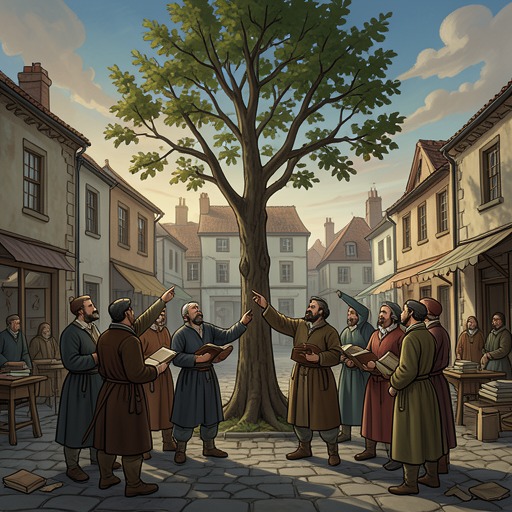
Abolition of Serfdom and Peasant Emancipation in the Russian Partition
The PeasantsThe Abolition of Serfdom and Peasant Emancipation in the Russian Partition was a decisive legal and social change: it ended the compulsory labor obligations that had bound peasants to landlords and made settled peasants owners of the land on which they lived. The change came later in the Russian Partition than elsewhere in partitioned Poland, and its consequences extended beyond legal status. It transformed rural labor relations without ending poverty, inequality, or the struggle for land—the conditions that remain visible in the world of The Peasants.
Background and timing
Before emancipation, peasants and the land they worked were subject to the landowners, to whom peasants owed labor without pay for a prescribed number of days each week. In the Russian Partition, this arrangement persisted after serfdom had already been abolished in the Austrian and Prussian partitions. The legal changes therefore occurred at different times across partitioned Poland: abolition came in the Prussian partition between 1811 and 1850, in Austria in 1848, and last in the Russian Partition, in 1864.
The account also identifies an earlier step toward the change: a tsarist edict dated 2 March 1863. Its provisions stated that, from 1 May 1863, mandatory relations between settled peasants and landlords would cease. Peasants would become owners of the land on which they were settled, while paying the treasury a rent reduced by 20 percent from the dues listed in the statutes until redemption deeds and costs were established. The edict thus sets out the transition in specific terms, while 1864 marks the abolition of serfdom in the Russian Partition in the broader chronology.
From compulsory labor to paid work
Emancipation dismantled the landowner’s right to demand unpaid labor, but it did not make rural households economically secure. With free labor no longer available, landowners had to buy peasant labor. Estates deprived of that labor began to decline or accumulate debt, while agricultural workers’ wages remained so low that many could not live on them. Around half the rural population was illiterate, further restricting access to other kinds of work or advancement.
This shift changed the terms of dependence rather than removing material vulnerability. Peasants were no longer bound to landlords by the former labor obligation, yet many still had to sell their work for wages inadequate to sustain them. The distinction between landholding farmers and land-poor workers consequently remained central: legal emancipation altered the structure of rural labor, but access to land and the income it could provide continued to divide village households.
Emancipation in the world of the novel
The Peasants places its village life in a later period, but its recurring scenes of debt, labor, and land scarcity show why emancipation cannot be treated as a simple ending to rural hardship. As winter approaches, households in Lipce calculate what livestock or grain they must sell and how to meet taxes, commune contributions, debts, and payments to servants. Even farmers with fifteen morgen face difficult choices; poorer households have still less room to maneuver. The need for ready money governs decisions in a countryside where ownership does not guarantee a cash surplus.
The hardship is especially sharp in the experience of Hanka Borynowa and Antek Boryna after they are expelled from the family homestead. With their money exhausted, their diet reduced to potatoes and salt, and credit unavailable, Hanka fears that they will have to sell their cow. Antek refuses a chance to earn a little money threshing barley, leaving her to confront the household’s immediate needs and the approaching winter. Their predicament is not a return to the former legal status of serfs; it shows instead how poverty and unequal control of land can constrain a household after emancipation.
The same limits appear on a village-wide scale during the imprisonment of the men. With most working hands in jail, women must manage livestock, childcare, household tasks, and seasonal farm work, while fields stand fallow and the spring planting is endangered. When neighboring villagers arrive to help, carts and ploughs return to the fields, and the work of sowing becomes a collective effort. This contrast makes land ownership’s practical condition plain: possession of a plot is not enough if a household lacks the labor needed to cultivate it.
Land, labor, and political identity
Land remains both an economic resource and the basis of peasant identity in the novel. The emancipation account connects the land question to the formation of national consciousness: after the partitions, building a Polish national identity among former serfs became a major political concern. Peasants had taken part in uprisings against Russia, although hostility among some peasants reflected the landed class’s opposition to their enfranchisement. Political thinkers therefore saw peasant national consciousness as essential to the prospect of a strong, free Poland.
The novel’s depiction of collective grievance gives that history a local form. When the manor refuses Lipce workers employment while felling forest that villagers regard as theirs, the threatened loss is not only a source of wages but also a challenge to customary claims and livelihood. The village speaker links the denied work, the cutting of the forest, and the community’s inability to secure redress. The conflict reveals the incomplete reach of emancipation: ending serfdom did not eliminate contests over access to resources or the unequal power to decide how land and labor would be used.
The historical change therefore has a double significance. It ended a system in which landlords could command unpaid labor and established peasant ownership of settled land, but it did not dissolve the economic pressures that made land, work, cash, and household labor precarious. In The Peasants, emancipation is a necessary historical threshold, not a guarantee of prosperity or power; its consequences are measured in the continuing struggle to keep a farm, find work, and make the land yield a living.