Abuse of village authority and public governance
The PeasantsAbuse of village authority and public governance in Lipce is presented not as a single corrupt act but as a struggle over who may speak and decide for the community, whose interests public power serves, and how far collective action can reach. The forest dispute brings villagers together against the manor; accusations against Piotr, the Voyt, turn the same language of common interest against a local officeholder. Yet Lipce’s resistance is neither frictionless nor wholly egalitarian: dependence on Boryna’s rank, suspicion of self-interested critics, and the neglect of the poor all complicate the village’s claim to act as one.
Authority, Custom, and the Forest
The forest conflict makes disputed rights tangible. Villagers complain that their registered pasturage is being treated as the manor’s, and that people who use it are driven away; one account links the pursuit to a cow’s death and violence against Walek’s boy. The grievance is thus about more than timber. It concerns access to resources and the authority to decide whether long-standing village use counts as a right.
Boryna’s own claim is at once communal and personal. On his way through the woods, he counts four morgs as his and adds Jagna’s one, looking over the trees as land that should not be taken from them. His calculation reveals how collective opposition can gather around individual holdings and local custom without erasing private interests. The forest is both a shared cause and a landscape already understood through ownership.
The threatened loss of logging work deepens the dispute. Hired hands in Lipce are short of money during a hard winter; some have lost potatoes to frost, and poor households are already eating hot meals only once a day or going to bed hungry. Villagers had expected the felling at Wolf’s Hollow to provide wages, but the squire refuses to hire Lipce men, reportedly angered by a complaint made against him. The conflict therefore joins access to land with access to work: a decision about the forest also distributes hardship.
Collective Mobilization and Its Limits
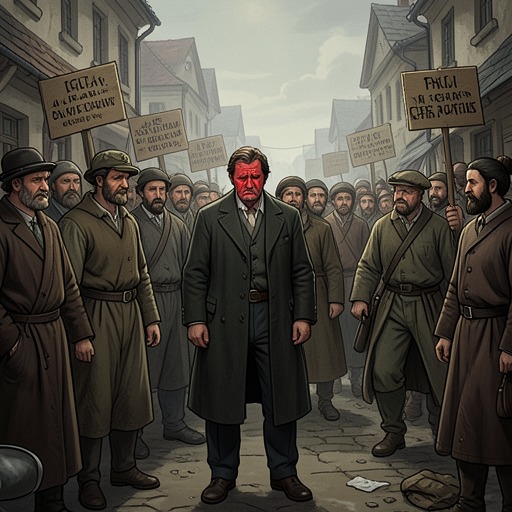
When the villagers assemble before the inn, they wait for Boryna, regarded as the village’s foremost farmer and the person without whom no farmer would take a step. The image is of a crowd gathering strength, but its first political act is to await an established leader. The blacksmith and the miller try to dissuade the people, warning that they may end up imprisoned; the crowd disregards them because both are widely believed to serve the manor’s interests. Distrust of intermediaries shapes who can claim to speak credibly for Lipce.
Boryna frames the forest dispute as accumulated injustice: the manor is felling the villagers’ forest, denying them employment, and repeatedly driving them toward ruin. He recalls that lawsuits and complaints have failed to secure redress, and argues that the villagers must defend what they consider theirs together. His appeal explicitly gathers farmers and hired hands under a shared identity as Christian Poles, making a local claim to resources into a public claim to justice.
The response is practical and immediate. The crowd disperses to change clothes, harness horses, and bring out sleighs and carts. Peasants, farmhands, women, and older children set out together, carrying poles, pitchforks, flails, and, in some cases, scythes. At the forest, they rush toward the woodcutters and demand that they stop and leave. The scene gives collective authority a physical form: numbers, shared movement, and the capacity to obstruct the work that formal complaints did not stop.
That unity does not amount to an established system of impartial governance. It relies on forceful leaders and on a crowd’s readiness to act, while the forest rights at stake remain entangled with private claims and uncertain boundaries. The mobilization demonstrates political capacity, but also the precariousness of a community that turns to direct confrontation after other channels appear ineffective.
The Voyt and Public Accountability
The criticism of Piotr, the Voyt, centres on the contrast between his office and the benefits he is accused of drawing from it. In village talk, he is said to enjoy bread paid for at communal expense, to fear no opposition because of his connections with officials, and to ride roughshod over the people. Mateusz counters the villagers’ deference with a principle of accountability: those who raised the Voyt to office can bring him down.
Płoszka develops that argument into a campaign to remove him. He mocks the Voyt’s authority, then tells farmers at the inn that the Voyt has sided with the squire against the community, supported a school in Lipce, recommended the Germans at Podlesie to the squire, and used communal funds to support a more prosperous personal life. These are Płoszka’s accusations, not a neutral accounting of the Voyt’s conduct. Their political force lies in recasting apparent private prosperity as a question about public money and allegiance.
The campaign is itself politically compromised. Płoszka first approaches people in their cottages and then speaks among smaller farmers at the inn, buying vodka before he presses his case. Sikora retorts that Płoszka would like to put his own snout in the communal trough. The interruption does not settle whether the charges are true; it exposes how a call for accountability can also serve a challenger’s ambitions. Village politics contests not only officeholders but the motives and credibility of those who would replace them.
Officials, Education, and Refusal
The school dispute shows another boundary of local authority: the village’s encounter with decisions backed by officials. When farmers gather at a cottage before setting out, they learn that the Voyt has been summoned to the district and that a notary is to call a meeting to approve a school in Lipce and Modlica. Kłąb objects that a new tax would follow, while the Soltys argues that an order from the notary must be obeyed. Grzela rejects that submission, insisting that official papers do not by themselves settle what villagers must accept.
Later, during the school-tax meeting, most of those in the square appear to favour voting against the school. When the notary calls for someone to come over and fetch fish from the manor, no one moves; a villager answers that they have not come to run errands. The refusal is small but pointed: the official’s command meets silence rather than service, and the villagers assert that attendance at a public meeting does not make them his messengers.
At a further confrontation, the crowd closes around the gendarmes when the Voyt calls them by name, then parts to let them pass and follows them toward the prefect with angry shouts and raised fists. Their complaint that every creature has its own tongue while peasants alone are ordered to use another’s joins resistance to official authority with resentment at linguistic subordination. The crowd does not simply prevent the gendarmes from moving; it surrounds their passage with a public demonstration of discontent.
Public Responsibility and the Poor
The novel’s picture of governance is also tested by what happens beyond formal meetings and confrontations. A woman recounts finding a family in a freezing cottage, with straw stuffed into the windows, children crowded together, no potatoes, and a quilt already sold. The eldest daughter’s apparent decline is attributed to hunger. Elsewhere, a sick woman gives birth without savings or help, while fields stand fallow because the men who might have worked them are imprisoned. These details show how collective and official crises enter the household as cold, hunger, unpaid labour, and the risk that a newborn will not survive.
The indictment is directed not only at authorities. Farmers, the speaker says, attend to their own food and lending profits while poor neighbours live across a field boundary; the comfortable can invoke divine order and leave the poor to God’s care. The contrast makes village solidarity an obligation rather than a fact. Lipce can assemble in defence of forest rights and challenge an officeholder, yet the poorest remain exposed when neighbours with resources do not act.
Together, these episodes define public governance in Lipce as a contested practice rather than a stable institution. Customary claims, elected office, communal money, official orders, and the needs of the poor all become grounds for judgment. Collective action can challenge the manor, scrutinize the Voyt, and refuse an official’s assumptions of obedience, but the community’s own hierarchies and uneven concern limit what such resistance can secure.