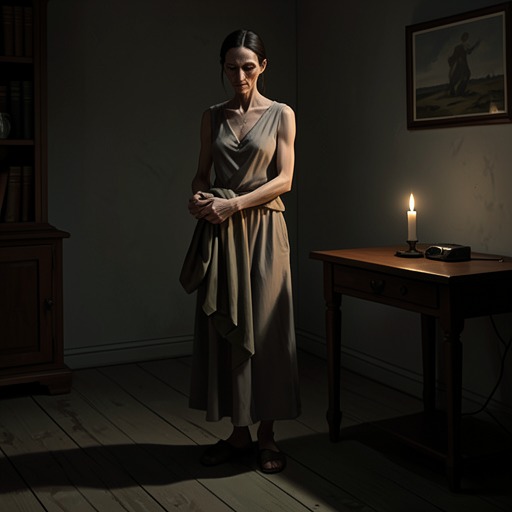
Agata’s terminal decline
The PeasantsAgata’s terminal decline is marked not by a prolonged account of illness but by a sudden collapse, a lucid preparation for death, and a final passage watched by the village. As the harvest draws everyone out to the fields, she is found helpless at a threshold; before sunset, she has arranged the objects of her funeral, welcomed those who come to her, and died amid prayers. Her death gives a lifetime of poverty a final, carefully claimed dignity, though its peacefulness does not spare Jasio the shock of witnessing it.
Discovery and foreknowledge
The household is empty because its members are working at the harvest when Jasio hears groans from the Kłąbs’ open cottage. He finds Agata lying in the hallway by the threshold, carries her inside, lays her on a bed, and gives her something to drink. She revives and opens her eyes. The abruptness of this scene sets the practical circumstances of her last day: while the village is occupied with the ripe crop, her need for care is discovered by chance rather than through a planned vigil.
Agata recognizes her condition as the approach of death. When Jasio wants to fetch the priest, she catches hold of his cassock and tells him that the Lady has instructed her to prepare for the following day. She says she still has time and gives thanks to God, her voice weakening as she speaks. Her confidence in this religious message coexists with an immediate bodily decline; she folds her hands, looks into the distance, and enters a breathless prayer. Jasio understands that she has begun to die and runs to summon the Kłąbs. The narrative reports Agata’s vision as part of her experience without explaining or confirming it from outside her point of view.
A lifetime gathered into a final outfit
When Jasio returns in the afternoon, Agata is conscious and has brought out the possessions she has saved for this hour. Her chest stands beside the bed. From it she takes fresh bedding and a clean sheet for beneath her body, holy water, an aspergillum, a votive candle, a picture of the Lady of Częstochowa, and new clothes: a smock, wool skirt, frilled cap, headkerchief, and shoes. These are not incidental belongings. The narrative identifies them as a funeral dowry begged for over a lifetime, so their arrangement makes visible the long labor of preparing for a death she could not control.
Agata spreads out each item, takes pleasure in it, and boasts of the collection to the women around her. She even tries on the bonnet and examines herself in a mirror, pleased by the image of a fine housewife. The scene gives her more than passive acceptance of death: she chooses how she will be dressed and takes satisfaction in the care she has invested in that choice. She tells those present to dress her in the treasures the next morning. Although her expectation of another day sits uneasily beside the evening’s ending, no one challenges her. They move quietly around her and allow her to inhabit these last hours on her own terms.
The vigil and the harvest fields
Jasio sits beside Agata and reads from the breviary. Jagusia arrives and crouches quietly in a corner, while the Kłąbs remain at home. The room fills with people who move and look in silently; Agata holds a rosary and remains conscious enough to say farewell. To the children gathered in the hallway and beneath the window, she gives a few groszy and asks them to pray for her. Even in extremity, she directs a small final act of generosity toward the young, turning the vigil into an exchange between the dying woman and the village around her.
The account of her lying beneath the holy pictures gives her death the form she has wanted throughout her life. Her quiet pride and tears of happiness are set against the fields beyond the window, where scythes flash among the ripe, heavy rye. The contrast is exact: the harvest proceeds outside while Agata lies still, yet the two scenes are not separated. The laboring fields provide the final landscape on which her gaze rests, and their continuing activity measures the life she is leaving. Her attention seems to reach toward a place beyond the visible fields, but the narrative keeps that destination within the limits of her dying gaze rather than explaining it.
Death and its witnesses
As sunset casts a red glow through the room, Agata suddenly becomes agitated, sits up, and stretches out her arms. She announces that her time has come, then falls back. Those gathered kneel around the bed as the wailing begins; Jasio reads the prayers for the dying, and a blessed candle is lit. Agata repeats the prayers with diminishing strength, faltering until she lets go of the candle and breathes her last. The passage slows the moment into a sequence of gestures and weakening responses: the community prays with her, but the final release is hers alone.
Agata, a beggar, is mourned with the attention accorded to the village’s first lady. Ambrozy arrives just in time to close her eyes, and Jasio says a fervent prayer over her. The whole village comes to pray and weep, and its people marvel at—and envy—the happy death and easy ending she appears to have received. This communal response does not erase her poverty; instead, it makes the contrast between her social position and the dignity of her final hours unmistakable. Jasio, however, cannot share the villagers’ composure. Looking at Agata’s lifeless eyes and death-stricken face, he is overwhelmed, flees home, and weeps into his pillow. Her death can be peaceful in its ritual and communal setting while remaining terrifying to the person who has watched it happen.