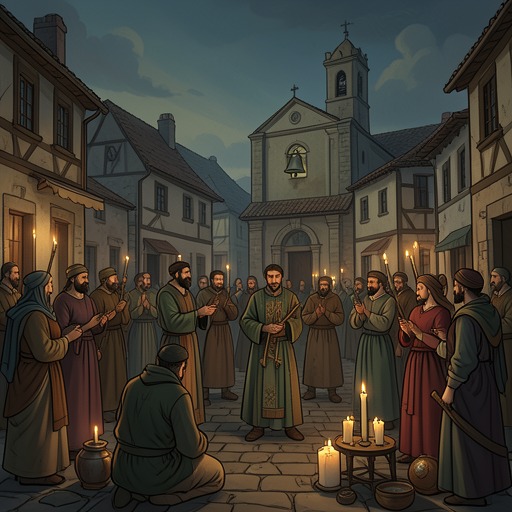
All Souls’ Day offerings to the dead
The PeasantsAll Souls’ Day offerings to the dead are a village observance in which the living give food, goods, or money in remembrance of the deceased and ask for their intercession. In Lipce, the practice takes both an organized public form and a more intimate one: while people fill cemetery barrels according to custom, Kuba carries bread to graves left outside the flow of communal attention. The contrast makes the observance not only an act of piety, but also a measure of who is remembered and who might otherwise be left out.
The public offering at the cemetery
On All Souls’ Day, people stream along the road to the graveyard carrying small portions of food and useful goods. They place bread, cheese, bacon or sausage, yarn, combed flax, or mushrooms in salt barrels set at the gates and among the graves. The offerings are divided: some are for the priest, some for the organist or Ambrozy, and the rest for the beggars. Those who bring nothing press a coin into a beggar’s hand instead. As they give, they whisper the names of the dead for whom they seek intercession.
The ritual binds remembrance to a visible sequence of acts: bring something, leave it at the cemetery, name the dead. Candles flicker among the graves as prayers, hymns, and the rhythmic chanting of names continue around the grounds. The dead are not remembered only in private thought; their names are spoken in a gathering where the living share food and give to the poor. Yet the distribution also has its limits. The barrels have designated recipients, and Kuba fears that the poorest and most forgotten souls are not reached by the system.
Kuba’s bread for the forgotten graves
When it grows completely dark, Kuba goes with Witek the Stork-Keeper deep into the old cemetery. The graves there are sunken, overgrown, and neglected: generations lie beneath crumbling crosses or in places where scarcely any trace remains. No one lights lamps or says prayers for them. Kuba draws a few chunks of saved bread from his bosom, tears them into pieces, kneels, and scatters them over the graves. He addresses the dead as Christian souls and penitents, urging them to eat.
Witek asks whether the dead will take the food. Kuba answers that they will, insisting that the public barrels do not feed these souls: the priest and beggars receive their share, while the penitents go hungry. The scene gives the custom a personal corrective. Kuba does not simply repeat the public offering; he carries food beyond its customary distribution, to those whose graves and memories have been neglected. His handfuls of bread turn remembrance into a direct act of care.
The dead as visitors and kin
Kuba explains the offering through a belief that on this day Jesus permits the tormented souls in purgatory to come to earth and visit their own. He tells Witek not to fear them, since prayers, lights, and litanies ward off evil; he also repeats what his mother and the old people taught him about the day. The observance thus joins inherited family speech to village ritual: the dead are not distant abstractions but visitors whose hunger and longing can be answered by the living.
The graves Kuba seeks are bound to his own losses. He points out that his kin lie there, including his mother, and kneels at the bare, sunken ground with Ambrozy, Jagustynka, and Kłąb. He recalls that his mother was Magdalena and that his father, Pieter, also called Socha, had once possessed land before Kuba’s uncles took it. His recollection reaches beyond family history to a manor household destroyed by violence: he returns from an errand to find the manor burned and his mother and others beaten to death. The bread he scatters is therefore both a customary gift and an offering to particular people whose deaths remain vivid to him.
A domestic form of remembrance
The cemetery is not the only place where food is offered. In some households, women set the remains of supper on the earth benches, cross themselves, and address the waiting souls in purgatory, inviting them to eat. This domestic practice carries the offering from the graveyard into the household’s ordinary space. Food left on an earth bench makes the home, for a moment, a place of hospitality to the dead.
Both forms depend on the same premise: the dead may still be hungry, and the living can answer that need through food, prayer, and remembrance. The difference lies in where the gift is placed and whose needs it recognizes. The public barrels organize charity and intercession for the village; the household’s supper remains and Kuba’s saved bread extend that care to souls imagined as waiting beyond the reach of ordinary provision. In the All Souls’ Day observance, remembrance is made tangible: bread is broken, names are whispered, and the living acknowledge obligations that death has not erased.