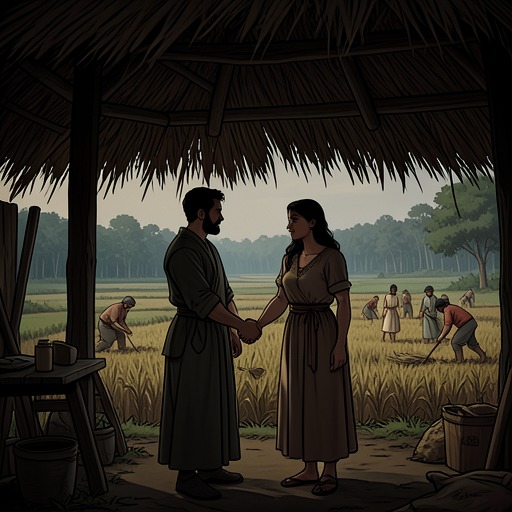
Antek and Jagna’s forbidden passion
The PeasantsAntek Boryna and Jagna’s forbidden passion is a desire that outlasts their separation and sharpens under the very restrictions meant to contain it. Jagna is now the wife of Maciej Boryna, while Antek arrives at Christmas Mass with his own wife; their attraction therefore presses against marriage, religious prohibition, and the watchful routines of the household. The narrative gives that conflict physical force: a glance across a snowbound road, the fixed intensity of Antek’s eyes, and the effort Jagna spends trying not to go to him.
Marriage and Separation
Jagna’s marriage to Maciej Boryna has moved her out of her mother’s home and into a new household. At her departure, she asks her family and the others for forgiveness and makes her farewells; the women embrace her and weep together. The scene marks marriage as a public passage into a changed place in village life, not simply a private bond. Yet the passion between Jagna and Antek does not disappear with that passage. Instead, it becomes an attachment that must be carried inside the role she has taken on.
The first sharp reminder comes on a winter road. Antek is chilled and disoriented in the mist when a sleigh rushes past, driven by Maciej Boryna and carrying Jagna. She breaks off what she is saying when she notices Antek; their eyes meet only for an instant before the sleigh sweeps on. For Antek, the brief sight is enough to arrest him. He watches the sleigh vanish into the snow, and Jagna’s eyes remain vivid in his mind even after the road is empty. His thoughts lose their ordinary sequence: he forgets where he is going and what has happened, suspended in a waking dream. Their separation is therefore not emotional closure. It turns a fleeting encounter into a memory that can return with overwhelming force.
Jagna’s Longing and Resistance
By the time Christmas approaches, Jagna has not seen Antek for nearly three months, apart from that passing on the road. The wedding, the move, and the demands of the farm have occupied her, and people have hesitated to mention him in front of her. His sudden return to her thoughts unsettles this apparent distance. She wonders why she is thinking of him rather than Mateusz, Stacho Płoszka, or any of the other men; the longing feels involuntary, as if it has taken possession of her attention. She looks for ways to be alone and finds that work cannot displace him.
Her desire is inseparable from the knowledge that she is Maciej Boryna’s wife. Jagna understands that meeting Antek would be forbidden and, as the priest has warned her in confession, a mortal sin. She imagines that even a conversation with witnesses might be possible, but immediately recognizes that it cannot be. The conflict is not presented as a settled choice between love and duty: she argues against her own memories, feels the yearning intensify, and fears what she might do if she heard Antek call to her.
Christmas makes that struggle especially acute. Lipce is busy with the preparations of Christmas Eve, while frost and snow enclose the fields and village. Against this season of communal activity and religious observance, Jagna feels estranged even among her household. Antek’s whispered invitation continues to sound in her heart, but so does the priest’s warning of divine anger and damnation. She tries to stay inside and avoid the farmyard, fearing that Antek may be waiting there and that she will be unable to resist him. With little work left to occupy her, she has no easy means of quieting either her desire or her fear.
The Reunion at Christmas Mass
At Christmas Mass, Antek comes with his wife and Stach’s family but stays behind in the pews rather than taking his former place among the farmers before the altar. When he sees Maciej Boryna’s household entering the church with Jagna at its head, he moves through the crowd and kneels beside her, partly screened by a spruce. Jagna at first cannot make him out in the faint light. During the Elevation she glances sideways, recognizes him, and remains bent to the ground for a long time before looking directly at him.
The public service continues around them, but the narration concentrates on the couple’s inward absorption. Jagna cannot read her prayer book; Antek’s sorrowful gaze fills her attention, and she feels the force of his presence as both sweetness and alarm. Fear, joy, love, memory, and desire seem to pass between them without the need for a conversation. Antek edges closer until his shoulder rests against her hip. When she kneels, he whispers her name and asks her to come beyond the rick on an evening when he will be waiting. The invitation turns an inward passion into a proposed secret meeting, but Jagna gives no spoken answer. The first carol interrupts the moment and returns her attention, at least partly, to the congregation around her.
The Unresolved Appointment
After Mass, Jagna’s conflict shifts from memory to immediate decision. She moves restlessly through the evening, urges others to eat after they have put their spoons down, joins conversations, and then abruptly crosses the house again. The narration links this feverish activity to her growing urge to go outside and meet Antek at the hayrick. She imagines him waiting, watching the cottage, or grieving because she has not come. Even as she searches for her apron and starts toward the door, she tells herself that she might go only to say she will not come because it is sinful.
The household becomes a source of surveillance and restraint. Jagustynka’s eyes follow Jagna like watchful hounds; Nastka also looks at her strangely, and Jagna wonders whether they have noticed something. Fear holds her back, though the effort leaves her exhausted and barely aware of what is happening around her. When the farm dog Łapa barks fiercely outside, Jagna leaps up in alarm, thinking Antek may have been unable to wait. The scene ends on that reaction rather than resolving whether they meet. Their passion remains poised between an invitation and a refusal, sustained by secrecy, religious fear, and the possibility of discovery.
Narrative Significance
The relationship develops through interrupted contact: the sleigh’s fleeting passage, months of absence, the concealed closeness at Mass, and Jagna’s aborted movement toward the hayrick. Each interruption intensifies rather than settles the desire. Winter imagery gives that pattern a distinctive shape: Antek’s memory appears amid snow and frost, while Jagna’s longing is described through an anticipated spring warmth that threatens to break through her restraint.
The contrast between public ritual and private passion is central to the state of the relationship. At Mass, the congregation sings and prays together, while Antek and Jagna become absorbed in each other; the sacred setting makes their attraction more exposed to the religious rules they fear violating. Yet the evidence does not turn their feelings into a completed escape from those rules. Jagna remains Maciej Boryna’s wife, Antek’s invitation is still only an invitation, and the uncertain ending leaves desire active but unfulfilled.