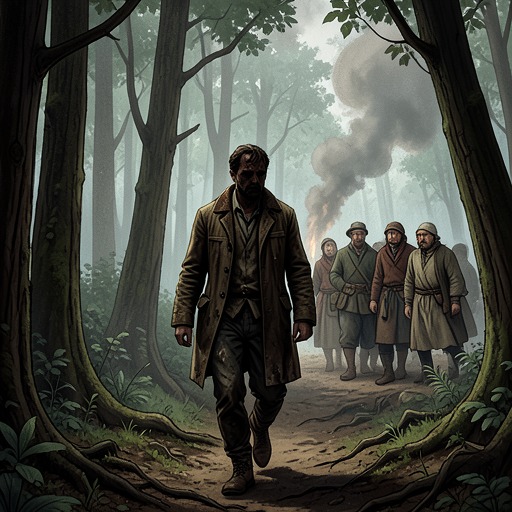
Antek and Mateusz’s reconciliation
The PeasantsAntek Boryna and Mateusz reconcile at an inn after a violent fight, exchanging hostility for drink and public companionship without settling the jealousy beneath their dispute. The scene makes peace visible in their gestures, even as Mateusz’s confession shows how much of their conflict still turns on Jagna.
From Suspicion to Accord
Mateusz arrives at the gathering still leaning on a stick, having only recently risen from bed. He sits by the hearth with vodka boiled with honey, calling cheerfully to his friends until he sees Antek in the doorway. Antek passes him as if he has not noticed him, but Mateusz calls him over. Antek, thinking the call is a challenge, answers sharply and distrustfully.
Mateusz instead catches Antek by the arm and makes him sit on the bench. He acknowledges that Antek beat him badly enough for the priest to be called, yet says he bears no anger and has come first to offer accord. His praise of Antek’s strength gives the exchange a teasing warmth, while Antek explains that Mateusz’s needling and harsh words provoked him until he stopped caring what he was doing. The reconciliation begins not by denying the beating, but by naming the provocation and choosing to put the grievance aside.
The Jealousy Beneath the Truce
The apparent proof of the reconciliation comes in repeated gestures. After asking whether Mateusz’s talk to the other young men was true, Antek receives a denial: Mateusz says he had been boasting out of spite. Yet he studies the bottle beneath the light as he speaks, keeping his eyes from Antek and leaving the denial less reassuring than it sounds. Their agreement does not rest on a full accounting of what was said; it proceeds through drink, a round bought by Antek, and their decision to sit side by side as though they were brothers. The inn watches in astonishment as former antagonists make their friendship public.
Drink loosens Mateusz’s manner again. He calls for the musicians to play faster, taps his foot, and laughs with the other young men; then he quiets and speaks in Antek’s ear. In this more private confession, he admits that he wanted Jagna, but says she scratched his face and preferred Antek. He describes his jealousy as something that gnawed at him, and compares his attempt to win her to leading an ox where it will not go of its own accord. His account makes clear that the rivalry between the two men had been bound up with Jagna’s preference, not simply with Mateusz’s resentment over the beating.
Mateusz also cannot understand why Jagna chose the old man and, in his view, wronged Antek. That judgment restores the grievance even as the men reconcile: Jagna’s marriage to Boryna is presented by Mateusz as an injury to his friend, while Antek’s answer reveals the deeper force of the wound. He quietly says that she wronged him and brought him to ruin, and nearly leaps up as the memory catches fire again. Instead, he curses and mutters to himself. Mateusz urges quiet because people might hear and spread gossip. Their truce holds, but it does not resolve the desire and humiliation that produced their conflict; the inn’s public show of brotherhood gives way to a whispered conversation still governed by Jagna and by the village’s appetite for scandal.
A Peace Made Before the Village
The reconciliation unfolds inside a gathering that has gradually become too crowded for its own room: voices rise, glasses ring, and people continue arriving until the door can scarcely be closed. Once the musicians strike up a mazurka, dancing begins, though many of Lipce’s young men remain in the corners talking quietly with the girls and mocking the visitors from Rzepki, while Ambrozy continues to flatter them. Against this mixture of festivity and watchful talk, Antek Boryna and Mateusz the Young Villager make their accord visible to everyone present. Their side-by-side drinking is therefore more than a private settlement: in a room where gossip circulates alongside music, the spectacle of former enemies treating one another like brothers becomes a public fact for the village to witness.
Strength Turned into Fellowship
Mateusz’s praise makes physical strength the language through which the former rivals can approach one another without returning immediately to blame. He likens the beating to being tossed like a sheaf, acknowledges that Antek drew blood and cracked his ribs, and compares him with Wawrzek from Wola, whom Antek says he had beaten at the harvest indulgences. The exchange turns remembered violence into competitive banter: Mateusz can honor the force that injured him, while Antek answers with another boast rather than a renewed threat. Their drinks and joking thus give the accord a shared idiom, even as the quiet question about Mateusz’s words and his later confession show that this fellowship remains fragile.