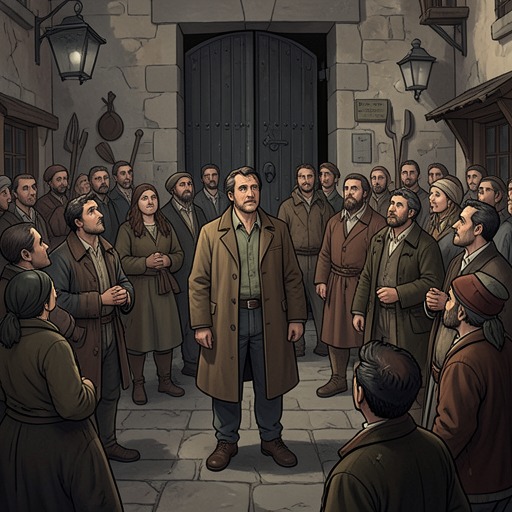
Antek’s release and return home
The PeasantsAntek Boryna’s release and return home reunite him with Hanka Borynowa and bring him back to the land whose inheritance has shaped his conflicts and ambitions. The homecoming is at once intimate and practical: Hanka’s longing breaks through her composed manner, while Antek turns from his embrace of her to the fields, livestock, and inherited labor that will define his life again.
News of His Return
The first word comes from the Voyt, who arrives at dusk in a britchka and tells Hanka that Antek will be back either that day or the next. He also brings news of Grzela’s misfortune. Hanka is reluctant to trust the announcement, asking whether the Voyt might be misleading her; he insists that information from the offices supports it. Though she answers coolly that Antek’s return is overdue, the news has already unsettled her. Her guarded reply contrasts with the intensity of the reunion that follows.
The confirmation comes from Józka Boryna, who hurries along the river path between reeds and young alders, waving and calling that Antek is home. Hanka drops her mattock and starts toward the farm, then checks herself, lets down her hitched-up skirt, and continues with an effort at composure. As she walks, she repeatedly asks whether Antek came with Rocho and how he looks. She learns that, on arriving, he asked for her immediately. That detail transforms the news from a report of his return into a personal assurance: Hanka was the person he wanted to find.
The Reunion
Antek is sitting on the porch with Rocho when Hanka reaches the farmstead. He comes out to meet her in the yard. Hanka approaches slowly, holding the fence as her legs weaken; tears choke her words until she can only repeat that it is really him. Antek clasps her to his breast, and she presses against him, overcome by happiness. Their embrace momentarily suspends the strain of his absence and the hardships she has faced in his place.
The reunion also reveals how much has changed during that absence. Antek notices that Hanka has grown thin and caresses her face. She does not answer his return with reproach or a recital of what she endured. Instead, after Rocho leaves for the village, she timidly asks whether Antek wants to inspect the farm. His response turns their private reunion toward shared work: he says the holiday is over and it is time to get to work, adding that he never expected his birthright to come to him so soon.
The Farm and the Inheritance
Hanka leads Antek through the holdings she has maintained. They visit the stable, where three horses and a foal are present, then the empty byre, the barn and its hay, the pigsties, and the shed containing tools and implements. Antek notices that the britchka needs to be rolled onto the threshing floor before it dries out; Hanka replies that she had told Pietrek to handle it, but he had not listened. Their exchange is more than a tour of property: it shows Hanka’s command of the farm’s condition and Antek’s immediate attention to its practical needs.
She calls the piglets and poultry, then reports broadly on the fieldwork, what has been sown, and how much has gone where. As she speaks, she watches Antek for a response. He listens closely, asks questions, and commits the information to memory before acknowledging how difficult it is to believe that she managed all of it herself. Hanka says she would do even more for him, and his praise gives her a moment of happiness. Her account establishes that his return is not to an untouched inheritance: the farm has continued through her labor, and any renewed authority must meet the work she has already done.
A Decision to Stay
Back among the fields, Antek feels himself once more on his father’s and grandfathers’ land, among his own people. The return stirs an almost physical joy: he imagines pressing his lips to the earth and embracing the world he has regained. He gives voice to the decisive meaning of his homecoming: “See, I’m back! I’m back and I’m staying!” The declaration makes clear that he is not merely visiting after release; he intends to remain and resume a place in the farm’s future.
Antek understands that place through succession. He prepares to take up the heavy labor his father performed before him and his grandfathers and great-grandfathers before that, carrying it forward until Pietruś can take his turn. He frames this order of inheritance as submission to divine will: “That’s how it must be! Young after old, son after father, in turn, for ever, while it be your will, merciful Jesus,” he thinks. The farm is therefore both material property and a continuing obligation, linking generations through work rather than possession alone.
The homecoming does not erase Antek’s past. As he rests his head in his hands, memories crowd in and his conscience begins to confront him with painful truths. He bows to that judgment, acknowledges his sins and offenses, and examines his dealings with sober severity. Pride and arrogance are presented as obstacles he must overcome; contrition comes hard, but he persists. The scene closes his return not with a claim that everything has been repaired, but with a commitment to stay, labor, and face the moral account of his life.