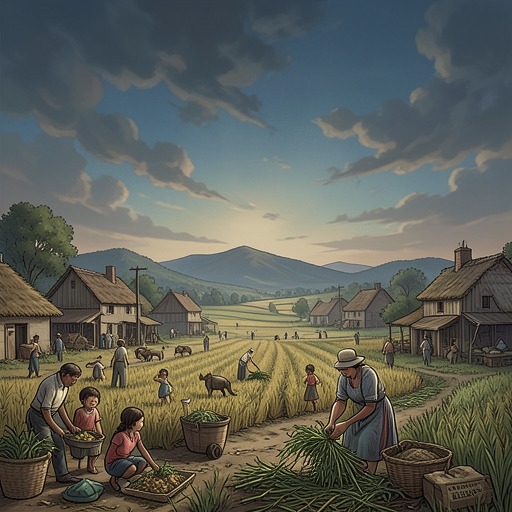
Autumn
The PeasantsAutumn is the opening season of The Peasants and the temporal frame of Volume I. It is more than a backdrop: as daylight fades, fields and roads change, water rises, and village work gathers urgency, the season gives the narrative its pace and material pressures. Its defining movement is toward winter, but it also contains weddings, fairs, and the concentrated labor of gathering and storing food.
Place in the Novel
The first volume is explicitly designated Autumn, and its early scenes begin in September, when the day can still be quiet and sunlit. That relative warmth does not last. As the volume advances, the narration marks autumn as late and increasingly close to winter; the season’s course becomes a visible measure of change in the village and countryside. The title therefore supplies a calendar as well as an organizing principle: the narrative follows a world whose social life is inseparable from the progress of the year.
Autumn’s place in that larger cycle is especially clear in the description of it as winter’s own mother. The image makes the transition feel continuous rather than sudden. Winter is already being prepared in the cold, the quiet, and the shortening days, even before its full severity arrives. The season is thus a threshold: it holds the last remnants of summer while making the next season palpable.
A Landscape Losing Its Warmth
The narration registers autumn through small, cumulative changes. Dawn comes later; frost stiffens the fields; the sun appears wan behind flocks of crows and jackdaws. A cold wind ruffles the water, strips the last leaves from poplars, and shrivels the remaining greenery. Leaves fall along the roads like tears, turning seasonal change into an image of summer’s ending without separating that image from the physical weather that causes it.
The altered landscape also changes the village’s tempo. Cattle go out to pasture more slowly, barn doors creak, and voices seem muffled by the stillness of empty fields. People sometimes stop to look into the distance, while cattle lift their heads from the yellowing grass. Later, smoke from cottage chimneys hangs lower among the bare orchards; birds seek shelter in barns and hayricks, and crows gather on roofs and trees. These details make the approach of winter something inhabitants and animals respond to through their ordinary movements, not simply an atmospheric impression.
By late autumn, quiet has become a defining condition. Songs, shouts, and birdsong are absent; wind moans in the thatch, drizzle marks the windows, and the sound of flails grows louder in the barns. Lipce seems to share the exhaustion of the stripped fields around it, lying in a frozen stillness before the long winter. The change is not only visual: sound itself contracts, with communal and natural activity giving way to indoor labor and weather.
Work, Water, and the Seasonal Calendar
Autumn does not mean that work stops. While much of the village is occupied in cabbage fields, occasional threshing continues in barns. Cabbages are cut and carried from peat bogs in carts, and the harvested heads fill threshing floors, hallways, and rooms, in places rising to the eaves. Great barrels are set out in the rain to soak. The volume of produce and the labor of gathering it give the season a practical density: food must be brought in and dealt with as the weather turns.
Water complicates that work. The pond swells until it overflows its banks and reaches the lower road on Boryna’s side, the fences, and cottage walls. Elsewhere the roads are sodden and muddy, farmyards and porches stand empty, and carts move slowly through the wet conditions. The contrast between full rooms of cabbages and water pushing across the road shows how seasonal abundance and exposure coexist. Autumn offers a harvest, but rain and flooding make the landscape harder to cross and manage.
The village’s preparations also follow a shared calendar. People anticipate the fair on St Kordula’s Day, described as the last notable feast before Yuletide, and make ready as though for a holiday. The event gives late autumn a point of expectation amid the greying weather: there is still a public occasion toward which people can travel and prepare, even as the season narrows the outdoor world.
The Threshold of Winter
The transition is registered in both weather and human events. Around a wedding, a night frost hardens puddles and the pond’s edges; smaller cattle cannot stand upright in the fields. Yet the day warms, ice drips from thatches, and mist rises over the marshes. The wedding’s autumn light makes the earth glisten, the pond shimmer, and roadside ditches glitter, before the brightness slowly dims. The celebration unfolds not outside the season’s decline but within it: the same day holds frost, thaw, warmth, and fading light.
Soon after St Barbara’s feast, the weather turns more violently. Winds sweep through the village, tug at roofs and fences, and race back toward the forest; gales follow, while snow is trampled and driven away. The storm passage extends autumn’s unsettled transition into winter weather, rendering wind and cloud as active forces rather than passive scenery. Elsewhere, the fear that autumn sowing may not happen in time gives the seasonal threshold an agricultural consequence: delay threatens the next cycle of cultivation.
Narrative Significance
Autumn shapes the novel through recurring contrasts: daylight against dusk, gathered food against exposed roads, communal festivity against the growing hush, and a last warmth against the first frost. The landscape is not merely made to echo human feeling. Flooding affects movement, cold changes the pace of daily tasks, and the seasonal timetable places limits on when work can be done. Weather and agricultural labor therefore help determine the circumstances in which village life unfolds.
As the opening season, Autumn also establishes the book’s larger method of attending to time. Change is conveyed through repeated observations of dawn, fields, animals, water, and work rather than by the calendar alone. The result is a season experienced as a process: summer recedes, necessary labor continues, and winter gathers at the edges of ordinary life. The volume’s seasonal frame makes that transition one of its central narrative forces.