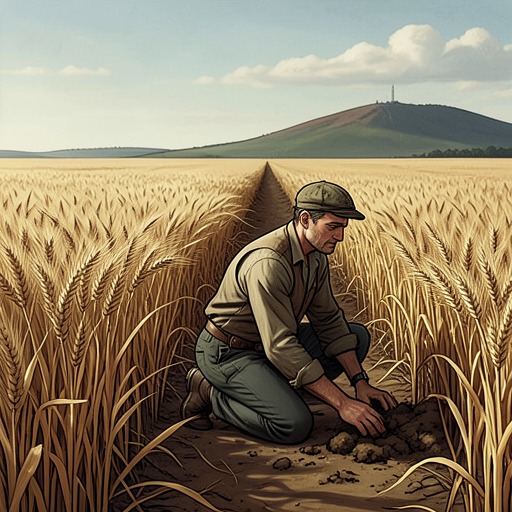
Boryna's image of sowing soil at death
The PeasantsMaciej Boryna’s image of sowing soil at death transforms a confused final night into a last passage through the labor and land that have ordered his life. Barefoot and in his shirt, he gathers earth as if it were seed, scatters it over his fields, and continues until he is sowing with an empty hand. The act is at once futile and sacred: it cannot produce a crop, yet the narration presents each clod as blessed and the field as the place where he returns his lifetime to God.
Waking into an old rhythm
Late at night, as the first cockerels begin to crow, Maciej Boryna sits up in bed. Moonlight falls across his face. His throat produces only a gurgle when he tries to speak, and he fumbles at the light as if he could gather its shimmering beams into his fist. The small, physical gestures establish the distance between waking and understanding: he is conscious enough to move, but not to recover a stable sense of where he is or what has happened.
Looking through the window, he takes the night for day and believes he has overslept, with urgent work waiting. He tries to pray and search for his clothes and shoes, but loses the thread of both tasks. Memories from before and during his illness break into pale fragments; each seems within reach, then dissolves. The narration compares his effort to that of a horse released from years on a treadmill, still walking in circles from habit. The image gives his return to work its governing pattern: he is not making a deliberate plan so much as being carried along by a familiar motion that has outlasted his capacity to understand it.
The hayrick and the field
Outside, Maciej moves through the moonlit farmyard, with Łapa following after recognizing his master. The impulse to sow surfaces and vanishes, then returns. At the rebuilt hayrick—the one burned in winter—his confused movement briefly sharpens into recollection. He pulls a fence stake and raises it like a pitchfork, ready to strike the rick posts; before he can hit them, the stake slips helplessly from his hands. The brief flare of violence makes the past visible without restoring lasting clarity. He moves on from the object that has recalled it toward the field and the work that now absorbs him.
The fields are already alive with the crops of a working farm: mature rye bends under its ears, wheat stands tall, and oats and barley have only begun to sprout. Against this setting, Maciej’s mistaken belief that sowing must begin again appears both out of season and perfectly continuous with the agricultural world around him. He kneels on a patch of stubble, stretches out his shirt, and fills it with soil as though drawing grain from a sack. After gathering as much as he can barely lift, he crosses himself, swings his arm, and begins to scatter the earth. The substitution is exact in its outward motions and impossible in its result: the material of the field becomes the seed, and the act of sowing can no longer lead to a harvest.
A final labor without a crop
Maciej walks slowly across the field, scattering handfuls of soil. Łapa darts from beneath his feet and returns to his side. The narration describes Maciej as blessing each clod and stalk as he goes, while he stumbles over ridges, trips in holes, and sometimes falls without seeming to notice. His need to sow overrides pain and exhaustion. When the soil in his shirt runs out, he gathers more; when stone heaps or thorny shrubs block his way, he turns back and continues elsewhere.
His path carries him far enough that the houses and village disappear into mist, leaving an expanse of tawny fields around him. He then comes nearer the houses again, back toward the sounds of birds and human labor. The movement between the distant fields and the inhabited edge of the village gives the scene a repeated, almost tidal course: he leaves the living world in appearance, returns to its margins, and sets off once more. He occasionally calls for Kuba as if addressing a farmhand, another fragment of working life that enters the present without explanation.
The narration insists on the work’s futility even as it dwells on its persistence. Maciej sows without tiring, stopping only to rest and stretch his bones before taking up the barren task again. The repetition does not turn soil into grain. Instead, it makes the act itself the scene’s measure of a life shaped by labor and attachment to the land. His body continues an agricultural gesture whose practical purpose has disappeared, while the fields remain real, cultivated, and larger than the failing memory that moves through them.
The empty hand and the return to God
As the night thins and the stars fade, Maciej slows and pauses more often. Eventually he forgets to collect further earth and sows with an empty hand. The image gathers the scene’s contradiction into one gesture: his movement persists after its material has run out. The narration presents him as sowing the last of himself into the fields of his ancestors—his lived days and human lifetime returned to the holy wheatfields and to God Eternal. What began as confused urgency becomes, in the scene’s language, a final offering.
The world darkens before dawn, and a heavy presence seems to pass through the gloom as the earth itself rocks. Maciej spreads his hands in a gesture compared to the Elevation; when he gives thanks to God, he falls face down before the Most Holy Majesty. He dies in that hour, as dawn rises, while Łapa howls. The death completes the image without making the labor fruitful: no crop follows from the earth he has scattered. Its significance lies instead in the convergence of bodily habit, ancestral land, religious gesture, and mortality. Maciej’s final sowing returns him to the ground he has worked and blessed, but it cannot distinguish renewal from departure.