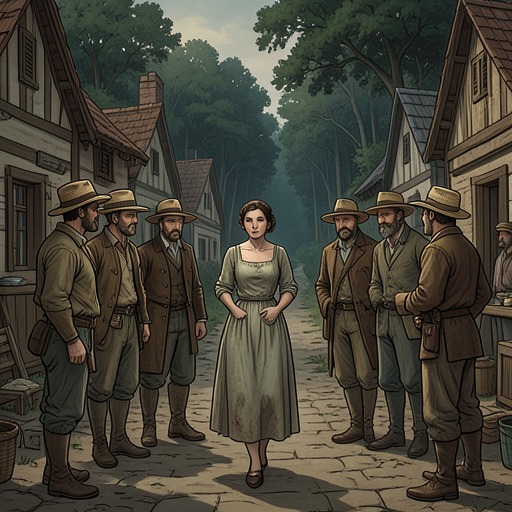
Boryna’s decision to marry Jagna
The PeasantsMaciej Boryna’s decision to marry Jagna takes shape as he walks home at night, weighing the need for a woman in his household against the land and livestock the marriage might bring. The moment turns a suggestion made in company into a private resolve: Boryna’s hopes for companionship and an orderly farm are inseparable from calculations about property, work, and his children’s claims. In the novel’s larger design, this marriage becomes one of the two central lines of a family story whose intimate tensions run alongside the villagers’ conflict over the forest.
The suggestion that sets the decision in motion
Earlier, someone proposes Jagna as a suitable match. The suggestion is accepted with a moment of recognition: she had been overlooked, though she is described as strong and beautiful. That exchange supplies Boryna with a possibility rather than a settled plan. The importance of the scene lies in what happens afterward, when he returns to the idea alone and begins testing it against his household’s needs and his own ambitions.
The novel identifies Boryna as the wealthiest peasant in the village, and his marriage to Jagna is one of its two principal plot lines. The other is Jagna’s affair with Boryna’s son, Antek. That broader structure gives the decision consequences beyond the formation of a new household: the marriage joins Jagna to Boryna while placing her within the family at the center of the novel’s entangled relationships. The decision scene itself, however, remains focused on Boryna’s reasoning, not on what Jagna has decided or on any later outcome.
A night walk becomes a reckoning
Rather than going straight home, Boryna takes a longer route past the pond and Jagna’s cottage. The narrator says he does not know why he has chosen it; perhaps he wants to pass her house, or perhaps he needs time to collect his thoughts. This uncertainty matters. His decision has not yet become a declaration, and the route gives him room to turn an unsettled possibility over in his mind.
At the pond he recalls what has been said about Jagna and concedes that it is true. He also thinks of the farm’s need for a woman, fearing that without one everything will fall into ruin or the property will end up in his children’s hands. His reasoning is both domestic and dynastic: marriage promises to maintain the household, while keeping control of the farm remains a pressing concern. His missing best cow adds an immediate material worry to those longer calculations.
The arithmetic of land and household
Boryna’s thoughts move from Jagna’s qualities to the resources her marriage could bring. He reckons that Jagna would receive five morgen from the fifteen held by her family of three, with the household and livestock settled as well. He identifies the fields beyond his potato field as the likely parcel, estimates that adding them would bring his own holding to nearly thirty-five morgen, and imagines manuring, tilling, and planting the enlarged land with wheat the following year. He also anticipates needing another horse and replacing the lost cow, but expects Jagna to bring a cow with her.
The sequence makes the economic logic of the proposal unusually explicit. Boryna considers land not as an abstract dowry but as fields to be worked, crops to be sown, and animals needed to make the expanded farm productive. His thoughts dwell on the details until he has, in the narrator’s account, weighed every point. The scene therefore presents marriage as a practical arrangement rooted in agricultural labor and property, without reducing Boryna’s response to calculation alone: his attention to Jagna’s beauty and strength is also part of the attraction.
Resolve, inheritance, and significance
The prospect of resistance from his children interrupts Boryna’s reckoning. He anticipates that they will make trouble, but the thought brings a sudden strengthening of his still-vague resolve. As he stands in front of Jagna’s cottage, he asserts inwardly that the land is his and that the others should keep their hands off it. The unfinished threat that follows leaves the conflict implicit, but makes clear that the marriage decision is tied to his authority over the farm and his refusal to yield it to his children.
The scene thus establishes the terms on which Boryna approaches marriage: household security, Jagna’s personal appeal, the addition of land and livestock, and the preservation of his control against his heirs. It also quietly prepares the novel’s larger conflict, in which family desire and the ownership of land continually press against each other. Boryna’s resolve begins not with a public announcement but in solitary calculation, and its destination is Jagna’s illuminated cottage.