Catholic Church
The PeasantsThe Catholic Church is one of the principal institutions through which the people of Lipce understand community, morality, and the rhythms of the year. Its presence is tangible in the village church and its services, but also in household customs, memories of the dead, and arguments about who deserves respect or help. The parish priest can offer Kuba recognition and summon a congregation to repentance; religious language can also be used to defend a rigid social order. The Church’s significance therefore lies not only in its rituals, but in the gap between the compassion those rituals express and the inequalities that continue outside them.
The Church in Village Life
The church gathers people across Lipce’s social ranks, but it does not make those ranks disappear. Kuba, a poor and disabled farmhand, attends Mass regularly and has often brought the priest small gifts, including birds, a hare, or mushrooms. One day the priest invites him inside and gives him a zloty, praising his piety and goodness. The gesture moves Kuba deeply: accustomed to being called a cripple, fool, and sponger, he takes the priest’s welcome as rare recognition of his standing as a Christian and a son of a farmer.
Kuba carries that recognition into the next service. Instead of remaining in the porch, where his customary position places him, he pushes through the congregation to the front near the high altar, among the farmers, the Voyt, and those with ceremonial roles. Other worshippers stare and rebuke him, but he holds the coin in his fist and refuses to retreat. The scene makes the church both a place of shared devotion and a stage on which social rank is enforced: Kuba can enter the same sacred space as the farmers, yet his attempt to occupy their place provokes visible disapproval.
The parish priest’s authority is felt especially strongly through preaching. During one service, the priest denounces avarice, drunkenness, debauchery, neglect of the elderly, and godlessness. Kuba, who had just been welcomed by him, watches the same man become a commanding preacher. The congregation weeps, beats its breast, and kneels together in penitence; the church’s collective response becomes almost as important as the sermon itself. Afterward, the organ, bells, incense, prayers, and the priest’s voice draw Kuba into an intense experience of devotion. His faith is not presented as abstract doctrine alone: it is made through sound, gesture, light, and the repeated acts of worship.
Ritual and the Seasonal Calendar
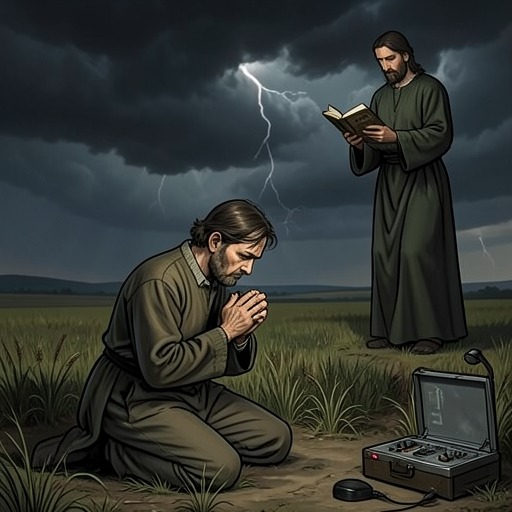
Religious observance gives the village year a shared shape. On All Souls’ Day, the bells ring across mist-covered fields, calling people to remember the dead. At night, Kuba and Witek go to neglected graves near the cemetery fence. There, Kuba recognizes the burial place of his mother and recounts his family history: his father had land but worked as a coachman at the manor; after his father died, his uncles took the land, and Kuba was left minding the manor’s pigs. He remembers later service, war, a gunshot wound, and his return to find the manor burned and members of his family dead. The cemetery visit joins personal memory to the community’s observance of the departed, while the unmarked graves reveal how easily particular lives can sink into neglect.
Christmas Eve brings another form of religious fellowship, woven into domestic work and customary food. Across Lipce, people clean their cottages, scatter fresh pine needles, bake bread and sweet rolls, prepare herring, and grind poppy seeds for dumplings. At the Boryna household, the family and guests gather for the meal. Boryna crosses himself and divides the Christmas wafer among those present; they eat it reverently, despite having had only dry bread during the day. The ritual makes a poor household meal part of a sacred observance and places the act of sharing at the center of the celebration.
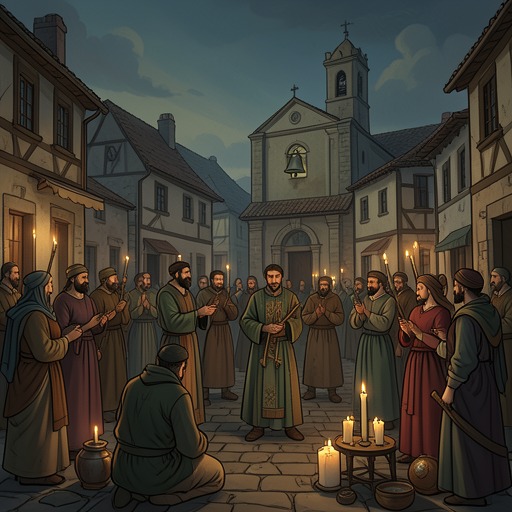
The church service extends that household fellowship into public space. At the first Mass, the packed congregation kneels as the priest celebrates, and afterward his sermon warns against evil and calls listeners to examine their consciences. At the second Mass, the carols prompt the congregation to sing together. Yet shared worship does not mean every worshipper experiences the day in the same way. Antek stays at the back, separated from his former place among the farmers, and, after seeing his father’s household with Jagna, presses through the crowd until he is beside her. The scene sets the collective voice of the congregation against private estrangement and desire.
Moral Authority and Social Rank
Religious language can affirm obligations of compassion, but it can also be turned into an argument for keeping people in their allotted places. Boryna invokes the priest’s teaching about respect for elders while admonishing Kuba for stepping forward among the farmers. He tells Kuba that a farmhand is not a farmer, that each person has a different place assigned by the Lord, and that crossing the line threatens the order of the world. Kuba answers that he is not a beast and has a mind of his own. The exchange does not establish that the priest himself has made this ruling; rather, Boryna uses religious authority to make a social boundary sound divinely ordained.
The priest’s preaching also depicts moral failings as matters for the whole congregation. At the Christmas service, he warns against wrongdoing and speaks so earnestly that some people beat their breasts, others search their consciences, and some weep. The Church supplies a language for remorse and correction, and the congregation responds as a body. But the novel sets this moral solidarity beside persistent need. In a conversation with Hanka, Jagustynka describes hungry households with no potatoes, sold bedding, cold rooms, and children whose mothers have little or no milk. She condemns prosperous farmers for tending to their own interests while leaving the poor to divine providence. Her account names the priest among those who could help, but does not show that religious observance has itself relieved the crisis.
Memory, Belonging, and Collective Action
The Church also gives religious form to belonging and departure. Before her wedding, Jagna kneels beside Boryna while her mother blesses them with holy water and makes the sign of the cross. Jagna then asks forgiveness of the others and takes leave; the women embrace her, and the group proceeds toward the church with musicians leading. The ceremony presents marriage as a transition witnessed by family and community, not simply a private agreement.
Religious memory also intersects with the village’s Polish identity. The historical account of Polish political thought describes the effort to build national consciousness among the peasantry, and identifies religious and cultural traditions as part of the wider world in which that effort takes place. In the village narrative, Witek’s belief that the Lord Jesus walks the earth leads him and Kuba to the graves of those killed in the forest conflict. Kuba’s recollection of family loss unfolds at this site during the observance of the dead. Such scenes connect personal and village memory, though they do not erase the divisions of class or the different positions people occupy within the community.
The forest dispute shows how religious and communal language can join a political appeal. Antek addresses farmers and hired hands together, naming the manor’s felling of the forest, refusal to employ local men, and continuing injuries against the villagers. His appeal frames their grievance as a shared injustice and draws an angry response from the crowd. The sermon and the rally are not the same kind of speech, but both present wrongdoing before a gathered community and seek to move listeners toward a collective response.
Significance and Limits
The Church in The Peasants is at once a setting for worship, an authority invoked in household disputes, and a framework for remembering the dead and marking major changes in life. The priest’s kindness gives Kuba a brief but powerful experience of dignity; the services let a divided village pray, repent, and sing together. At the same time, Boryna’s appeal to religious order shows how sacred language may be recruited to protect class distinctions, while Jagustynka’s account of hunger exposes the distance between professed concern and practical relief.
That tension makes the Church’s role neither purely emancipatory nor merely disciplinary. Its rituals offer forms of recognition and collective belonging, but the social world around them remains unequal, and the novel does not treat shared worship as a solution to poverty or conflict. Religious life matters because it gives the village ways to articulate obligation, grief, repentance, and solidarity—and because the story repeatedly measures those ideals against the treatment people actually receive.