Death and human fate
The PeasantsDeath and human fate become collective concerns when Maciej Boryna lies lifeless in the quiet of his home while Lipce wakes to another day of work. His death is more than an individual ending: it exposes the helplessness of human beings before mortality, draws the village into a shared reckoning with loss, and sets resignation beside a tenacious will to continue living. The passage does not resolve that tension. It gives the dead man to the silence of the house, the mourners to prayer and grief, and the living world to the rain that begins to fall.
Boryna’s death and the waking world
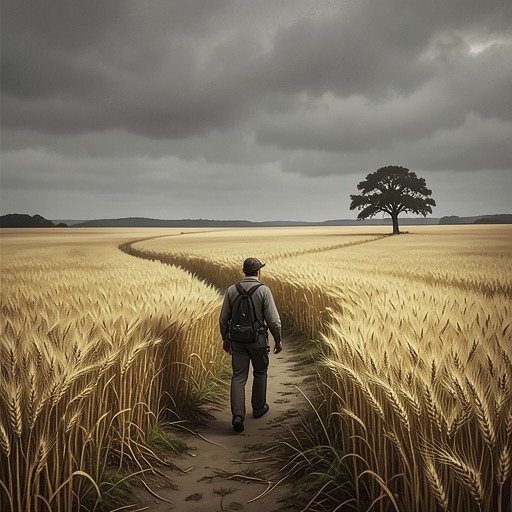
At daybreak the village stirs into its ordinary labor. Water gurgles, wheat sways, sheep bleat, geese honk, cockerels cry, and gates creak as people rise. Against this movement, the Boryna household remains quiet. Those inside have slept after their troubles, while wind rattles the open door and windows and troubles the last candle. It ruffles the dead man’s hair, but cannot wake him or summon him back to work. The familiar measure of rural life—rising, laboring, and urging others to labor—has stopped for Maciej Boryna.
The surrounding world appears to recognize what the household has not yet announced. Wind, trees, hollyhocks, a bee, a butterfly, a swallow, flies, and beetles gather in the room through a sequence of restless movements and sounds. The narration gives their mingled response the shape of a cry that Boryna has died. This imagined chorus makes death both intimate and more than human: the news belongs to the room, but it seems to pass through the living creatures that enter it. Then the wind drops and the world holds still as a great red sun rises. The sun disappears behind clouds; the landscape turns grey, and warm rain begins. Death has changed the morning, but has not stopped its weather or the renewal of its fields and orchards.
Mortality as an inescapable condition
The funeral lament broadens grief into questions about the worth and brevity of human life. The mourners consider labor, kindness, happiness, and hope against the image of a life that melts away like snow. Even a person’s own children may not remember that life. The comparison reduces human permanence to something as vulnerable as winter snow, while the reference to descendants makes forgetting part of mortality: death ends a person’s presence, and time may also thin the memory of that presence.
The reflections deny that earthly advantages can defeat this limit. Paradise, unlimited power, and exceptional intelligence are each imagined as gifts that death can take away or leave powerless. The human being is compared to a tiny leaf tossed by the wind and to a young bird exposed to a sudden, deadly hand. These images make vulnerability physical rather than abstract. People may imagine themselves masters of creation, but they remain creatures whose lives can be cut short and whose fate they cannot command. The passage therefore treats death not as a punishment explained by a particular wrongdoing, but as a condition shared by the human creature.
Grief, generations, and faith
The people walk together through Lipce, yet their mourning is also intensely solitary. Each person is absorbed in individual sorrow, and their eyes seem to carry the tears of fathers, grandfathers, and great-grandfathers who have already gone to the graveyard. Grief reaches backward through family generations as well as outward across the crowd. The village is physically gathered, but shared procession does not erase private loss; people can jostle together and still feel as though they are moving through an empty land alone.
The prayers give this helplessness a religious answer, though not a promise that death can be avoided. The mourners beg Jesus for mercy and understand the Lord’s compassion as humanity’s refuge, the soul’s only escape. Latin words fall upon them with the weight of frozen earth. They bow their heads as if submitting to death’s implacable scythe, yet continue walking. Their faith accompanies recognition of mortality rather than canceling it: mercy is sought because human beings cannot overcome fate by their own strength.
The funeral procession and the persistence of life
Bells and a mournful hymn carry the crowd toward the graveyard among wheat, crosses, tombs, and trees. The graveyard appears to open like a bottomless pit into which the world is flowing. In the rainy air, the mourners imagine coffins emerging from every cottage and funeral processions filling every lane. Boryna’s death thus awakens a broader fear: each funeral makes other losses imaginable, and the village’s grief seems capable of engulfing heaven and earth.
Yet the procession does not end in paralysis. The people remain unyielding and resigned, compared both to grey boulders along the field boundaries and to trees that may be struck by lightning but still reach for the sun. The same images hold fragility and endurance together. The trees are vulnerable to sudden death; they also continue to grow and sing with life. This contrast, prepared by the red sunrise and the rain after Boryna dies, gives the passage its central understanding of human fate: people cannot master death, but they can go on living without pretending that they are invulnerable. Their persistence is neither triumph over mortality nor escape from sorrow; it is a hard, communal continuance under the knowledge that life remains brief.