Dominikowa—Szymek
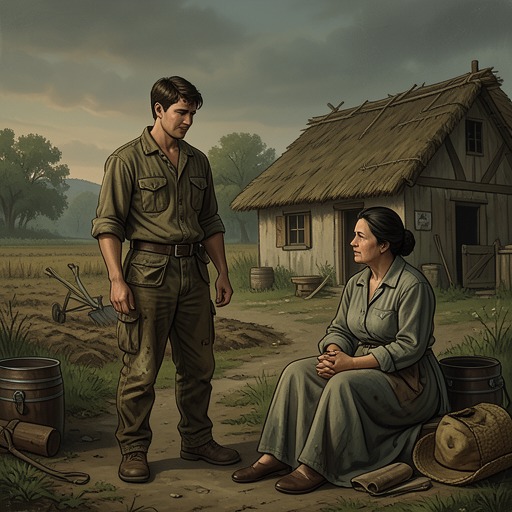
The PeasantsDominikowa and Szymek Pacześ are bound together by a family relationship that becomes a contest over marriage, authority, and control of property. When Szymek seeks money to arrange his banns with Nastusia Gołębianka, Dominikowa refuses both the request and the marriage. Their argument turns into a physical struggle that leaves her badly burnt and ends with her throwing his clothes out of the house and declaring that he has no claim to its land or food. The scene makes the household’s material resources—not merely maternal approval—the ground on which their relationship breaks open.
A relationship governed by control
Before the confrontation at home, Dominikowa has already tried to compel her sons to return with her. She storms into the Lipce village inn carrying a stick, intending to beat them and take them away by force. Szymek and Jędrych resist and drive her out. The episode establishes a pattern of attempted command and refusal: Dominikowa asserts her authority physically, while her sons do not simply submit to it. The public setting and the disturbance in the inn also make the family conflict visible to others rather than keeping it within the household.
The later quarrel reveals what that authority includes. Dominikowa tells Szymek to water the heifer, treating the task as an ordinary household order; he refuses, rejects the role of her servant, and demands the money he needs. Their exchange moves rapidly from a dispute about work to a dispute about whether he may marry at all. In this household, parental power is exercised through daily labor and access to resources as well as through the right to give or withhold consent.
Szymek’s marriage demand
After breakfast, Szymek sits by the window with a cigarette and considers what to do before making his request. He says he needs money for the banns and must go to the priest before Vespers for the prayers. When Dominikowa asks whom he intends to marry, he names Nastusia Gołębianka. The detail that he has a specific wedding step and time in mind gives the dispute an immediate practical stake: he is not speaking abstractly about a future marriage but trying to obtain what is needed to proceed.
Dominikowa answers with mockery and refusal. She will neither provide the money nor allow him to wed. Szymek replies that he will manage without her permission. His response challenges her authority directly, but the exchange also shows the limits of that declaration: he still wants money held within the household, and their conflict is inseparable from his dependence on resources she controls. Her refusal therefore operates both as opposition to his choice of wife and as a material obstacle to carrying it out.
From argument to physical violence
When Dominikowa refuses, Szymek moves toward the chest and tears off its lid, turning the demand for money into a search through the household’s belongings. Dominikowa tries to stop him, first pulling at him and then attacking him, striking his head and face and kicking him. He shakes her off; she takes up a poker and renews the assault. Jędrek runs about crying for their mother, while Jagna enters and tries to separate them. The attempt fails: the fight continues, and others gather, unable to pull Dominikowa away from Szymek.
The violence escalates until Szymek punches her between the eyes and throws her aside. Dominikowa falls onto the hot baking plate among the boiling pans; the stove collapses around her. The scene’s domestic objects—the chest, clothing, poker, stove, and pans—become part of the struggle, so that a quarrel over the means to marry is transformed into an assault within the ordinary working space of the home. Dominikowa is retrieved from the rubble with severe burns, yet she continues trying to reach Szymek. He, meanwhile, is battered and bloody, unable to speak and visibly frightened by what has happened.
Property as the terms of separation
Even after the fight has quieted, Dominikowa breaks away from the women holding her and throws Szymek’s clothes out of the window into the orchard. She then declares that nothing in the house belongs to him and that she will give him neither land nor food, even if he is starving. Her words make explicit the material terms of the rupture: refusing the marriage is accompanied by refusing Szymek a share of the household’s property and sustenance. The conflict is therefore not only a clash between a mother’s command and a son’s defiance; it concerns whether he can establish a life apart from her using resources she claims as hers alone.
Dominikowa ends the scene exhausted and in acute pain, moaning as the family and neighbors crowd into the room and hallway and look in through the window. Szymek’s attempt to act without her permission has produced neither a negotiated settlement nor a calm departure: the visible outcome is injury, expulsion of his belongings, and a declaration of disinheritance. The relationship is left in a state of open rupture, with marriage, household membership, land, and food all entangled in the same struggle for independence.