Folk beliefs about the dead and purgatory
The PeasantsFolk beliefs about the dead and purgatory give All Souls’ Day in The Peasants the force of a visitation: the dead remain bound to the living by kinship, prayer, memory, and food. The observance joins Catholic liturgy to local custom, but its care extends beyond the recognized dead and the church’s formal rites. In Kuba’s hands, remembrance becomes a duty owed especially to those whom the village has forgotten.
All Souls’ Day as a communal rite
The annual observance gathers the people of Lipce around the dead. In the church, a coffin stands beneath blazing candles while the Parish Priest of Lipce recites a long litany of names. When he pauses, those present answer together in prayer for souls still in purgatory. Later, at the cemetery, people bring bread, cheese, bacon, sausage, yarn, flax, or mushrooms and place their offerings in barrels. Some provisions are assigned to the priest, the organist, or Ambrozy; the rest go to the beggars. Those who bring no food give a coin and whisper the names of the dead for whose intercession they ask.
The ceremony makes remembrance both public and material. Names are spoken aloud in the church, while gifts pass through the hands of the living at the graveyard gate. Prayers, hymns, and the repeated chanting of names continue as people move among the graves and lights begin to show in the dusk. The dead are not treated as an abstraction: the living address particular souls, and the offerings answer an imagined need that prayer alone does not satisfy.
The forgotten graves and Kuba’s offering
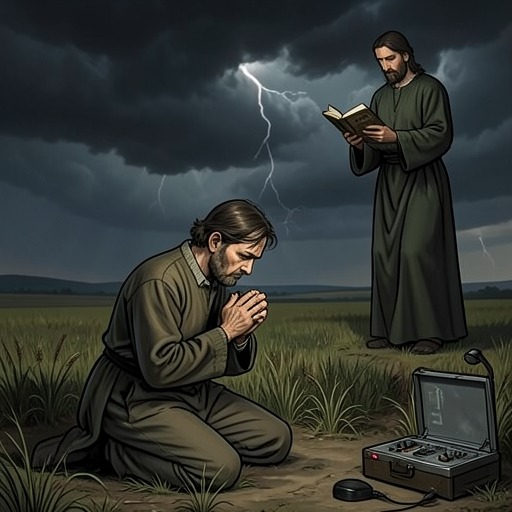
Kuba leads Witek away from the busy cemetery into its older, neglected section. There, sunken graves and crumbling crosses mark the place of whole families and generations, but no one comes to pray, cry, or light a lamp for them. The desolation sharply contrasts with the candles and food of the public observance. Kuba takes pieces of bread he has saved, breaks them apart, and scatters them over the graves, addressing the dead as Christian souls and urging them to eat.
His action follows the same logic as the offerings placed in the barrels, but redirects that care toward those left outside the communal system of remembrance. Kuba explains that the forgotten souls receive nothing while the priest and beggars are fed. His complaint does not reject the ritual; it insists that its obligations reach further. Witek asks whether the dead will take the food, and Kuba answers with confidence that all the tormented in purgatory are released to visit their own on this day. The scene presents the custom not as a decorative superstition but as a practical response to the belief that the dead remain hungry and dependent on the living.
A day when the dead may return
Kuba’s account places the observance within a wider folk cosmology. He tells Witek that the dead are allowed to come back on All Souls’ Day, and that Jesus himself walks the earth to see how many souls remain before gathering them all up. The belief is transmitted through family memory: Kuba recalls what his mother told him and what old people say. Witek repeats the claim in a whisper and looks around warily, turning inherited teaching into immediate fear and wonder.
That expectation shapes the evening outside the cemetery as well. People leave the roads nearly empty; the inn is closed, and villagers listen anxiously at their windows and outside their cottages for wandering souls. In some homes, women set the supper’s remains on earth benches, cross themselves, and invite a soul still in purgatory to eat. The food offered at the graves and the leftovers set out at home extend the same hospitality from public burial ground to household threshold. The narration surrounds the custom with shadows, rustling trees, and voices that may be understood as either supernatural presences or the fearful atmosphere of the night; the villagers’ belief itself is unmistakable.
Kinship, memory, and historical loss
At the graves by the fence, Witek points toward a light and cries that someone is there. Kuba identifies the dead as people who were struck down in the forest and says that his own kin lie among them, including his mother. The visit therefore links the community’s ritual care to particular histories of violence and loss, not merely to a general fear of death.
Kuba recalls that his mother was Magdalena and his father Pieter, nicknamed Socha. After his father died, his uncles took the family land; Kuba minded the manor’s pigs and later served as a coachman and hunter. He remembers being taken away with the manor household, carrying a wounded young squire, and returning on an errand to find the manor buildings burned and his mother and others beaten to death in the garden. His grief surfaces at the graves as a personal memory within the public holy day. The neglected burial place holds lives and family ties that official rites and communal provision have failed to preserve.
These beliefs give remembrance a social and ethical edge. All Souls’ Day gathers Lipce in shared prayer, yet Kuba’s bread exposes the unequal reach of that fellowship: even within a community devoted to feeding and naming the dead, some remain abandoned. His small offering repairs that omission for a moment, joining compassion for the forgotten to the ordinary, bodily acts of feeding and remembering.