Folk tales and fantastic imagination
The PeasantsFolk tales and fantastic imagination in The Peasants are not decorative escapes from village life: they are a form of shared storytelling through which the villagers temporarily transform hardship, express longing, and imagine models of justice and belonging. Around Rocho’s tales, everyday work gives way to enchanted kingdoms, frightening spirits, and sacred history. The listeners’ responses make these stories social events, while their imagery also resonates with the novel’s larger questions about peasant identity and political community.
Storytelling as a communal performance
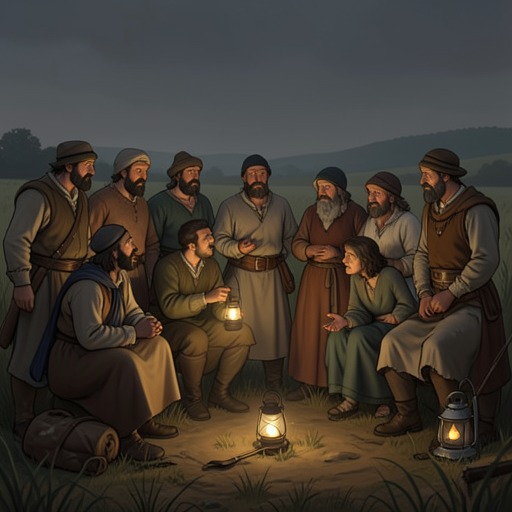
On a cold winter evening, the girls gather around Rocho at the fireside and urge him to tell a story, recalling an earlier occasion at the Boryna household. He seats himself beneath the lamp while the villagers settle into a semicircle. The room’s ordinary sounds—the spindles and the fire—frame a performance that gradually commands everyone’s attention. Rocho tells slowly and quietly; the listeners answer with questions, memories, and their own tales. Storytelling here is not simply a tale delivered to passive hearers but a shared village practice, shaped by the teller’s pacing and the audience’s reactions.
Rocho’s repertory ranges widely. He describes kings, cruel wars, an enchanted army waiting for a trumpet, castles with golden chambers, princesses awaiting rescue, and countries inhabited by giants. Firebirds, magic cudgels, the divine twins Lel and Polel, noonwraiths, phantoms, and ghouls mingle in a world where marvels and terrors belong to the same imaginative landscape. The women add stories of a drowned woman who suckles a hungry child, vampires stopped by a stake through the heart, talking trees, werewolves, witches, and repentant souls. Each voice extends the gathering’s store of wonder and fear.
The tales produce visible changes in the room. Spindles fall idle; listeners hold their breath, and some are moved to tears. When the stories turn frightening, the villagers glance at the windows, cross themselves, and murmur prayers, as though the imagined presences might have entered the house. Their alarm passes, and storytelling resumes. The scene presents belief not as a simple choice between credulity and disbelief but as an experience shared in the moment: the stories can frighten the listeners even as they know themselves to be gathered safely together.
Sacred legend, justice, and political longing
Rocho’s stories include religious narratives as well as marvels. One begins in a time when the Lord Jesus walked the earth and went toward Mstowo for the indulgences. The journey crosses burning sands beneath a fierce sun; the Evil One raises dust and darkness in an effort to mislead him and prevent him from reaching the people he hopes to save. The story places hardship within a moral and sacred frame: the journey is difficult, but the attempt to obstruct it is itself part of a struggle between evil and the saving of souls.
Another tale offers a more explicitly social ideal. Rocho describes a just peasant king, mocked by gentlemen for being decent and doing good for the nation. The king travels among villages in peasant clothing, seeks out wrongdoing, rights wrongs, and assuages anger. To live in fellowship with the peasantry, he marries a farmer’s daughter from the outskirts of Kraków, named Zofia, and later governs from the castle in Kraków as a father to the nation and its foremost farmer. The story imagines authority as legitimate when it is joined to justice, care for ordinary people, and a ruler’s kinship with them.
Jagusia is especially captivated by this account. She imagines the king’s world with such intensity that she says she would follow him anywhere for a single word. Her response gives the story an emotional force beyond its place in Rocho’s repertoire: the imagined king represents a wider and more just world than the village’s daily round. The episode resonates with the novel’s political question of how peasants might become part of a Polish national community. In the broader context of The Peasants, that question is complicated by the history of serfdom and by the absence of Polish educational and administrative institutions under Russian rule. Rocho’s ideal of a ruler who enters village life and seeks justice provides one vernacular image of political belonging, though the novel does not present the villagers as having reached a settled political unity.
Fables of labor, punishment, and survival
Rocho’s animal fable gives the gathering another way to consider power and consequence. A poor farmer has five morgen and a horse that refuses to work despite kindness and good food. When the farmer forces the horse to plough a long-fallow field and beats it, the animal remembers the insult. It kills the farmer when he bends to remove the harness, then runs into the world. The tale turns a conflict over labor and coercion into a stark reversal: the creature compelled to serve retaliates against its master.
Escape, however, does not bring lasting security. In summer the horse can rest and graze, but winter brings snow, frost, scarce fodder, and wolves. After running for days, it reaches what appears to be a warm meadow with grass, streams, and shade. The apparent refuge proves deceptive: the grass is gone, the water is mud, and the sun burns. The surviving passage carries the fable from revolt into exposure and deprivation, linking freedom to the material conditions needed to endure. It does not resolve the horse’s eventual fate in the scene preserved here, but its movement from forced labor to an uncertain struggle for survival gives the story a force distinct from the enchanted legends.
Imagination against the grey world
As the winter evening continues, the villagers’ storytelling becomes an imaginative passage beyond the room. They roam in thought through haunted fields, silver brooks, cursed woods, ruined castles, battles, tombs, heaven, and hell. The narrative presents these visions as a temporary release from the cold night and from daily trials, injuries, tears, and regrets. The contrast does not erase hardship; it makes the longing for another kind of life more palpable by setting enchantment against the listeners’ ordinary circumstances.
Jagusia turns listening into a material art. Using sheets from which Rocho teaches the children, she cuts out figures of kings, ghouls, ghosts, and dragons, then colors them with red and blue paint that Antek hands her. She works so intently that she does not notice his impatient, covert signs. The detail joins oral invention to craft: the story does not remain only in the air but takes visible form in paper figures, while Jagusia’s absorption briefly interrupts the secret communication Antek seeks. The rest of the company is equally engrossed, so neither his signals nor her inattention draw notice.
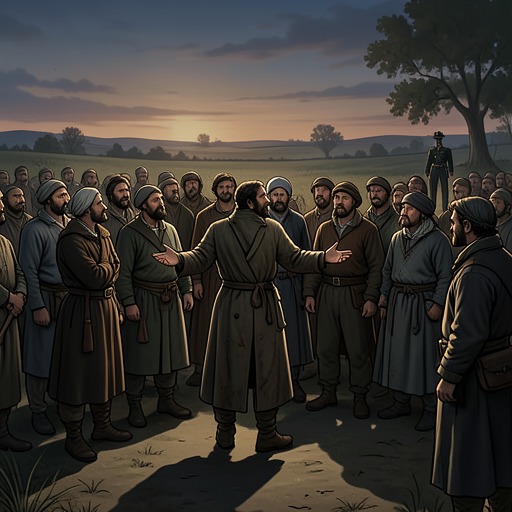
The novel also places these fantastic forms beside collective action in the village. In a public appeal against the manor’s felling of the forest, a speaker addresses Christian people, Poles, farmers, and hired hands as members of a community joined by shared injustice. That political speech is not itself a folktale, but it uses oral address to make a broad claim of common identity, just as Rocho’s stories give listeners shared images of justice, authority, and wonder. The connection remains contested: during a later dispute, Płoszka accuses Rocho of misleading the people and pushing them toward ruin, and another villager alleges that he is setting them against officials. The suspicion shows that oral influence can be politically consequential as well as consoling.
Folk tales and fantastic imagination thus occupy two registers at once. They offer the villagers a vivid imaginative world in which justice, marvel, and sacred purpose can be pictured; they also reveal how stories circulate through communal performance, shape individual feeling, and become entangled with arguments over authority and collective life. Their power lies not in proving that the marvels are real, but in showing how urgently the listeners respond to the possibilities those marvels contain.