Forest-use easement
The PeasantsForest-use easement is the right peasants invoke to use woodland and pasture that the manor treats as its own. In Lipce, the right matters not as an abstract legal term but as a contested condition of livelihood: villagers cite the register, describe the woods as common by easement, and finally confront the woodcutters when the manor begins felling trees. The novel follows the widening gap between a claim that can be stated in court and a customary right the peasants believe they must defend together.
The claim and its limits
A dispute over grazing makes the documentary basis of the peasants’ claim explicit. One speaker insists that the pasturage belongs to them and is clearly entered in the register, while another recalls that the manor’s men drove off the animals and that the pursuit exhausted a cow, which died of inflammation. The complaint links access to the land with tangible losses: the same account reports that Walek’s boy was badly beaten and estimates the lost value at three hundred zlotys. The speaker proposes taking the matter to court or the commissioner, showing that the villagers recognize official channels even as they describe repeated interference with their use of the land.
The novel does not provide the text of the easement or define every use it permits. It does, however, show peasants treating woodland and pasture access as an established right rather than a favor granted by the manor. In court, peasants from Rokiciny protest a timber-theft complaint brought by a bailiff, arguing that the woods are common woodland by right of easement. The judge’s response is procedural: Jacek is told to quiet the courtroom, and the cases proceed one after another. The judgment against the peasants is rejected, and they give notice of appeal. The scene establishes both the existence of a legal vocabulary for customary access and the uncertainty of its practical protection.
Land, livelihood, and competing claims
Maciej Boryna’s reflections in the forest connect rights to a particular landscape and to the landholding claims he counts as his own. Looking over the trees, he thinks of his four morgen there and adds Jagusia’s one morgen to the total. He fears that the manor may wrong them, but his confidence that they will not stand for it sits beside his appeal to divine protection. His claim is personal and measured in land, while the larger village dispute concerns what the manor may do with woodland that peasants regard as subject to their use.
Those competing claims acquire immediate economic force when the squire refuses to hire Lipce men for the felling at Wolf’s Hollow. A villager points to at least twenty hired hands who desperately need work, with frozen potatoes, little money, and a lean preharvest period ahead. People had expected the cutting to provide employment. The refusal is linked to the squire’s anger over a complaint made to the commissioner, so formal protest and loss of work become entangled. One signer vows to stand by the complaint and says that no fir should be cut until the squire reaches an agreement and gives the villagers what they consider theirs. The forest dispute is therefore about access and authority, but also about who bears the cost of the manor’s decision.
From appeal to collective resistance
The conflict intensifies when news spreads that the squire is felling the peasants’ forest. At first villagers doubt the report: the manor has not been cutting there, and mid-March seems an unlikely time to begin. The uncertainty gives way to a call to action. In a public appeal, a speaker addresses farmers and hired hands together, listing perceived injuries, confiscations, failed complaints, and the refusal of employment before presenting the cutting as the last straw. The crowd answers with demands to drive the workers off and stop the felling. The easement has become a shared political claim, one that binds people across differences in occupation and circumstance.
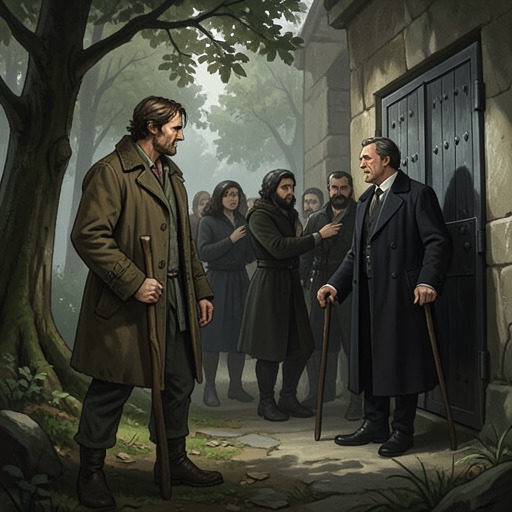
When the villagers reach the clearing, Maciej Boryna rushes forward at their head. Men arrive with sticks, pitchforks, flails, scythes, or branches; the women join with their hands and voices. Their first demand is that the woodcutters leave because the forest is theirs. Boryna then calls on workers from Modlica and Rzepki to listen, making clear that the confrontation is not only between the manor and Lipce: people hired from elsewhere are now cutting the disputed trees. The scene turns the question of who may use the forest into a physical contest over who can enforce that claim.
Collective action beyond the woodland
The same logic of united pressure appears when villagers discuss the possibility of German settlers buying Podlesie. Rather than treating the threatened purchase as an isolated transaction, one proposal is to approach the buyers together and warn them not to proceed. If they do, the villagers propose refusing to let them sow or build and remaining in the fields. This is a planned collective response to a perceived threat to land and local control, not evidence that the forest easement itself governs Podlesie. The distinction matters: the narrative connects woodland rights to a wider politics of access and solidarity without making every land dispute an identical legal claim.
Forest-use easement thus operates on several levels. It gives peasants a language for challenging dispossession in court, marks the difference between recorded or customary access and the manor’s power to control the trees, and supplies a shared justification for resistance when appeals appear ineffective. The forest is at once a resource, a livelihood, and contested ground; the villagers’ insistence on calling it theirs exposes the distance between a right they believe they possess and the power needed to make that right effective.