Gendarmerie
The PeasantsThe Gendarmerie enters village life as both an instrument of official demands and a source of apprehension. Its members enforce orders, investigate incidents, and pursue information about Rocho’s teaching, yet their authority meets resistance: a crowd of women can drive them back, villagers can refuse the resources demanded of them, and a payment to a gendarme brings promises rather than security. Across these episodes, the force is present but not all-powerful, and its reach is experienced through encounters that leave villagers uncertain about what protection or justice it can provide.
Official demands and village resistance
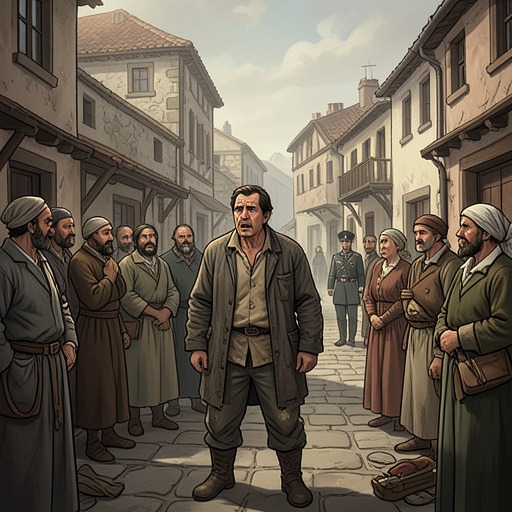
When officials require twenty carts and workers for compulsory road repairs in the forest, the Gendarmerie appears alongside the Voyt. The work is being ordered because a notable is expected to travel that way and the potholes are to be fixed. The women’s refusal is specific: they will provide neither horses nor carts. The demand thus makes state authority visible in the village not as an abstraction but as a claim on local labor and property.
The confrontation also shows that enforcing such a claim depends on cooperation from village authorities. The Voyt tries to explain the order and restrain the women while the gendarmes withdraw cautiously toward the pond, then go on toward the mill. The Voyt follows, still commenting and threatening boys who have begun throwing mud. The Gendarmerie leaves the immediate crowd, but the scene does not establish that the villagers’ refusal has been overcome. Instead, it reveals a limit: the force can appear with an order, yet a united group can make carrying it out difficult.
Investigation and the limits of protection
In a separate incident, the Voyt arrives with another local official to inspect what has happened and question Józka. The party suspects that the household may have been frightened off without anything being taken. A bloody iron rod is then found, and the Voyt says the Gendarmerie must be told because Burek has been harmed. The rod gives the disturbance a material trace, but the evidence does not identify who was responsible. The episode presents the force as the next recourse in an unresolved investigation, not as an authority that has already determined the culprit.
The hope attached to that recourse is sharply qualified elsewhere. A villager reports having given a gendarme three roubles in connection with a horse and receiving promises in return. The exchange does not secure the outcome he wanted; he instead describes life as a state of constant fear and says there is no security to be had. The episode records a specific payment and its disappointing result, without establishing what the gendarme promised or whether any action followed. In the villagers’ experience, access to an official can therefore coexist with distrust: contact has been made, but protection remains uncertain.
Antek’s detention and feared punishment
The Gendarmerie also figures in the news Hanka receives about Antek’s imprisonment. A visitor says that, according to what he managed to learn from a gendarme, Antek will not be released before his case. Hanka had understood that a lawyer thought release might be possible; she reacts with shaking and asks why the expectation has changed. The report presents the gendarme as a source of information about the authorities’ position, while making clear that Hanka receives the news second-hand.
The same visitor warns that Antek may be sentenced severely, perhaps to ten years, and claims that the authorities will not release him because he might run away. Those statements are predictions and explanations offered by the visitor, not a recorded judgment or a direct account from the Gendarmerie. Their effect on the household is nonetheless immediate: Hanka’s hope of his return before trial is shaken, and imprisonment becomes a looming uncertainty rather than a settled term. The episode shows how the force’s power reaches beyond an arrest into the family’s expectations and fear of what the case may bring.
Surveillance of Rocho and Polish teaching
The Gendarmerie’s attention to Rocho extends its role from enforcing immediate orders and handling incidents to monitoring local instruction. At a village discussion about the children’s need for a school, the Soltys recounts being questioned closely by a gendarme at the chancellery about Rocho. The official, according to this report, already suspected that Rocho was teaching children and distributing Polish books and newspapers. The Soltys says he disclosed little, angering the gendarme, and warns that Rocho should be cautious.
The exchange places education under scrutiny without showing Rocho being arrested or the teaching being stopped. Grzela responds bitterly to the suggestion that fear should lead the villagers to give Rocho up. The force’s pressure therefore becomes part of a local argument over how to protect both the children’s learning and the person teaching them. Taken together with the crowd’s refusal of road labor and the uncertain results of seeking help, the episode gives the Gendarmerie a consequential but contested presence: its questions can make a village wary, while villagers still debate whether they will comply, resist, or keep information from its officers.