German settlers of Podlesie
The PeasantsThe German settlers of Podlesie enter the story as buyers of an estate whose sale threatens to place a large tract of land beyond the reach of the crowded villagers of Lipce. Their arrival turns an anxious rumor into a visible conflict: the villagers see new occupants with the means to acquire land, while they themselves face poverty, limited acreage, and uncertain work. The settlers remain largely a collective presence rather than individually developed characters, but their purchase gives concrete form to the village’s fear of dispossession and to its struggle over who may claim the land.
Arrival and the proposed purchase
The first sight of the newcomers is a group of five yellow-and-blue britchkas with iron axles and linen canopies. Women sit among farming tools, and ten German men drink at the inn bar. Their sturdy appearance, good food, and silver chains sharply contrast with the precarious circumstances of many Lipce residents. The villagers gather nearby and watch, but struggle to understand the conversation. Mateusz the Young Villager can communicate with the Jewish innkeeper, and Grzela, the Voyt’s brother, speaks some German; their efforts to learn what the visitors intend make language itself part of the scene’s division between newcomers and residents.
After the Germans leave, the Jewish innkeeper tells the farmhands that the visitors have nearly bought Podlesie and plan to establish a colony of fifteen families at the grange. The prospect sounds especially threatening because the villagers feel compressed onto their narrow strips of land, while the newcomers appear poised to occupy hundreds of morgen. The Germans’ landholding is therefore not an abstract transaction: it offers a visible contrast between the settlers’ prospective acreage and the villagers’ scarcity.
Debt, price, and the manor’s position
Grzela’s investigation uncovers the financial pressure behind the proposed sale. The Squire owes one of the German buyers fifteen thousand roubles and cannot repay the debt. The creditor wants to take Podlesie against the amount owed and pay the balance in cash. The Squire appears willing to accept, but is also seeking other buyers because the German offer is only sixty roubles per morgen. He delays while trying to improve his position, yet his other financial difficulties narrow his choices: the estate is burdened by debts, its cows are already marked for tax, and a lawsuit prevents the cutting of timber that might otherwise provide money.
This account places the settlers within a transaction driven by the estate’s insolvency, not simply by an announced plan to displace Lipce. Yet the villagers experience the sale through its likely consequences for their own access to land and security. Their anger is intensified by the perception that the Squire may be forced to sell at a low price while they lack the resources to compete. The contrast between a creditor able to claim an estate and residents who can only complain makes economic power part of the conflict from its beginning.
The village confronts the settlers
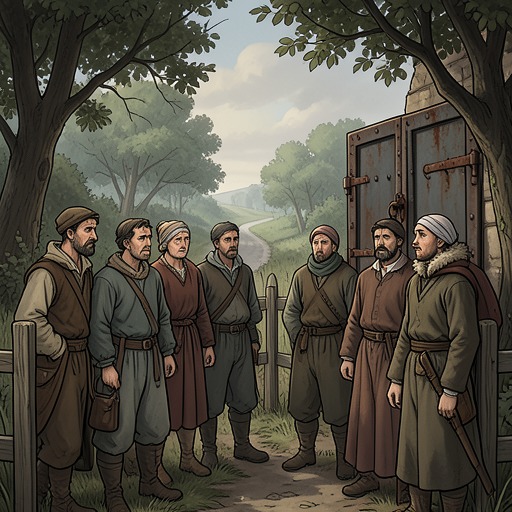
The village’s concern becomes collective action when a group of Lipce men goes to Podlesie. They find the grange’s buildings and cottages charred and ruined, with a burned orchard surrounding collapsed roofs and broken chimneys. The German settlers are nevertheless living there: they sit outside in shirts, drinking beer from clay pots, while children play and cows and horses graze nearby. The men approach across the parched ground. The settlers rise to face them, and the two groups stand opposed in tense silence as women watch from windows, children retreat indoors, and large dogs growl by the walls.
Rocho speaks for the village in Polish, asking the settlers not to buy Podlesie. The villagers echo him and beat their sticks, presenting the appeal as the will of the whole community rather than an individual objection. The German response makes clear that this request comes too late, or at least that they do not accept the villagers’ authority over the purchase: they declare that they have bought the estate, that it belongs to them, and that it will remain theirs. Grzela answers by demanding that they keep their hands off the villagers’ land. The exchange changes the dispute from rumor and negotiation into an open confrontation over competing claims of ownership and need.
Land conflict and narrative significance
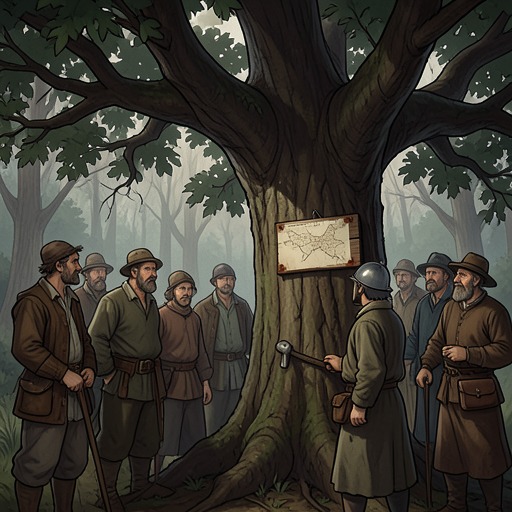
The settlers’ presence intersects with the wider conflict between Lipce and the manor over land, forest, and livelihood. At a village gathering, Antek Boryna calls the assembled Christian Poles, farmers, and hired hands to account for the manor’s felling of the forest and refusal to employ Lipce men. He presents these injuries as part of a long history of complaints and confiscations, culminating in the cutting of what the villagers call their wood. That speech is not directed at the German settlers, but it establishes the larger conditions in which the Podlesie sale becomes explosive: residents who already feel denied work and rights understand another transfer of land as an added threat.
The settlers also sharpen a question raised by the novel’s wider political frame: how a scattered, formerly subordinated peasantry might become a political community. The villagers’ appeal at Podlesie invokes the whole village, while their objection rests on the material pressure of inadequate land and the suspicion that powerful owners and creditors decide its future without them. The newcomers are not given a comparable collective argument or an interior viewpoint; they appear through their arrival, their occupancy, and their insistence on ownership. This limited presentation keeps attention on the villagers’ encounter with a purchase they cannot control, while making the boundary between legal title and communal need the central stake of the confrontation.