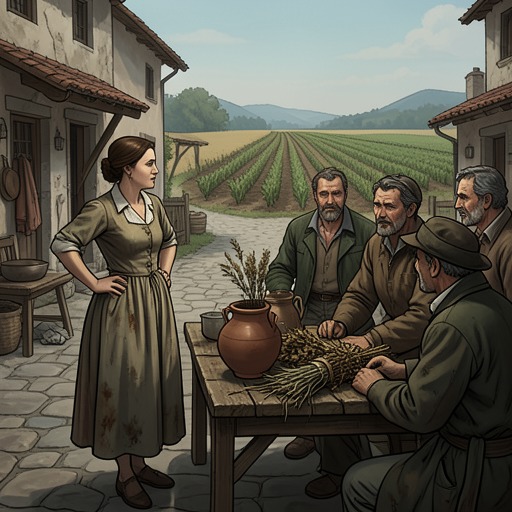
Hanka takes charge of the farm
The PeasantsHanka Borynowa’s takeover of the farm during the men’s absence changes both the household’s balance of power and her own standing in Lipce. Previously timid and betrayed by Antek Boryna, she steps into the place left by Maciej Boryna and Antek, protects the estate from those seeking to profit from it, and becomes a visible example of women’s capacity to sustain village life when its customary male authorities are gone.
The Men’s Absence and the Farm
The temporary absence of men from Lipce leaves land lying idle and unsettles social relations organized around male authority. In that disruption, Hanka does not hesitate to take up the place left by Maciej Boryna and Antek. Her responsibility is not merely domestic: she confronts Michał the blacksmith, who is preying upon Maciej Boryna’s estate. The farm becomes a test of whether its affairs can be maintained without the men who had occupied the leading positions in the household.
A Changed Bearing
Hanka’s new authority is accompanied by a marked change in her appearance and personality. She becomes physically stronger and more self-confident, while remaining self-controlled and precise in speech. Jagustynka remarks, “You’ll be at war again!” Hanka answers calmly, “M’dear, warfare’s all I live by!” The exchange makes her readiness to face conflict sound less like a passing outburst than a settled capacity to defend what has been entrusted to her.
Recognition in Lipce
The change in Hanka’s conduct alters how the village sees her. Women who had thought she would not “say boo to a goose” now observe that “she manages as well as a man.” Their assessment registers a reversal in status: the quality once associated with weakness gives way to recognized competence. Hanka’s authority does not come through a formal appointment; it is established in the practical work of managing the crisis and facing the people who would take advantage of the household’s vulnerability.
A Wider, Fragile Possibility
Hanka’s emergence belongs to a broader, temporary reordering of village life during the men’s absence. The disruption activates forms of mutual aid, including material support for Szymek Pacześ when he leaves his mother’s house and marries a much poorer girl. Hanka’s relationship with Jagna Paczesiówna also briefly softens: despite their fundamental conflict, there are moments when the two women feel sorry for one another and might have talked amicably. These changes suggest that women’s authority and mutual support can grow under altered circumstances, but the possibility remains fragile; it is tied to the men’s absence rather than established as a lasting new order.