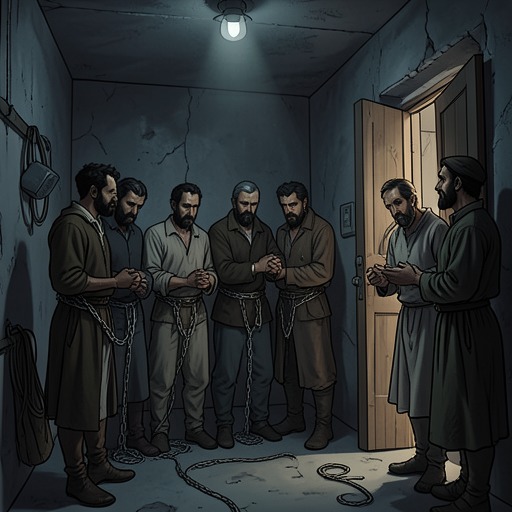
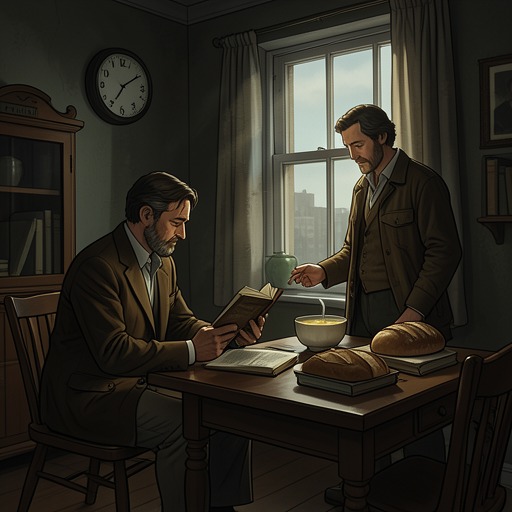
Hanka visits Antek in prison at Easter
The PeasantsHanka’s Easter visit to Antek Boryna in prison turns a journey of marital devotion into a painful encounter with estrangement. She goes carrying blessed food and money, having sustained the farm while the men were imprisoned, and hopes for her husband’s affection as well as news. Antek is in good spirits and accepts what she brings, but his coldness toward her exposes the emotional cost of her loyalty. Hanka keeps her hurt concealed until she is home; then, exhausted and alone with it, she breaks down.
The journey and its purpose
The visit follows Hanka’s work of managing the household and farm during Antek’s imprisonment. Her preparations are practical and intimate at once: she orders the horses readied and sets out with a bundle of blessed food for her husband so heavy that she can barely lift it. The food carries the observance of Easter into the prison visit, but it also makes visible the care she has continued to give Antek across their separation.
The horses are already waiting outside when Jagustynka arrives, breathless. Her arrival catches the urgency of the departure, while Hanka’s bundle and journey show that she is making a determined effort to reach her husband. This is no visit made from ease: Hanka has been working beyond her strength to maintain the farm, and the trip adds to that burden. Yet she goes with a faithful, loving heart, hoping to recover some closeness with the man for whom she has labored.
News from the prison
Antek tells Hanka to send his greetings, and she reports that he is well and in good spirits. She has sat with him through the afternoon and has also seen the other imprisoned men. They are to be released, she says, though nobody knows when. She has gone as well to the man expected to defend Antek in court, evidence that she is attending not only to his immediate comfort but also to his legal situation.
The news offers a prospect of release without a date or certainty. Hanka brings back information, but the conversation with Rocho reveals that she has not told him everything pressing on her heart. She gives other news and avoids speaking of Antek’s treatment of her. Her silence lasts until she suddenly begins to weep, covering her face with her hands even as tears slip through her fingers. The journey has brought her physically to her husband, but she returns unable at first to explain how far apart they have become.
A painful reunion
Antek receives the blessed food with relish and takes the dozen zlotys Hanka has brought, without asking where she obtained the money. These concrete acts of acceptance are set against his failure to offer the care she had hoped for. He does not ask after the children, though she is their mother and his wife, or show concern for her health after her long journey. To Hanka, his manner makes him seem like a stranger, and makes her feel treated as one.
When she tells him how the farm is being run, Antek does not praise her efforts. Instead, he reproaches her on several points. He asks about the village but not about the children, and listens to her account with little attention. Hanka has gone to him longing for affection and comfort after laboring for his good; the encounter gives her neither. When her distress finally shows, he rebukes her for bringing her weeping to him. His response turns the visit from a hoped-for reunion into a fresh humiliation.
Grief held back until home
Hanka does not let herself collapse before Antek or on the journey back in front of other people. Only after she has returned, lain down with the children, and found a private moment does she surrender to the grief she has contained. She presses her head into the pillow so as not to wake them, and her body shakes with weeping, grief, humiliation, and a sense of injustice. Her restraint has not lessened the hurt; it has postponed its release until she is beyond the public demands of the visit.
Her anguish is sharpened by the imbalance between what she has given and what she receives. She has worked beyond her strength for the farm, made the journey, brought food and money, and come hoping for tenderness from her husband. In return she receives criticism, indifference to the children, and no word of comfort. The episode makes clear that Antek’s imprisonment is not the only separation shaping their marriage: even in the face-to-face visit, Hanka’s devotion meets a husband who does not respond to her emotional needs.
Significance within the Easter setting
Easter lends the journey a language of blessing, food, and renewed communal life, but the visit offers Hanka no corresponding restoration of intimacy. The blessed food is welcomed at the prison, yet the care embodied in it is not returned as tenderness. The sharp contrast is between the visible, practical forms of Hanka’s devotion and Antek’s failure to recognize their personal cost.
The scene also marks the limits of the role Hanka has taken on. She can keep the farm functioning, carry news, bring money, and sustain her obligations as wife and mother, but she cannot compel Antek to value that labor or answer her longing. Her delayed tears give the episode its decisive turn: outwardly she completes the visit and makes the return journey, while privately she recognizes how alone she feels within the marriage. The Easter encounter therefore joins the story’s concerns with household survival and separation to the quieter injury of affection withheld.