Harvest and the seasonal cycle
The PeasantsIn Lipce, the seasonal cycle is not a decorative backdrop but the measure of livelihood, labor, and communal time. Autumn’s gathering, winter’s assault, spring’s urgent demand for cultivation, and summer’s harvest repeatedly alter what people can eat, how they work, and whether they can look ahead with confidence. The land is at once a source of abundance and a force that will not wait for human troubles to pass: its crops must be tended in season, even when poverty, imprisonment, illness, or conflict have left the village short of hands.
The Seasonal Rhythm of Work
The cycle is visible in the shift from one demanding task to the next. During the cabbage harvest, Lipce’s roads and yards are nearly empty because people are working in the fields. Cabbages fill threshing floors, hallways, and rooms, rising in places to the eaves, while large barrels soak in the rain outside the cottages. The swollen pond overflows its banks onto the low road beside Boryna’s property, reaches the fences, and sends foam against cottage walls. The harvest brings a communal glut of produce, but it does not suspend the weather: rain and rising water shape the work and press against the built edges of village life.
Soon after St Barbara’s Day, the weather turns with sudden force. Winds strip and maul the remaining snow, snatch at thatched roofs and fences, and give way to dark clouds and gales. By morning, the snow lies ravaged in scattered patches and the frozen roads are stiff beneath a hard frost. This transition marks more than a change in scenery. The seasons impose their own pace, moving Lipce from autumn’s gathering into a winter that threatens homes, roads, and subsistence.
Spring brings a different pressure. As the water subsides and the fields dry, the earth is ready for ploughing and sowing; gardens need planting, potatoes must be sorted, and water drained from the land. Livestock also reproduce and require care: cows calve, poultry hatch, and sows farrow. The return of growth is therefore not effortless relief. It creates a dense calendar of work at precisely the moment when the village’s ability to meet that demand is most strained.
Labor, Scarcity, and Unequal Burdens
The seasonal economy makes the consequences of absent workers tangible. While men remain imprisoned after the forest conflict, the women left in Lipce must shoulder fieldwork alongside animal care, cooking, child-rearing, and the daily maintenance of households. The spring account itemizes the competing demands: manure must be lifted and carted, wood split and brought from the forest, feed chopped, gardens planted, and livestock watered. Women who are pregnant or caring for children cannot simply add these tasks without limit. Even after working themselves numb, they have not finished half the jobs, while the fields still require their labor.
Hanka Borynowa’s experience gives this burden a domestic scale. During the three weeks she has been staying with relatives, she describes a household marked by daily shouting and quarrels. The strain of shared accommodation compounds her other worries; when she finally opens up to the organist’s household, she is able to disclose her griefs and troubles for the first time in weeks. Their sympathy leads to a practical offer of spinning work. The moment shows how seasonal and household survival can depend not only on field labor but also on small forms of paid work and assistance between women.
The pressure reaches beyond the families directly affected by imprisonment. Hanka recounts the poverty of Filipka’s household: a daughter is gravely ill from hunger, there are no potatoes left, the family has sold its quilt, and groats must be begged from the miller because no one will lend until harvest. Elsewhere, Florka gives birth while sick and without savings or milk, and her fields stand fallow because Adam is imprisoned. These accounts connect the agricultural calendar to the precarious interval before crops mature. The coming harvest is not an abstract promise; it is the point until which the poor must somehow survive.
Nature as Pressure and Participant
The weather repeatedly changes the conditions under which the village acts. In late May, heat arrives with the force of July. Vegetables wilt, fallow grass is scorched, streams dry up, and potato plants that had begun well barely cover the soil. Winter crops fare better, growing tall enough to obscure the cottages except for their roofs. The contrast shows that seasonal change does not distribute its effects evenly across crops or households: one part of the harvest is damaged while another continues to develop, and the village enters a restless, quarrelsome period under heat, hardship, and preharvest anxiety.
Water, too, has its own narrative force. In autumn, the pond swells beyond its banks; in spring, fields need draining as waters recede. Later, after the announcement of Maciej Boryna’s death, a fine warm rain begins to fall. The rain reaches thirsty crops, drooping leaves, trees, streams, and parched earth. Its arrival does not erase the death that precedes it, but places human loss within a wider natural rhythm of thirst and replenishment. The landscape is not merely an echo of human feeling: its water, frost, heat, and growth materially shape what the villagers can do and what their labor can yield.
Harvest as Communal Labor and Renewal
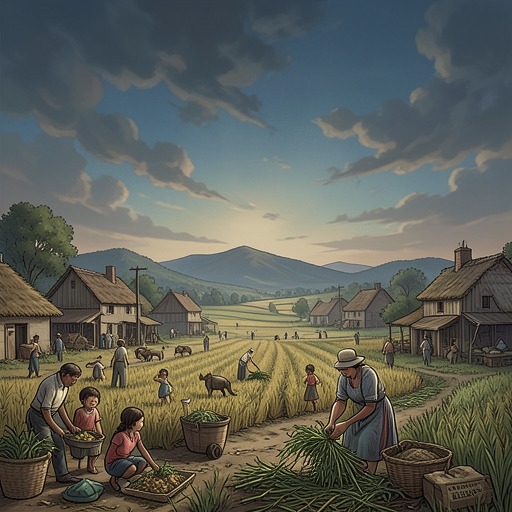
When summer harvest approaches, preparation itself becomes a village-wide undertaking. A couple of days after Rocho’s flight, hayricks are repaired, carts are soaked in the pond, barns are opened and readied, straw ropes are woven, and men peen their scythes. Women bake bread and prepare provisions. The roads and mill fill with people from neighboring villages bringing grain to be ground, though the drought has left so little water that only one gristmill works, and that one barely moves. Even the practical arrangements for harvest reveal how local labor depends on water, tools, food, and traffic between villages.
After a storm, a clear morning sends Lipce out to reap. When the Angelus rings, workers on their plots pause to pray: some kneel, some pray aloud, and others sigh before crossing themselves, spitting into their palms, and taking up their scythes. The prayer is part of the transition into work, not a substitute for it. A solemn silence settles over the fields as labor begins, and people from nearly every cottage work from daybreak until evening. Children, the old, and the sick go out too; even dogs break away from their tethers and follow. The harvest joins household labor into a common scene, while each worker remains bent over an individual strip of land.
The contrast with Dominikowa’s neglected fields is stark. Rye spills grain and crops wilt in the drought, yet no one appears to reap them; villagers look on with anxious sadness before turning back to their own work. The wider harvest proceeds through collective effort, but that shared rhythm does not mean every field is cared for. As grain is tied into sheaves and stacked on the strips, carts carry it home, straw spills across roads and yards, and threshing begins in the barns. Rye gives way to oats, barley, and wheat, so that successive crops keep labor moving even when the workers are exhausted.
The cycle finally changes the village’s outlook. Once the barns are full and grain abundant, the time of scarcity has passed; even the poorest can raise their heads and look toward the future with confidence. This ending gives harvest its material and social significance. It is the result of strenuous work coordinated across households, but it is also a seasonal reprieve on which the whole community depends. In Lipce, renewal arrives not as an escape from labor, but through labor performed at the land’s appointed time.