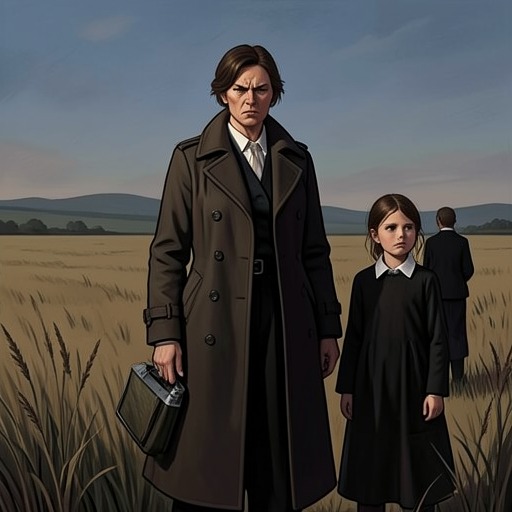
Jędrzych
The PeasantsJędrzych is Dominikowa’s younger son, the younger brother of Szymek and brother of Jagna. In a household governed by his mother’s strict authority, he moves between obedient domestic labor, anxious efforts to manage family conflict, and acts of solidarity that test the boundaries she has imposed. His eventual help in establishing Szymek’s farm contrasts with the neglected work at home and exposes how a family’s labor and land can be divided by old grievances.
Identity and Household Role
Jędrzych belongs to a family whose daily life is shaped by seasonal work, debt, and Dominikowa’s command. As winter approaches, Lipce households argue over what to sell and how to meet taxes, communal contributions, debts, and payments to servants. The pressure gives ordinary farm tasks particular weight: livestock and provisions must be managed even when ready cash is scarce. At Dominikowa’s, Jędrzych patches a roof leaking in several places while Jagna and Szymek work in the cabbage fields. When they return in the evening, he is peeling potatoes as Dominikowa sets supper. He is shown not as a detached observer of farm life but as one of the hands expected to keep its routines going.
Dominikowa’s authority extends well beyond assigning chores. On a visit to the inn, she tells her sons to put on their capotes, warns them against getting drunk, and reminds them that the cows still need attention and the potatoes must be mashed for the pigs. Though Jędrzych and Szymek are physically grown men, both answer timidly and obey her. The narration makes the imbalance vivid: their mother can still discipline them by climbing onto a stool to seize their hair and strike them. Jędrzych’s role in the household is therefore marked by a tension between adult responsibility and a dependence enforced through fear and habit.
Family Conflict and Loyalty
Jędrzych’s concern for Szymek appears most plainly when the brothers’ drinking turns into a quarrel. After Dominikowa has set out to bring her sons home, Jędrzych calls to Szymek in tears, warning that their mother is coming. The old woman and Jagna soon catch up and find the brothers under a fence, close to wrestling and rolling in the mud. His appeal is practical and urgent: he tries to stop the situation before their mother arrives, even though the scene ends with her gathering both sons herself.
His loyalties later become more consequential. Szymek, now establishing a homestead, does not ask the neighbors for help with ploughing, and is puzzled when a cart arrives. Jędrzej is driving it and offers to show where to plough. When Szymek asks whether the decision was his own, Jędrzej admits that he had wanted to help earlier but had been afraid: Dominikowa was watching him, and Jagna had warned him against it. He works alongside Szymek for the whole day and promises to return the next morning; he does. Szymek notices bruises on his cheeks, though Jędrzej does not explain them. The episode establishes both the cost of acting independently and the persistence of his attachment to his brother. Where the household’s authority had kept him from helping, his work now helps Szymek make a farm of his own.
Independence, Marriage, and Resentment
The same conflict between obedience and self-assertion surfaces around Szymek’s wedding to Nastusia. On the morning of the wedding, Jędrzych cautiously tells Dominikowa that he is leaving and reminds her that Szymek is marrying that day. She answers with a mocking laugh, says she is thankful the wedding is not his, and threatens him if he gets drunk. Jędrzych mutters that he will do so on purpose and runs across the village to Mateusz’s cottage. The exchange does not show him escaping his mother’s control; it shows how resentment finds an outlet in defiance, even when that defiance takes the form of a threatened drunken evening.
Jędrzych also carries information across the household’s relationships. When Mateusz discusses Dominikowa’s plan to take Jagna’s land dispute to court, he reveals that Jędrzych had told Nastusia about the plan in confidence. The detail places Jędrzych within the circulation of private family news, but the evidence does not make him the author of the lawsuit or a participant in its resolution. His significance lies instead in the way he connects people living through the family’s disputes, sometimes cautiously and sometimes against his mother’s wishes.
The Farm’s Decline and His Ending
As Dominikowa grows half-blind and struggles to manage the farm, Jędrzych increasingly spends his time at Szymek’s. The consequences at home are concrete: cows are sometimes driven out unmilked, pigs squeal for food, and horses chew at empty hayracks. Work accumulates in the fields and around the buildings—manure needs ploughing in, flax needs picking, potatoes need weeding, and fuel is short. Dominikowa hires a woman as a laborer and rushes about herself, but Jagna ignores her appeals and Jędrzych does little to restore the household’s former order.
Instead, he answers one of his mother’s threats by reminding her that she drove Szymek away. Jędrzych deliberately uses his brother’s success to taunt her: Szymek has a house, money, a wife, and a cow, and has become a proper farmer. The contrast turns Jędrzych’s earlier, fearful help into a rebuke. Szymek’s separate household now demonstrates what his mother’s authority could not prevent, while the original farm deteriorates under the strain of estrangement and neglected labor. Jędrzych’s ending is not a declared departure or a fully achieved independence of his own; it is a withdrawal toward his brother and a pointed refusal to treat the family rupture as forgotten.