Jagna Paczesiówna
The PeasantsJagna’s marriage to Maciej Boryna and her affair with Antek Boryna make her the center of a family romance that runs alongside Lipce’s struggle over the forest. Yet she is more than the object of those conflicts. The novel presents her as a beautiful, strong, wealthy woman whose indifference to property, marital obligation and religious decorum unsettles the values that hold the village together. In the narrator’s imagery, she resembles the earth itself: powerful and sacred, but also moved by forces that no one can command.
Identity and independence
Jagna belongs to a well-connected family headed by her mother, Dominikowa. Her father is dead, and the household’s matriarchal arrangement gives Jagna an unusual degree of freedom. Her brothers obey their mother’s commands, including work commonly assigned to women, while Dominikowa is portrayed as intelligent and respected. Jagna’s independence therefore has a material and familial basis: she is wealthy, has a strong mother behind her, and is not dependent on a husband for her place in the household.
Her physical presence reinforces that distinction. She is as tall as the tallest men, and when her brother struggles with a load, she takes the bundle from him and carries it to the cart herself. She also has an aesthetic sense and artistic talent. To Kuba, her beauty makes her look like “a picture,” an image that recalls the Częstochowa Mother of God. This comparison sets up a tension that runs through her portrayal: she can appear almost sacred to observers, even as her desires and choices defy the community’s sacred rules.
Jagna’s freedom is not simply a matter of youthful conduct that marriage will end. Even after marrying Maciej Boryna, she refuses to have her hair cut and withholds sexual relations from him. The narrator notes that she has liaisons both before and after the marriage, yet does not become pregnant. These details distinguish her from a character whose life is entirely organized by marriage, motherhood and property transfer. They also place her independence within the constraints of the village: her choices are visible, discussed and judged by others.
Marriage, property and desire
The novel’s central family plot links Maciej Boryna’s marriage to Jagna with Jagna’s affair with Antek Boryna, his son. That triangle brings sexual desire into direct conflict with the household and inheritance arrangements through which land and family authority are maintained. Jagna’s response to property makes the conflict especially sharp. When Dominikowa insists on the importance of land, Jagna replies, “Land, land – that’s all you’ve got on the brain: it’s as much as nothing to me”. The line does not argue for a rival system of ownership; it reveals her lack of reverence for the principle that governs so much of village life.
That disregard becomes a decisive gesture during her quarrel with Hanka Borynowa. Jagna throws down the settlement that entitles her to six morgen of land. For Hanka, the document represents substantial security; Jagna treats it as something she can discard. Hanka is shaken by the gesture, unable to understand how anyone could toss aside such a valuable portion of fields. The contrast exposes two different relations to property: for Hanka, land is consequential and material; for Jagna, its claim on her is weak. Her action therefore unsettles not only a personal dispute but the assumption that land must command obedience and shape a woman’s choices.
The earth, the sacred and transgression
The narrator’s extended comparison of Jagna to the earth gives her an almost mythic dimension. Her soul lies in unknown depths, immense but unaware of its immensity, powerful yet without a settled will. Like the earth, she is awakened by spring and carried by changing forces; like the earth, she creates and destroys. The passage ends by insisting that “as this earth was holy, so was Jagna’s soul”. This language does not make her a conventional moral exemplar. Instead, it places her beyond ordinary realist description, as a force whose natural vitality cannot be reduced to the village’s rules.
That sacred imagery sharpens the contradiction at the center of her role. In the novel’s social order, land and religion are foundations of what is treated as holy. Jagna disrupts both, not by laying out a political critique, but through impulsive acts that disregard their authority. The settlement thrown at Hanka’s feet violates the obligation attached to land; Jagna’s attraction to Jasio, the organist’s son and a future priest, draws a figure marked for religious service into human desire. The episode makes her challenge especially threatening to an order that would separate sacred vocation from sensual life.
Community reaction and ending
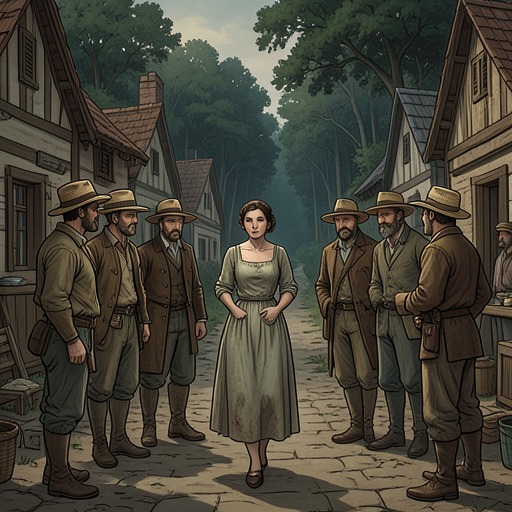
The community’s response is presented as more than a straightforward judgment of personal wrongdoing. Jagna’s repeated transgressions disturb the social order on several levels, and the collective reaction works as a corrective: it seeks to make her harmless and contain the disruption she represents. In this reading, she is not simply removed as an outsider. She remains part of the social organism even as that organism turns against her, an internal test of how the village defends its boundaries.
By the end, Jagna is left with Dominikowa, battered, ill and incapacitated, but alive. The ending preserves both the cost of the community’s response and the possibility that it has not settled her future. The suggestion that she may, after recovering, succeed Jagustynka is explicitly uncertain: a possible turn from desecration toward speaking openly, rather than a completed transformation. Jagna’s trajectory thus leaves the village’s conflict unresolved in human terms. The force it has tried to suppress survives, though in a severely damaged state.