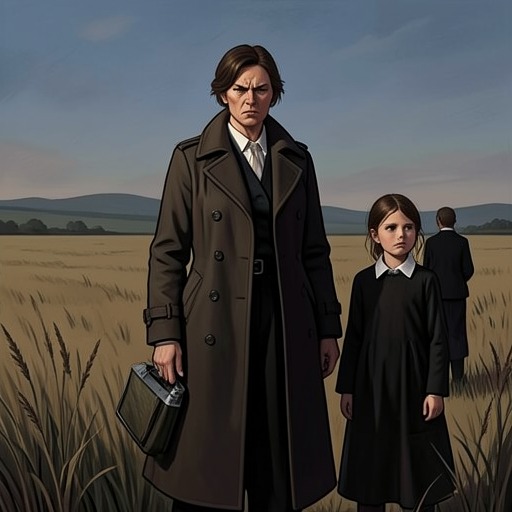
Jagna and Dominikowa
The PeasantsJagna and Dominikowa’s relationship is defined by a tenderness that does not dissolve under pressure: as Jagna prepares to marry Maciej Boryna, her mother tries to protect her through advice, prayer, and practical vigilance, even while grieving the change in their life together. The wedding makes that intimacy visible to the village, where the mother’s repeated embraces are mocked even as Jagna’s new position as mistress of a substantial household draws envy.
A Bond at the Threshold
On the morning of the wedding, Dominikowa watches Jagna sleeping and feels the departure approaching with a mixture of affection and dread. She has wanted the marriage, and believes Maciej Boryna is a good man who will respect Jagna; she also expects her daughter to be able to guide him because he thinks so highly of her. Yet the certainty she tries to summon is repeatedly interrupted by fear. She worries especially about the stepchildren and the anger that may follow the expulsion of Antek Boryna’s family from the homestead.
Dominikowa’s anxiety is not simply about whether Jagna will be happy. The wedding arrangements are already far advanced: the banns have been announced, a hog slaughtered, guests invited, and the settlement placed in a chest. These preparations leave little room to turn back. Dominikowa resolves that, for as long as she lives, no harm will come to her daughter, then rises to hurry the household toward the day’s work. When doubt returns, she kneels at the window and prays until she feels strong enough to continue.
Counsel, Land, and Household Risk
As Jagna dresses, Dominikowa gives advice meant to help her survive her new household. She urges her to respect Maciej Boryna, behave gently toward him, and avoid giving the village fresh material for gossip. Her warning is both moral and material: if Jagna treats her husband carelessly, he might withdraw the land or keep his ready money from her. Jagna answers impatiently that she does not care, but her mother insists that land is the difference between security and a life of poverty as a hired hand.
For Dominikowa, the concern is bound up with a lifetime of effort. She tells Jagna that she has striven for her daughter, and that the village’s constant quarrels and lawsuits are ultimately about land and property. Calling the earth holy, she presents Jagna’s settlement not as a luxury but as protection against dependence. At the same time, the prospect of Jagna’s new position leaves Dominikowa imagining her own loneliness: the boys in her household offer her little comfort, and she expects to be left alone.
Their exchange also exposes a difference in how they judge the conflict with Antek’s family. When Jagna objects that Maciej Boryna acted cruelly in driving them out, Dominikowa counters that Antek himself spoke fiercely against Jagna and wanted to take the land from her. Jagna rejects that account and cannot accept that Antek would have opposed her. She explains that she is not siding with him for bread; she believes he is being wronged because everyone is against him. When her mother suggests that she might hand him the settlement, Jagna cannot answer and retreats to the storeroom in tears. Dominikowa lets her weep, though the possibility that Jagna’s sympathies lie with Antek brings a new vexation to her own heart.
Blessing and Farewell
The wedding departure turns their private attachment into a public ritual. Maciej Boryna takes Jagna by the hand, and the two kneel while Dominikowa takes down a picture, makes the sign of the cross over them, blesses them, and sprinkles them with holy water. Jagna then falls at her mother’s feet in tears before asking forgiveness of the others and taking leave. The women embrace her one after another, and the farewell becomes a shared outpouring of grief. Józia Borynianka is especially moved, remembering her own dead mother.
As the party walks toward the church, Dominikowa keeps looking at Jagna as though fixing her image in memory; she scarcely takes in what anyone says. The details of the departure—her daughter going on foot with the wedding party, the musicians leading, and the church already prepared for the ceremony—give the separation a measured, communal form. Dominikowa’s attention, however, remains fixed on Jagna rather than on the spectacle around them.
Tenderness After the Wedding
At the wedding gathering, Jagna changes into her best ordinary clothes and comes out to receive the guests, but Dominikowa will not let her do anything. She urges her daughter to enjoy herself, holding her close and embracing her again and again through tears. Her tenderness surprises the onlookers because Jagna has not been sent away to follow a man to another village or into hardship. The scene makes clear that the wedding changes their relationship even though the mother and daughter are still together at the celebration: Jagna has moved into her husband’s cottage as mistress of a home with land and property.
The villagers’ response sharpens the contrast between private feeling and public judgment. Some ridicule Dominikowa’s displays of affection; others feel envy now that Jagna’s marriage has secured her a substantial household. Her mother’s grief is not proof that the marriage has failed, but it does register what the new status cannot replace: the closeness of their former life and Dominikowa’s fear of being left behind. Across the wedding morning and celebration, their bond appears as both emotional attachment and practical care, shaped by the same land and household arrangements that make Jagna’s future more secure while unsettling her mother’s.