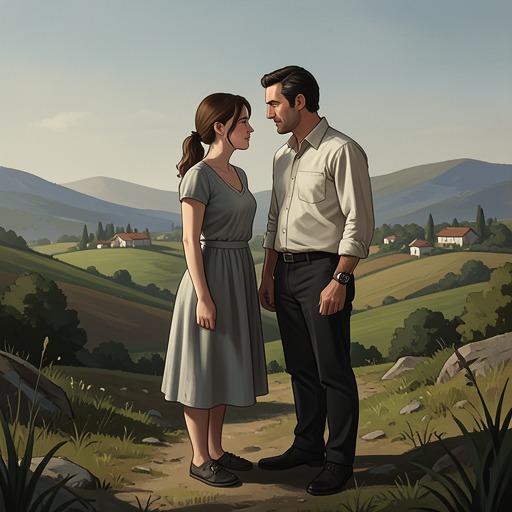
Jagna and Jasio’s confession of love
The PeasantsJagna and Jasio’s confession of love is a brief meeting in a potato field that turns an inward, mutual attachment into an openly acknowledged bond—and then abruptly separates the pair. Its movement from grief to confession, from sacred imagery to public hostility, makes the scene both an intimate declaration and a demonstration of how little privacy or freedom the lovers possess in the village.
Background and Approach
The meeting follows Agata’s burial. During the service, Jagna’s gaze repeatedly distracts Jasio, and he makes mistakes in his singing. As they walk with the coffin, she stays close to him despite the hostile looks of the organist’s wife. He reads Jagna’s sighs and weeping as signs not of grief for Agata but of an injured heart. That reading prompts his resolve to speak with her, though the day’s activity delays him.
The next day, people arrive from distant villages and other parishes for the pilgrimage to Częstochowa. The company is due to depart after a solemn votive Mass, and Jasio is occupied with matters on behalf of The Parish Priest of Lipce. As evening approaches, he takes a book and slips out behind the barns to the baulk beneath the pear tree where he and Jagna have often sat. The book scarcely holds his attention: he throws it into the grass, scans the fields, and moves stealthily through the rye toward Dominikowa’s gardens.
Jagna is there thinning potatoes, unaware that he is watching. She repeatedly straightens with effort, leans on her hoe, looks around with sad eyes, and sighs. Jasio calls her name timidly. She turns pale and stands motionless, scarcely able to believe he is there; then a smile appears on her lips. The scene has begun in secrecy and hesitation, but the recognition between them is immediate.
Confession and Mutual Recognition
Jagna kneels in the furrow and presses close against Jasio’s knees. Her gaze appears to him at once tempting and innocent, a mixture that intensifies his conflict rather than resolving it. Trying to defend himself against the force of the encounter, he lists the sins his mother has told him about Jagna. She listens without lowering her eyes, though she can scarcely attend to the accusations: what matters to her is that the man she has chosen is before her.
Jasio asks insistently whether any of the allegations are true. Jagna denies them with such apparent sincerity that he believes her at once. She then confesses her love quietly and gives herself over to his mercy, as though opening her soul in confession. The scene therefore turns on both a disclosure and a judgment: the accusations have reached Jasio through his mother, but face to face with Jagna he accepts her account. Her trust is not a general declaration to the village; it is an intimate surrender addressed to him alone.
Jasio trembles and tells her to be silent because what she is doing is sinful. Yet his warning does not end the encounter. They fall quiet, avoid one another’s eyes, and remain pressed so close that they can hear each other’s hearts beating and their breathing. Both are happy; tears run down their pale faces as their lips smile. The narration describes their silence through the language of the Elevation and sacred mystery, making their emotional closeness resemble a devotional experience even as Jasio names their desire a sin.
The Walk and the Interruption
At sunset, they leave the field and walk among the baulks, flowers, and ripened wheat. Their hands brush the ears of grain as they pass. The bells ring for the Angelus, while the fields and sky take on the light of dusk. They exchange no further words, but their glances cross; a hymn seems to arise in them without their awareness. The description carries their silence beyond the private field into the open landscape, where their shared feeling is rendered as a kind of inward prayer.
That passage ends when a harsh voice calls Jasio home. His mother stands in their way with an implacable expression. He becomes sober at once, babbles incoherently, and then submits meekly as she takes him by the hand and pulls him away. The change is immediate: the shared, wordless walk gives way to maternal command, and Jasio offers no resistance. Jagna follows as though spellbound, but she is not allowed to accompany him.
The organist’s wife then picks up a stone and throws it at Jagna, shouting contemptuously for her to leave. Jagna looks around without understanding at whom the insult is directed. After the others disappear, she wanders along the lanes for a long time. Returning home after everyone has gone to bed, she sits by the cottage wall until daybreak. The separation thus continues after the lovers are parted: Jasio is taken home, while Jagna is left alone through the night.
Consequences and Significance
The encounter confirms that Jagna’s love is not merely inferred from her looks or grief: she says it directly, and Jasio believes her denial of the accusations against her. His own response remains divided. He calls the attachment sinful, but his trembling, stillness, and shared joy reveal an intimacy that his admonition cannot simply undo. The scene gives the lovers a moment of mutual recognition without giving them a way to secure that relationship against the claims of family and village authority.
Its religious imagery sharpens that tension. The lovers’ silence recalls the Elevation and the Angelus, and their walk is described as if a Mass were taking place within them. Yet the scene does not turn this private feeling into public approval. Jasio’s mother interrupts it, while the organist’s wife’s stone and insult convert village hostility into a physical act. The movement from sacred language to thrown stone makes the contrast concrete: the lovers experience their bond as an inward blessing, but the people around them enforce separation and contempt.
The timing deepens the rupture. Jasio has just taken part in Agata’s burial, and the pilgrimage company is assembling for its departure the following day. In the stillness after the funeral and before the communal religious journey, the confession briefly creates a private world of its own. It cannot last. The final image is not a reconciliation or a promise, but Jagna sitting alone by the wall until morning, after Jasio has been taken away and the village’s hostility has become unmistakable.