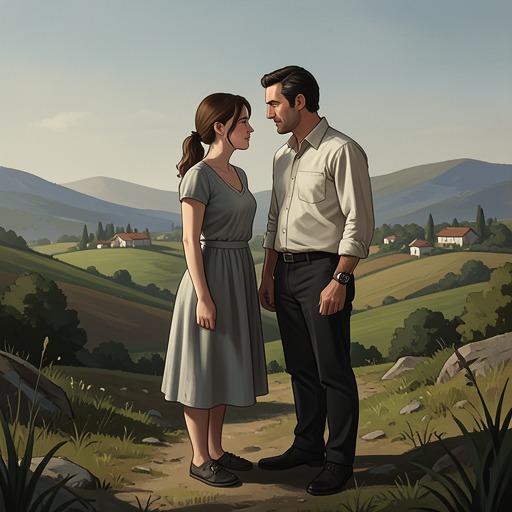
Jagna and Jasio’s love
The PeasantsJagna and Jasio’s love is a fervent attachment shaped by distance, religious imagery, and a sudden interruption. Jagna’s longing gathers around Jasio’s solitary reading in the fields until she confesses her love to him; for a short time they share a rapturous silence that seems to lift them above ordinary life. Their encounter ends not in resolution but in separation: Jasio’s mother takes him home, while the organist’s wife drives Jagna away with a stone and an insult.## Longing at a DistanceJasio’s mother rebukes the young man for sitting and grinning among the women and sends him to the garden, saying that this is no place for him. As usual, he takes his book out into the fields, beyond the village, where he reads or reflects alone beneath pear trees or on the raised boundaries between plots. His familiar retreat gives Jagna a map of his solitude. She knows where he goes and how she might reach him, even if, at first, that access exists chiefly in her imagination.Jagna’s desire is represented as a force she cannot master. She circles Jasio like a moth drawn to a candle and imagines herself carried away by rushing waters into a world of happiness. The image conveys both the attraction’s intensity and its peril: she abandons herself to the current without considering where it may take her. Her longing is not an occasional impulse. At night and again in the morning, a single hope occupies her thoughts: that she will see him again.The distance between them therefore has two forms. Jasio repeatedly withdraws into the open country, while Jagna remains emotionally close to him, tracking his haunts and anticipating another encounter. The evidence does not make that pursuit a series of confirmed meetings; it shows, instead, how thoroughly the possibility of seeing him has taken possession of her attention.## Love Seen Through Sacred ImageryAt Mass, Jagna watches Jasio dressed in white, slender and beautiful, standing with his hands pressed together amid incense, smoke, and colored light from the windows. She sees him as though a living angel had stepped down from a holy picture and were coming toward her. The vision belongs to her experience of desire rather than to an actual supernatural event: the church’s familiar ritual gives her a language in which to understand the intensity of her attraction. She presses her lips to the place where his feet have passed, a gesture that makes her longing resemble worship.The sacred imagery returns when the two are together in the fields. Kneeling in a furrow and holding Jasio’s knees, Jagna looks at him with an expression the narration describes as at once tempting and childlike. Jasio shudders and tries to defend himself from what feels like a spell. He begins listing the sins his mother has told him about Jagna, bringing the judgment of the household into the encounter. Jagna listens without lowering her eyes, but the accusations scarcely register: she is absorbed in the fact that Jasio is before her and that she is kneeling as if before a saint.His appeal for her to tell him the accusations are untrue meets an immediate denial. Jagna answers with such apparent sincerity that he believes her. She then confesses her love, opening her soul to him as if at confession and surrendering herself to his mercy. The scene makes their intimacy both erotic and devotional. Her posture, confession, and appeal for mercy borrow the forms of religious submission, while the physical closeness and Jasio’s trembling keep the encounter rooted in bodily desire.## A Shared RaptureThe first response from Jasio is resistance: he wants to push Jagna away and run, but can only tell her to be quiet because it is a sin. His warning marks the moral boundary he recognizes, even as his inability to act decisively reveals his own disturbance. Jagna falls silent, drained; neither speaks, and both avoid the other’s eyes while remaining pressed close enough to hear each other’s hearts and breathing. Their shared happiness is conveyed through physical detail before it is explained: trembling, closeness, tears, and smiling lips.The scene then expands beyond the pair. At sunset, the earth glows with dew, the bells ring for the Angelus, and the fields hold the quiet of evening. Jagna and Jasio walk along flowered field boundaries and through ripened wheat, their hands dangling among the ears of grain. The landscape does not merely surround their meeting; it gives their feeling its scale. They seem haloed against the golden sky, and the narration describes their silence as if a Mass were taking place within them. Their shared rapture is private, but the imagery makes the whole countryside appear to participate in it.They do not speak as they walk. Their glances meet, while the hymn that seems to rise from within them carries across the fields and out into the wider world. The lovers themselves are described as unaware of where they are going or why. This loss of ordinary orientation echoes Jagna’s earlier image of being borne away by a current: desire suspends practical judgment and direction. The scene’s religious language intensifies that suspension, turning a walk through working fields into an experience they perceive as benediction.## Interruption and SeparationThe spell breaks when a harsh voice calls Jasio home. His mother is waiting on the poplar road with an implacable expression. He becomes sober at once, babbles incoherently, and offers no resistance as she takes him by the hand and pulls him away. The change is abrupt: a moment ago the two seemed enclosed in a world of shared devotion; now maternal authority restores the household boundary and removes Jasio from Jagna’s side.The rejection then becomes public and physical. Jagna follows as if still spellbound, but the organist’s wife picks up a stone and throws it at her, shouting an insult and ordering her back to her kennel. Jagna looks around in confusion, not understanding at first that the words are directed at her. The contrast is stark: the lovers’ passage through the dusk has been rendered as silent, golden, and almost sacred, while the return to village life brings a stone, a shouted slur, and an unmistakable expulsion from the scene.Jagna wanders along the lanes after the others have disappeared. When she returns home and finds everyone asleep, she sits by the cottage wall until daybreak. Her night-long vigil is the encounter’s final image, set against the intimacy and movement of the walk with Jasio. The available scene establishes no lasting union or reconciliation: Jasio has been taken away, Jagna has been publicly attacked, and she remains awake and alone.## The Relationship’s SignificanceThe relationship is defined by a tension between inward intensity and external constraint. Jagna’s longing is sustained even when she does not meet Jasio; when they do come together, her open declaration is answered by his trembling, hesitation, and insistence that their intimacy is sinful. Their feelings are therefore not presented as a settled partnership. They appear as a moment of mutual rapture caught between Jagna’s surrender and Jasio’s moral alarm, and between the lovers’ private world and the authority of his mother and the hostility of the organist’s wife.Religious language provides the scene’s central contrast rather than a simple judgment on their desire. Jagna’s devotion makes Jasio resemble an angel and their walk resemble a Mass, yet Jasio himself names the encounter a sin. The narration holds those registers together: the lovers’ experience feels sacred to them, while the social and moral world around them refuses to leave it untouched. The ending returns desire to its vulnerable human circumstances—family control, public contempt, and Jagna sitting alone until morning.