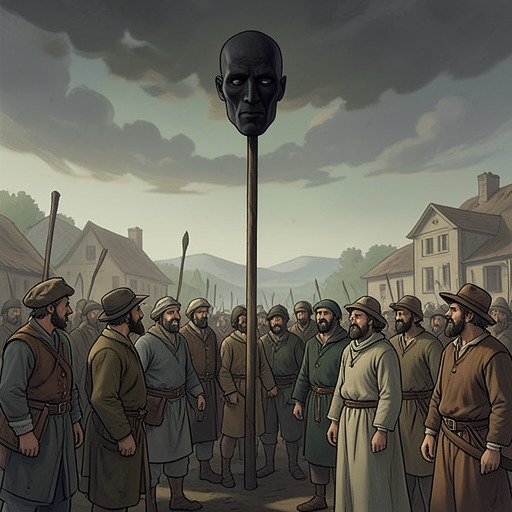
Jagna as a scapegoat
The PeasantsJagna as a scapegoat describes how Lipce turns Jagna’s transgressions into a reason for collective punishment, making her the sacrificial victim through whom the village attempts to restore its social order. The punishment is not simply a verdict on her private conduct: it reveals a community that protects its inherited arrangements by rendering a disruptive person harmless, while leaving the conditions that produced its conflicts intact.
The community and its threatened order
The novel places Jagna’s story within a village shaped by competition over land, family inheritance, and material survival. Its central family plot joins Maciej Boryna’s marriage to Jagna with her affair with Antek Boryna; alongside it, the dispute over forest ownership exposes a broader conflict between Lipce’s peasants and The Squire. These pressures make the community’s rules more than abstract moral conventions: they organize access to property, work, and belonging.
The novel also raises the political question of how formerly subjugated peasants might become a Polish national community. The inherited ideal of patriotic struggle had been formed through resistance to Russian rule, but the peasantry’s own experience included a history of landowners opposing their emancipation. In this setting, Jagna’s punishment becomes one sign of a community unable to turn shared grievances into a durable, inclusive political bond.
Transgression against land and sanctity
Jagna unsettles the village’s land-centered values not by offering a political argument against them, but by refusing to treat land as the overriding measure of a life. When her mother insists on its importance, Jagna replies, “Land, land – that’s all you’ve got on the brain: it’s as much as nothing to me.” The response cuts across a social order in which land secures livelihood, status, and continuity between generations.
Her disregard becomes unmistakable during her quarrel with Hanka Borynowa. Jagna throws down the settlement document that entitles her to six morgen of land. Hanka sees the gesture as incomprehensible, as if Jagna had discarded a substantial inheritance as casually as a broken jug. The episode makes the conflict concrete: what the village regards as an essential guarantee of security, Jagna can reject in a moment of anger.
Her relationship with Jasio, the organist’s son and a future priest, carries the challenge into the religious sphere. The commentary presents this episode as a desecration of the boundary between sacred office and human desire: Jagna draws a figure associated with Providence into ordinary erotic life. Her repeated violations therefore reach beyond a single marital betrayal. They unsettle the linked codes through which the community distinguishes property from disposability, holiness from the secular, and acceptable conduct from transgression.
Punishment as collective correction
The novel’s framing of Jagna’s fate is systemic as well as moral. Her actions disturb the village’s social equilibrium on several levels, and the community’s response functions as a corrective: she must be incapacitated so that its arrangements can continue. In this interpretation, the violence against her does not arise simply from an honest effort to uphold morality. It is a way for the social organism to contain a force that exposes the instability of its own rules.
The logic of collective authority is voiced in the declaration, “The people are sanctioned to punish and sanctioned to reward!” Antek, once Jagna’s lover and a rebel against his father, now aligns himself with the village. He says, “I live in the village, and I stand with the village! You want to cast her out, then cast her out; and if you want to stick her on an altar, then stick her on it! It’s all the same to me!” His answer makes the violence more disturbing: the community’s verdict takes precedence over personal attachment, while his professed indifference leaves Jagna exposed to the force of a judgment he will not contest.
Jagna’s victimization also contrasts with the failed possibility of solidarity suggested by the forest dispute. The peasants have a shared economic grievance: The Squire is felling woodland in which they have a co-owner’s interest and has refused them employment. At a moment of protest, a speaker appeals to “Christian folk, honest Poles, farmers and hired hands!” and names the injuries they have borne together. Yet the broader account stresses that resentment and suspicion prevent shared interests from consolidating into lasting unity. The scapegoating of Jagna is one expression of this failure: collective force is readily mobilized against a vulnerable member, but does not become an inclusive political community.
The scapegoat’s unresolved place
Jagna’s ending complicates the idea that the community can simply remove what threatens it. She is left alive with her mother, battered, ill, and incapacitated. The response has contained her, but it has not erased her from the village’s social world. Her fate embodies the novel’s larger claim that society demands a sacrificial victim while remaining dependent on the very people and conflicts it tries to suppress.
The commentary leaves open a possible future beyond her role as a desecrator. It suggests that, if she recovers, Jagna may succeed Jagustynka and turn from transgression toward parrhesia. This is presented as a possibility, not a completed transformation. The proposed change would give her a different relation to the community: not the figure whose desires expose its taboos, but a person capable of speaking within its life. Her unresolved future preserves the central tension of the scapegoat figure: punishment may enforce conformity, yet it does not prove that the order being defended is just, stable, or capable of hearing dissent.