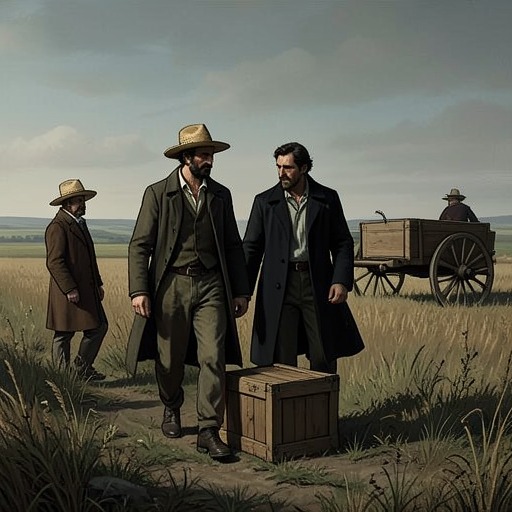
Jagna's land agreement
The PeasantsJagna's land agreement is the settlement document made by Boryna that entitles Jagna to a portion of his land, including six morgen. Its decisive appearance comes when Jagna throws it at Hanka the Farmstead Keeper's feet: a paper carrying substantial material value becomes the instrument of a defiant rejection of the land-centered order around her.
The settlement and its material value
The agreement gives Jagna a defined claim to land, though the evidence does not specify the parcel or the document's legal terms beyond that entitlement. Its importance is made unmistakable by Hanka the Farmstead Keeper's reaction. She understands Jagna's gesture as casting aside six morgen of fields as casually as a cracked jug, and is so shaken that she wonders whether Jagna has lost her reason. The contrast establishes how differently the two women value the same object: to Hanka, it represents a consequential holding; to Jagna, it is something she can discard.
The quarrel and the document's rejection
The agreement appears during Jagna's quarrel with Hanka the Farmstead Keeper. Jagna pulls out the settlement made by Boryna and throws it at Hanka's feet. The gesture gives physical form to an attitude Jagna had already expressed to her mother, Dominikowa: land, she said, occupied her mother's thoughts but meant almost nothing to her. The paper does not merely illustrate that disagreement; in the moment of throwing, Jagna rejects the entitlement the document records before a witness who regards it as an extraordinary sacrifice.
Meaning in the land-centered order
The scene treats land as more than property: it is held as a sacred possession and an organizing value in the peasant community. Jagna does not argue against that valuation in abstract terms. Instead, by treating her six-morgen entitlement as disposable, she violates its practical and symbolic authority at once. The agreement therefore measures the distance between Jagna's indifference and Hanka the Farmstead Keeper's sense of what land is worth. Its force lies in that collision: a document capable of securing a substantial share of fields becomes, through Jagna's gesture, an act of desecration.