Jagna’s ostracism and trauma
The PeasantsJagna’s ostracism and trauma are the aftermath of a communal attack in which Lipce turns long-held grievances into violence and expels her through deliberate public degradation. The assault leaves her physically injured and psychologically stunned; its consequences persist after the mob has gone, in her disordered memory and repeated calls for Jasio.
The eruption of collective judgment
The violence grows from resentments that had been accumulating around Jagna. As one accusation after another is voiced, envy, anger, and hatred spread through the crowd until people shout over one another. The scene presents the village’s judgment not as a measured inquiry into particular claims but as a sudden, contagious release of grievances, with each new denunciation intensifying the next.
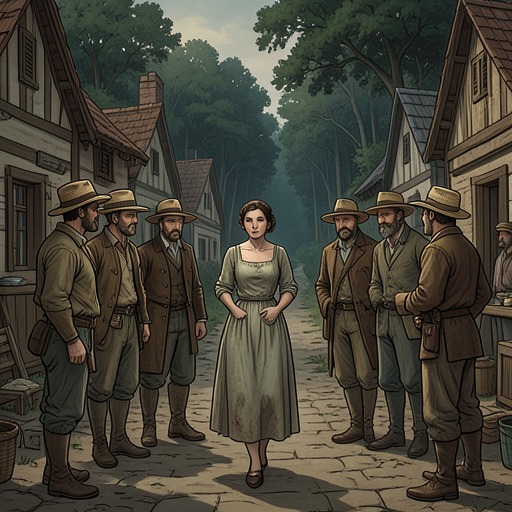
The crowd converges on Dominikowa’s house in a noisy mass led by the wives of the organist and the Voyt. Inside, Dominikowa tries to bar the way, but the intruders trample her. Jędrzych leaps to defend her and is beaten down as well. Mateusz makes a final stand at the storeroom with a bar; the crowd splits his head and leaves him unconscious against the wall. Each attempt to protect Jagna is answered with further force, until the assault reaches the locked room where she has been shut away.
When the villagers tear down the door, Jagna stands pressed against the wall and does not resist or speak. Her pallor, fixed stare, and silence register the shock of the attack before the narrative describes its physical handling of her. A hundred hands seize her and pull her from the house as if uprooting a shallow-rooted plant. The comparison makes the expulsion an act of removal from her home and community, not merely a punishment delivered inside the cottage.
A cart waits on the road, harnessed to two black cows and filled with pigs’ dung. The villagers bind Jagna and throw her onto the load; the procession then sets off amid insults, laughter, and curses. By choosing this vehicle and making the humiliation visible to the community, the mob turns her expulsion into a spectacle. Its collective fury is made concrete in the treatment of her body, while the village’s claim to judge her is enforced through force rather than deliberation.
The expulsion’s aftermath
At the boundary mounds beneath the wood, the villagers lifted the cart’s boards and dumped Jagna onto the ground with the dung. She was fettered, her clothes in rags, her face bruised; she lay without moving, as if unable to hear or feel what was happening. Tears streamed down her face, and at times her breast heaved as though a cry had hardened inside her. The public degradation that began with the cart continued at the village’s edge, leaving her not simply expelled but physically battered and overwhelmed.
The injury does not end when the mob leaves. Two weeks later, Jagna is still in bed and remembers hardly anything of the world around her. Those reporting on her condition insist that she is not mad, but describe a woman whose memory has scarcely returned; even a stone, one says, would pity her. The words shift attention from the crowd’s accusations to the suffering it has produced, while the community’s collective decision to claim a right to punish her remains in place.
Nastusia says that an old beggar has brought water from the nuns in Przyrów, instructing her to sprinkle it on Jagna and rub her head three times a day. Yet the remedy has not restored her: she still lies without memory, and sometimes starts up as if trying to flee, wailing and calling for Jasio. Her recurrent cries give the aftermath a fractured rhythm: the mob’s violence has passed, but terror returns in her body, and the person she calls for is absent. Beside her, Dominikowa sits as if herself a corpse, keeping vigil over a daughter whose trauma has also brought the mother to the edge of collapse.
Accusation and the limits of communal judgment
The mob’s violence is prepared by a cascade of accusations that reach beyond any single alleged offense. An accuser claims Jagusia tried to lure Jasio, describes him as innocent, and says he fled and told his mother what had happened. She also accuses Jagusia of showing no reverence even toward a priest. The charge becomes a measure of supposed moral corruption, while the crowd’s mounting denunciations turn private grievances into a public case against her.
The accusations widen further when villagers invoke Maciej’s death and condemn the thought that their holy soil should bear someone like Jagusia. These claims draw together sexual suspicion, religious language, and grief, making Jagusia appear responsible for harms that the evidence of the scene does not establish. The narrative instead shows how rapidly the allegations accumulate: one voice provokes another, and the resulting uproar replaces any examination of what happened with a shared certainty that she deserves punishment.
That certainty is expressed as communal authority. Later, a villager reports that the whole community has decided it has the right to act, even as another voice asks whether destroying a Christian soul is just. The contrast is not between an orderly village and an outsider, but between a crowd’s asserted right to punish and the pity its action provokes. Jagusia’s condition becomes the measure of that claim: the community can expel her, but its decision does not make the injury righteous or bring her back to herself.
Even within the procession, the response is not wholly uniform. Pietrek, the Borynas’ farmhand, leads the cart because no one else will, and uses each opportunity to whisper words of pity and promise that there will be vengeance for the injury. His quiet words do not stop the expulsion, and he continues alongside a spectacle organized by the crowd. The smallness of his intervention against the procession’s curses makes visible both the reach of collective force and the survival of individual compassion within it.
From public spectacle to private aftermath
The narration changes scale after the expulsion: the mob’s noisy, many-voiced assault gives way to reports exchanged by people who visit or ask after Jagna. That shift matters because Jagna has almost no speech of her own in either phase. During the attack she remains silent; afterward, the only words attributed to her are wails and repeated calls for Jasio. Her condition is therefore conveyed through others’ observations, while the narrative makes the gap between the community’s loud certainty and her injured, inaccessible experience increasingly stark.
The episode’s aftermath does not restore the order the villagers claim to defend. Their verdict has removed Jagna from Lipce, but it has left her unable to remember much of the world and Dominikowa sitting beside her in near-despair. The scene thus distinguishes the power to impose an expulsion from any power to repair its consequences: the procession ends at the boundary, while the suffering continues in the home.