Kuba and Jankiel Agree on a Game-Hunting Deal
The PeasantsKuba and Jankiel Agree on a Game-Hunting Deal begins as a tavern negotiation and ends with a practical, if uneasy, agreement to procure a shotgun for Kuba. Jankiel offers payment for game and proposes a price for deer; Kuba weighs the possible reward against the costs and terms of hunting. The exchange also exposes the strain between Kuba’s need for money and his insistence that he is not a thief.
From snared birds to a hunting proposal
Jankiel asks whether Kuba has made money in the forest. Kuba corrects him: the money came from birds caught in a snare, six of which he took to the priest, who paid him a zloty. Jankiel counters that he would have paid ten groszy for each bird. When Kuba wonders aloud whether partridges are kosher, Jankiel tells him not to trouble himself over that question: he should bring many, and Jankiel will pay ten groszy apiece. The offer includes liquor, making the proposed trade inseparable from the tavern setting in which it is struck.
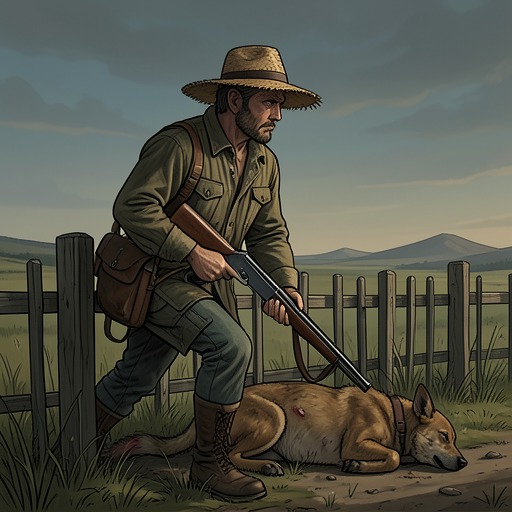
The bird-buying offer prompts Kuba to imagine earning enough for necessities. He calculates the cost of a sheepskin, shoes, and a shotgun, then abruptly turns the discussion toward larger game: if he had a shotgun, he says, he could shoot a deer. Jankiel asks whether Kuba knows how to shoot. Kuba answers that he has hunted in the forest with the squires and that this is where his leg was shot. The detail establishes that the proposed hunt is not merely a fantasy: Kuba claims experience, though that experience carries the mark of an earlier injury.
The proposed terms
Jankiel takes out chalk, makes calculations, and whispers the figures to Kuba. He offers a whole rouble for a deer, with fifteen kopecks charged for the powder and deducted from the payment. Kuba is also to bring a quart of oats if the shotgun is damaged. Jankiel promises to obtain the gun and the necessary supplies, while Kuba is to bring him what he shoots. Kuba repeats the deer price and powder charge aloud, checking the numbers as he tries to grasp what the arrangement might yield.
That arithmetic is shaped by Kuba’s immediate circumstances. He has already spent money at the inn and is drinking on credit; the promised proceeds from hunting therefore stand beside a debt he cannot presently pay. When Jankiel suggests taking oats from the horses, Kuba objects that this would be theft, insisting that Boryna has oats elsewhere. Jankiel replies that farmhands commonly find money for tobacco, vodka, and a Sunday dance by such means. Kuba answers with sudden anger, striking the table hard enough to make the glasses dance and demanding to know whether Jankiel takes him for a thief. The dispute makes the bargain’s costs more than a matter of bookkeeping: Kuba resists the implication that taking farm provisions is an acceptable way to finance his needs.
Debt, agreement, and refusal
Kuba does not pay Jankiel or leave when challenged to do so. He has no money left and now owes the innkeeper. Jankiel pours him another drink, and the negotiation continues amid Kuba’s growing intoxication. When the other men leave, Kuba remains asleep in the ashes. Jankiel has to wake him; Kuba kicks and thrashes, declaring himself a farmer with a will of his own and insulting the man trying to get him up.
A bucket of water brings Kuba partly to his senses. He is alarmed to learn that he has drunk a whole rouble’s worth, counting the arak, herring, tobacco, and additional drinks as the total is explained to him. The amount he owes has now equalled the price Jankiel had offered for a deer, giving the proposed hunt a sharp financial counterpoint: Kuba has heard what successful hunting might pay, but has already consumed a comparable sum without earning it.
Jankiel finally persuades him, and they agree that Jankiel will bring a shotgun from the fair. They seal the arrangement with spirits. Kuba nevertheless refuses one term: he will not promise the oats. He invokes his father’s honesty and says that his own son will not be a thief. The refusal leaves the agreement in place while drawing a clear boundary around what Kuba will accept as collateral for damage to the gun.
The bargain’s uneasy ending
Jankiel says that he still has prayers to say. As Kuba heads home, he mutters that the innkeeper is a speculator who persuades a man to steal and then goes off to pray. The closing contrast does not undo their agreement; Jankiel is still to bring the gun, and Kuba has agreed to bring back game. Instead, it leaves the transaction morally unsettled, with each man’s position visible in the same exchange: Jankiel calculates the price and conditions, while Kuba accepts the opportunity but rejects the demand that he pledge oats.
Kuba walks away still trying to account for the rouble he has spent. Not yet sober, and disoriented by the fresh air, he sways against fences and timber lying in front of cottages. The episode therefore closes not on a hunt or its proceeds but on a promise, an unpaid tavern debt, and Kuba’s stumbling effort to reckon with what the night has cost. Its central reversal is modest but telling: a discussion of earning money through game ends with Kuba already in debt, yet holding to a distinction between hunting for payment and stealing from the farm.