Land access and grazing rights
The PeasantsLand access and grazing rights in Lipce were not simply matters of who held title to a field: customary use of pasture and forest shaped whether villagers could feed livestock, earn wages, and sustain a household. The boundary between recognized common use and excluded claimants remained contested, and disputes over it helped turn practical hardship into collective resistance against the manor.
Customary use and its limits
Pastures in the woods and beyond that had never been sown or mown were regarded as common grazing ground, available for anyone’s use. This customary access did not amount to ownership, but it made uncultivated land a necessary part of village life: pasture could support animals even where a household’s own holding was inadequate.
The entitlement was not shared equally. Hired hands, because they owned no land, were not entitled to rights of easement in land held in common by the manor and the village. The distinction placed landless workers outside a resource system on which farming households depended, even as their need for paid work made access to the manor’s forest especially consequential.
Claims, damage, and rival authority
A dispute over grazing shows how custom, documentary claims, and livelihood could collide. Villagers complained that manor people drove them and their animals off pasture that they said was theirs and recorded as such. The pursuit was blamed for a cow’s inflammation and death, while a boy was reportedly beaten; the loss was valued at three hundred zlotys. The proposed response was to take the matter to court or the commissioner, bringing a local grievance into formal channels without resolving the underlying disagreement over who could use the ground.
The forest also carried claims that villagers expressed in terms of their own holdings and rights. Riding through the woods, Boryna counted four morgen as his and another morgen as Jagusia’s, and regarded the manor’s position as an attempt to take too much. His private reckoning belonged to a wider struggle over the forest: the manor was felling trees, while villagers maintained that their claims were being disregarded. Customary access, individual landholding, and the manor’s authority therefore overlapped without becoming the same thing.
From livelihood pressure to collective action
The consequences of restricted access went beyond grazing. When the squire refused to employ local men for the felling at Wolf’s Hollow, at least twenty hired hands were left without work in a severe winter. Some had already lost potatoes to frost; families faced a meagre preharvest period, and some people ate a hot meal only once a day. Villagers had expected the logging to provide wages, so exclusion from the work turned the manor’s decision into an immediate threat to subsistence as well as a dispute over the forest.
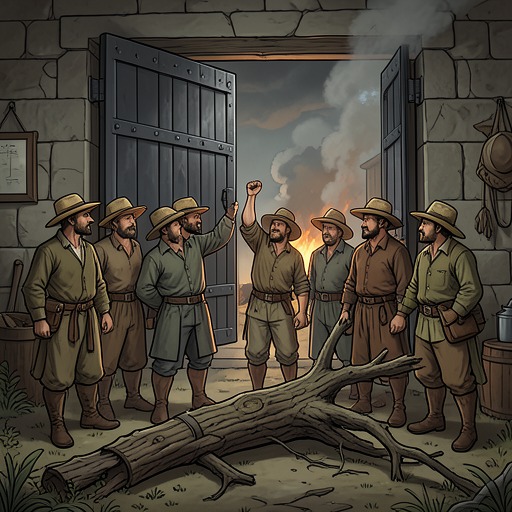
At the forest, Boryna addressed farmers and hired hands together, presenting the felling as the latest in a series of injuries and failed complaints. Villagers arrived in a crowd and confronted the woodcutters, insisting that the forest was theirs and ordering the workers out. The gathering made a collective claim where individual appeals had failed, though the shared cry did not erase the unequal rights within the village itself: landless workers could join the protest and needed its promised employment, yet did not possess easement rights on the same basis as landowners.
A later proposal to resist German purchase of Podlesie used the same logic of coordinated pressure. Villagers considered approaching the prospective buyers together and threatening to prevent sowing, building, or work on the fields if the land were bought. The tactic shows how control over access could be asserted not only through established custom or formal complaint, but also through collective obstruction.
Land access as social security
The story links access to land with the distribution of risk. During the men’s imprisonment, women faced fields left fallow alongside the ordinary demands of children, livestock, and seasonal work; the earth was ready for cultivation, but labor and household resources were strained. Elsewhere, accounts of hunger, illness, and families without food or credit expose how little protection the poorest had when they lacked secure means of support. These conditions give land access a material urgency beyond the abstract language of rights.
When Hanka returns to the farm, memories of hunger, grief, and Antek’s infidelities give way to the certainty of being back on the land. That return makes possession and access inseparable from security and belonging, while the forest disputes reveal their public dimension: land and common resources determine who can work, graze animals, and endure a bad season. Lipce’s conflicts therefore expose both the force of customary claims and their limits, especially for those who own no land.