Land and inheritance
The PeasantsLand and inheritance in The Peasants bind together household survival, social standing, family authority, and collective claims over the countryside. Fields are not simply property to be divided: they determine who can support a family, who commands respect, and who has the power to decide another person’s future. The novel sets the elder’s control of land against children’s expectation of a portion, and private holdings against villagers’ insistence that the manor cannot dispose of forests without regard for their needs.
Land as livelihood and rank
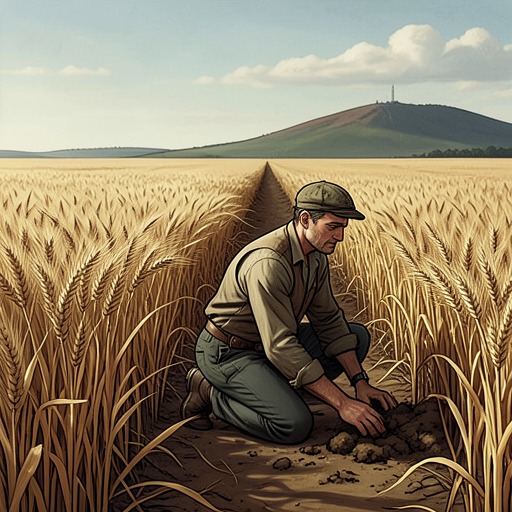
The economic value of land is made concrete in Antek Boryna’s resentment toward his father. In his view, Boryna recognizes wisdom chiefly in a man with at least fifteen morgens and a substantial herd of cows. Land and livestock become the measure not only of wealth but of whose judgment counts. Antek and Hanka imagine how a portion might sustain their own household: three cows could feed the land, their own horse would help work it, and a surplus might even be sold. Instead, they feel that Boryna counts every husk and peel and repeatedly reminds them that the food is his. Their resentment is not abstract; it grows out of daily dependence on a property they believe should partly belong to them.
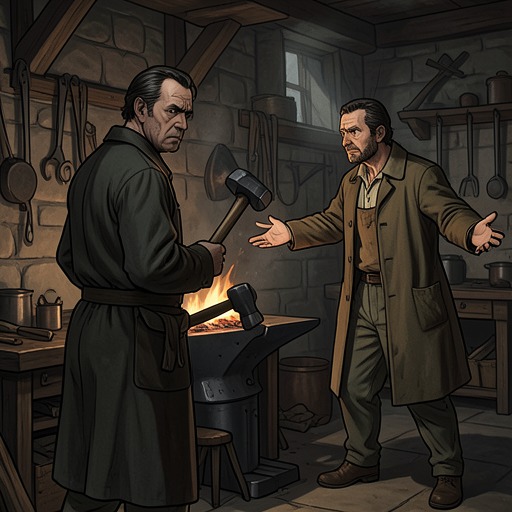
When Antek calculates that the division would come to no more than eight morgens, the figure gives shape to a hoped-for independent life. Hanka points out that the land must also be considered alongside the claims of Józka, the blacksmith, Grzela, and their own family. The blacksmith might be paid off, they reason, and the couple could remain in the cottage with fifteen morgens; but Hanka’s question of what they could pay him with exposes the gap between an imagined settlement and their actual lack of resources. Looking across Boryna’s fields, she sees land as something valuable and near at hand, yet still someone else’s. Their discussion shows inheritance as both a possible escape from dependence and a source of conflict among several claimants.
Boryna’s authority and Jagna’s proposed settlement
Boryna’s control of his property shapes the marriage negotiations around Jagna. Her mother presents marriage as a route to security: Boryna is old, but still strong and respectable, and Jagna could become mistress of his household. A settlement could be arranged beside her mother’s land, and the mother hopes he might sign over as much as six morgens. The proposed marriage thus joins personal status to a transfer of land. Jagna’s mother also fears village gossip and treats marriage as an answer to the talk surrounding her daughter.
Jagna herself is largely passive in this calculation. She says she will marry Boryna if her mother wishes, or remain at home if not; portions and property matter little to her. She thinks of the gifts Boryna has bought her, but also of the other young men who might have offered similar things if they had his money. The contrast is sharp: her mother sees land, marriage, and reputation as practical necessities, while Jagna drifts through the choice without the same concern for property. The narration’s image of her soul as earth connects this passivity to a larger motif of fertility and susceptibility, but the immediate social arrangement is plain: others negotiate the conditions under which she will live.
Boryna’s land authority is not merely an assertion of wealth. Hanka later recognizes that he had the right to give away his property or refuse to do so while he was alive. She recalls that he had transferred land to Jagna and expelled Antek’s family, but also judges that Antek’s violence and persistent quarrelling helped provoke the rupture. Her reassessment does not erase the couple’s hardship; it distinguishes Boryna’s power over his land from the injuries caused by the family conflict. When her father advises her to make peace with Boryna and consider the children’s future, the farmstead appears as a place where her labor might again be needed and where his favor could matter. The possibility of being invited back rests on both household work and the uncertain future of inheritance.
Inheritance and the order of the household
Boryna also uses customary hierarchy to define who may claim a place. When Kuba presses forward among the farmers at church, Boryna rebukes him: a farmhand is not a farmer, and each person has a place allotted by God. The speech turns social rank into a divinely sanctioned order and warns Kuba not to raise himself above it. Kuba answers that he is not a beast and has a mind of his own, but Boryna insists that he must not cross the line. The exchange makes clear that control of land carries authority over status and belonging, even beyond the immediate question of who owns a particular field.
The same pressure appears in a village discussion of the older generation’s hold on land. Grzela argues that elders who keep the property while denying their children a say create an injustice; he also objects that they manage village affairs badly. His example is the forest dispute, where he believes an agreement with the squire could have settled matters sooner. Others answer that the village was owed more than the two morgens offered for each share, while one speaker says the commissioner had advised against accepting two. The disagreement is not simply over a number: it concerns whether elders should negotiate for the community, whether officials can be trusted to determine what is owed, and who has standing to speak for the villagers.
Boryna’s own exclusion from a forest council deepens his anger. He resents that the others met without him and privately condemns the miller, the village head, the blacksmith, and the squire. Yet he also refuses to beg the squire for work on behalf of the hired laborers, despite hearing that at least twenty men need employment during a harsh winter. His position reveals a tension between personal authority and communal responsibility: he regards the forest as theirs and signs a complaint against the squire, but will not adopt the conciliatory approach others urge. He declares that the squire must not cut a single fir until an agreement is reached with the village.
From household claims to collective rights
The novel connects disputes over inherited plots to a wider struggle over access to land and natural resources. A complaint about pasture describes a cow worn out after villagers were driven away from grazing ground that the speaker says is clearly recorded as theirs. Other animals and a boy are said to have been driven off or beaten, and the loss is valued at three hundred zlotys. This account shows how a claim to land can be enforced through everyday access—or denied through physical intimidation—and how the written register becomes one resource in a dispute that still depends on power on the ground.
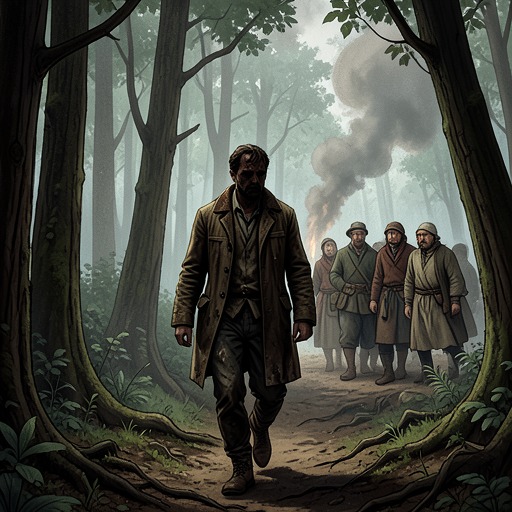
Forest rights enlarge the same conflict. Riding through the woods, Boryna counts four morgens as his share and Jagna’s as one, looking over the trees as resources tied to those claims. He believes that the manor regards the villagers’ demand as excessive while they themselves are asking too little, and he invokes both Christian justice and their own determination not to accept injury. Later, as the manor’s felling threatens work and access, Antek argues that the villagers should not leave the matter to the elders. He proposes that the whole village go to the Germans together and warn them not to buy Podlesie; if they proceed, the villagers will refuse to let them sow or build. The proposed collective resistance is distinct from the family’s private inheritance struggle, but it shares its central question: who may decide what happens to land on which other people depend?
Antek’s public appeal during the forest conflict draws farmers and hired hands into a single claim. He lists the manor’s felling, refusal to hire Lipce men, and repeated injuries as parts of a continuing injustice; the crowd answers that the forest is theirs and charges forward against the woodcutters. In that confrontation, ownership is asserted not only through documents or inheritance but through collective presence. The contrast with Boryna’s earlier insistence on each person’s allotted place is significant: land can preserve a hierarchy within the household and village, yet a shared grievance can also bring farmers and laborers together against an outside authority.
Significance
Land and inheritance organize the novel’s material and moral conflicts. A father’s right to withhold a portion can leave adult children dependent; a proposed settlement can turn marriage into a transfer of security; and a farmhand’s exclusion from the farmers’ place at church shows how property distinctions shape social belonging. At the same time, village disputes over pasture and forest reveal that land rights extend beyond family title to include access, work, and the survival of people with little or no property. The novel does not present these claims as easily reconciled: elders disagree with children, villagers argue over the amount owed, and collective resistance competes with private bargains. Its recurring tension is between land as a guarded possession and land as the material basis of a wider community’s life.