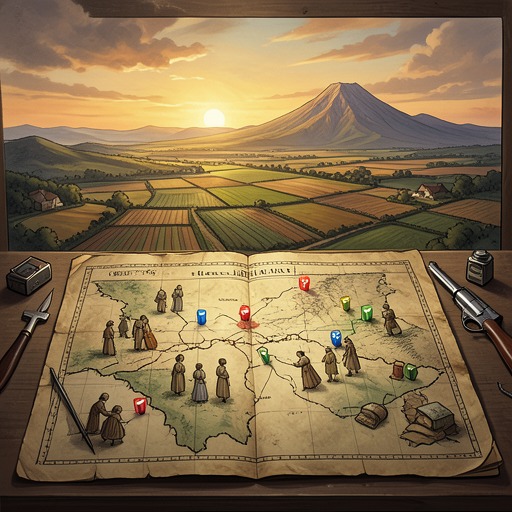
Land and peasant identity
The PeasantsLand in The Peasants is more than property or a source of food: it grounds livelihood, family continuity, and a sense of who belongs. Its power is clearest where personal attachment meets scarcity and unequal control. Fields pass through generations, but ownership does not erase poverty or settle who has a right to use the resources on which village life depends. The novel makes land a foundation of peasant identity and, at the same time, a testing ground for whether shared material interests can unite a community politically.
Land as livelihood and inheritance
For the villagers, land means the means to live: fields to cultivate, pasture and woodland to draw upon, and a farmstead that can sustain a household. In one moment of acute uncertainty, Hanka contemplates the scale of the farm before her: thirty-two morgen, with pastures, wood, buildings, and livestock. She imagines buying out the others and keeping it together, like her father had done. Her resolve is practical as well as emotional: she will not yield even half a volok, and she will not relinquish the milch cows. The measures of land and the animals in her reckoning make the stakes tangible. A farm is not an abstract inheritance; it is an integrated basis of work, food, and security.
Hanka’s vision joins present survival to an older household model, but inheritance is not simply a peaceful transfer between generations. The broader conflict over land repeatedly sets a parent’s control against a child’s expectation of a place and a future. In the novel’s central family plot, the marriage of Maciej Boryna and Jagna is entangled with Antek’s conflict with his father, so that intimate relations and property arrangements become inseparable. The land carries continuity, yet the power to dispose of it can also fracture the family that continuity is supposed to preserve.
Scarcity and the claims of the poor
Land and access to work matter most when households have little to fall back on. During a hard winter, a speaker argues that at least twenty hired hands in Lipce are desperate for employment. Potatoes have frozen, money is scarce, and some people eat a hot meal only once a day before going to bed hungry. They had expected the Squire’s felling at Wolf’s Hollow to provide work; instead, they hear that no one from the village will be hired. The appeal is not only for wages. It expresses a moral expectation that decisions over local resources should account for the people whose survival depends on them.
The same vulnerability appears in accounts of families facing hunger, illness, and absent male laborers. One cottage is cold, its windows stuffed with straw; the household has no potatoes left and has sold its quilt. The family must beg groats from the miller, while debt and the lack of credit close off relief until harvest. Elsewhere, a sick mother has no money put by, no one to cook, and fields standing fallow as spring approaches because her husband is imprisoned. These details show how land alone cannot guarantee security: cultivation requires labor, food reserves, tools, animals, and help at the moment of need. A household may possess a plot and still be exposed to hunger when illness, imprisonment, or poverty interrupts the work that makes it productive.
The criticism extends to the village’s more prosperous farmers. They attend to their own food and lending, while the poor live nearby without disturbing their sleep. Invoking divine order does not itself relieve anyone’s need. In this contrast, land-based identity carries an ethical question: whether living in the same village creates obligations across differences in wealth, or whether the poor are left to endure hardship alone.
The forest as a collective claim
The dispute over Wolf’s Hollow turns the villagers’ relationship to land into collective action. At a gathering, a speaker addresses farmers and hired hands together, naming the felling, the refusal of employment, and a longer history of perceived injuries and unsuccessful complaints. The claim that the forest is theirs does not describe an uncontested legal title; it presents the villagers’ sense of customary entitlement and shared injury. Because the forest supplies both a material resource and expected work, its sale and cutting threaten more than income. They challenge the community’s standing in decisions that shape its livelihood.
The crowd’s response shows the strength and volatility of that common claim. Calls to go to the forest gather force as anger becomes public and collective. Yet agreement over an immediate grievance does not guarantee a stable political unity. Later, a farmer from Przyłęk accuses Rocho of standing with the gentry and turning the people against officials. The accusation is shouted down, but it reveals that villagers can interpret political leadership and authority differently even when they share a landscape. Land can bring people together around a threatened resource without resolving disagreements about whom to trust or how resistance should proceed.
From peasant belonging to national identity
This local attachment has a larger historical and political dimension. Under serfdom, peasants in the Russian partition had been bound to landowners and required to provide unpaid labor for set days. Serfdom ended there in 1864, later than in the Austrian and Prussian partitions. Emancipation altered rural labor relations, but it did not by itself supply the institutions or political language needed to make former serfs feel part of a Polish national community.
The novel’s village therefore raises a question beyond individual property: how can peasants become citizens sincerely attached to Poland when educational and administrative institutions are in Russian hands? The national ideal had been shaped by Polish Romanticism and by memories of uprisings against Russia, but many landowners had opposed peasant enfranchisement. That history helps explain why patriotic appeals could meet with reluctance or hostility among people whose experience of the landed class included domination. In The Peasants, common attachment to fields and forest offers a possible basis for solidarity, but it cannot simply erase class memory or manufacture national allegiance.
The land across generations and the limits of unity
When Antek returns to his father’s and grandfathers’ fields, his renewed sense of belonging becomes a commitment to stay and take up the burden of work. He understands his return as following a path made by earlier generations, with his son Pietruś expected to carry the labor onward in turn. The scene makes inheritance temporal as well as material: land gives a person a place within a succession of ancestors and descendants, and labor is the means by which that connection continues.
The novel also places this continuity beside mortality. In a procession through Lipce, the people walk beneath the weight of grief, yet the imagery holds them close to fallows and flowering fields. They are compared to trees that may be struck by lightning and offered to death, yet still reach toward the sun. The image does not promise that land will spare anyone from suffering; it presents endurance and renewed life as part of the same order. Land binds identity to work, vulnerability, and continuity, but it does not abolish loss.
That tension informs the novel’s political significance. The village’s shared dependence on land can produce protest and mutual recognition, as the forest dispute demonstrates. It can also coexist with social indifference, household conflict, and suspicion of political leadership. The result is not a simple account of land automatically creating national unity. Instead, land is the material ground on which peasant identity is formed and contested: a source of belonging across generations, a condition of survival, and an unresolved basis for collective action.