Lipce
The PeasantsLipce, the principal setting of The Peasants, is both a particular village shaped by weather, work, and local custom and a deliberately representative rural world. It is not a documentary portrait of the actual Polish village whose name it bears: the novel’s Lipce gathers a large, varied peasant community into a tightly observed setting where private affairs become public knowledge and disputes over livelihood expose the forces governing village life.
Identity and setting
The name Lipce came to the novel through Władysław Reymont’s connection to the Warsaw–Vienna Railway: he worked as a linesman at the Krosowo–Lipce railway crossing. The real place supplied a name, not a one-to-one model. The Lipce of The Peasants represents a typical Polish village at the end of the nineteenth century, and its separation from the wider world is central to how the setting works. Some characters leave the village or return to it, but the narrative does not follow them into the world beyond. Instead, it holds its attention on Lipce, making the place a bounded social universe through which broader questions can be examined.
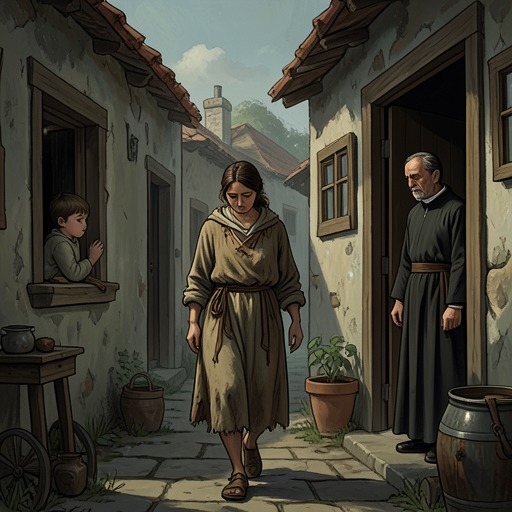
That boundary does not make Lipce simple or uniform. The village contains at least a hundred named characters and encompasses households with very different degrees of wealth, security, and influence. Its social life is continually renewed by marriages, births, deaths, court cases, illness, work, and argument. A christening, a betrothal, a death, or a dispute over rights gives people something to discuss, celebrate, or grieve; the village’s collective voice emerges from the accumulation of such distinct household events. Lipce is therefore not just the backdrop to the novel’s central conflicts but the community through which those conflicts acquire consequence.
A landscape shaped by the seasons
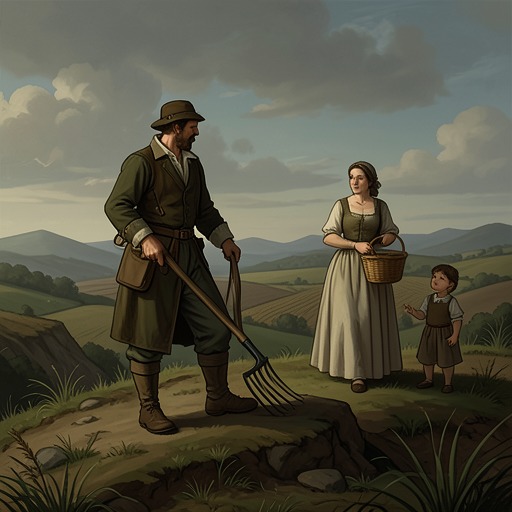
The changing weather gives Lipce a physical and emotional rhythm. In September, the village can appear quiet and luminous, with a fine, sunlit stillness. As the year turns, however, the landscape grows increasingly bare: fields lie stripped and exhausted, trees stand twisted and mournful, and the frozen quiet seems to numb the countryside in anticipation of a long winter. In another period of bad weather, persistent rain coats the village in a thin glaze; black thatch and wet stone walls appear through the gloom, while smoke drifts above the orchards. Such descriptions place human activity inside a landscape that changes independently of anyone’s wishes and sets real limits on what the villagers can do.
Winter makes those limits immediate. Snow rises nearly to the roof of an exposed house on the edge of the village, far from the road and without a protective fence or garden. A few crooked wild cherry trees are almost buried; the potato pit is difficult to make out beneath the snow. The scene gives the season a material presence: distance, shelter, and stores of food matter as much as the beauty of the weather. In another dawn landscape, Hanka tends the hearth while darkness still obscures cottages and trees. A faint light gathers in the east, but chill and quiet remain over the land. The work of keeping a household going begins before the day has fully appeared.
Lipce’s seasons also set the terms for collective life. In winter, poverty can leave hired hands and families with little land without work, making the prospect of employment in the felling seem like a lifeline. In spring, the contrast between Lipce and its neighbors becomes stark: fields elsewhere are ploughed and sown, while Lipce’s fields remain empty after the village’s crisis. Later, the arrival of harvest preparation brings a rapid change of pace. Hayricks are repaired, carts are soaked in the pond, barns are opened and cleaned, straw ropes are woven, scythes are sharpened, and women bake bread and prepare supplies. Seasonal labor is not decorative background; it determines when people have work, what they can eat, and whether a household or the village can recover.
Work, scarcity, and the village’s divisions
Lipce’s social order includes wealthy farmers, less prosperous households, hired laborers, and people who own little more than a cottage. The poorest do not always acknowledge their circumstances, partly because they fear losing the friendship of wealthier villagers. Landless workers take whatever jobs they can find: threshing for farmers, using an axe at the mill, or doing other work that offers a chance to get by. In winter, some families have no local work at all. This uneven distribution of security becomes especially visible when the squire arranges logging work for people from nearby places but excludes Lipce entirely. Workers from Rudki, Modlica, Dębica, and Rzepki have been promised places; none are promised to Lipce. The woodsman confirms the news, turning a rumor into a concrete grievance. Those who had waited for the work as a possible means of survival have reason to feel the exclusion most sharply.
The village is also divided by its relation to land and authority. The forest conflict grows out of the peasants’ claim to be co-owners of woodland that the owner wishes to sell. The dispute joins customary claims and material need to a broader contest with the manor: the villagers’ interest is not merely in the trees as scenery, but in access, work, and the rights on which rural livelihoods depend. Later, the threatened sale of Podlesie to German settlers raises another question of who will possess land around the village. When Grzela warns that a deed could be signed at any time, the danger is presented as imminent rather than abstract.
Scarcity also shapes proposals for settlement. During discussion of an agreement with the squire, Grzela marks out on a table how land might be divided: the proposed exchange would allot peasants fields at Podlesie in return for a morgen of wood, with further land released in instalments, and wood made available on credit for cottages. The chalk marks turn negotiation into a visible calculation of who might receive what. Yet the existence of a proposal does not erase disagreements among the farmers or the pressures that have produced them. Lipce’s collective interests are real, but they do not make every villager equally secure or every bargain equally acceptable.
Public life, ritual, and crisis
Lipce’s ordinary life is sustained by recurring gatherings and religious observances. On a holiday, the village may seem nearly deserted: the roads are empty, the inn is closed, and small lights glow through misted windows while prayers and singing are heard for the dead. At other times, the same lanes fill with people. During a winter holiday, crowds gather around the pond amid sleighs, children, geese, barking dogs, and horses; cold and snow become part of a shared celebration rather than signs of isolation. On Three Kings, villagers leave church for the inn to celebrate a betrothal, and the return of music after Advent and Yuletide makes the gathering especially noticeable. Religious time and social time overlap, setting the occasions on which the village comes together.
That closeness also makes Lipce a place of observation and rumor. When the villagers expect the gendarmes to take Antek Boryna away, chores are neglected, cows low at empty mangers, people move from house to house, and faces watch from windows, doorways, and over fences. The village’s attention becomes almost an event in itself. In a separate night of upheaval, the narrator compares the uproar to an anthill disturbed by a stick; news can spread through Lipce with the speed and force of fire, sending people from cottage to cottage in distress and anger. Collective life offers companionship and common purpose, but its constant circulation of information also makes privacy difficult.
Political and administrative pressure enters the same close-knit space. The announcement of a government-run school for Lipce and surrounding villages makes education a matter for communal decision and brings the village into direct contact with authority beyond its customary institutions. The school question belongs to a wider political tension: the people are required to contend with official arrangements imposed upon their rural community. The village is not simply insulated from the world; rather, institutions and conflicts from outside arrive there, where their effects are debated in familiar rooms and assessed in terms of local consequences.
Collective endurance and narrative significance
The village repeatedly moves between life in common and isolation in suffering. After the forest conflict, Lipce is likened to an open grave: many men have been taken away, while women’s wailing and children’s cries remain in the empty cottages. The image registers more than grief for absent individuals. It makes the injustice of the village’s condition visible in the altered sound and population of the place. The following spring sharpens the contrast: neighboring communities are busy sowing, ploughing, and planting potatoes, while Lipce’s fields lie silent and lifeless. The absence of work in the fields records the crisis materially, in land that should be cultivated but is not.
The response is not only mourning. When the imprisoned men return, the village begins to fill and hum again. Men greet their thresholds with the sign of the cross; some fall before their holy pictures, crying with happiness. This return does not undo the losses, but it restores people to their homes and to the routines through which village life is made. Later, despite continuing heat, troubles, and political quarrels, the community prepares for harvest with a coordinated surge of labor. As the day advances, bands emerge from cottages with sickles and scythes, and carts roll from farmyards toward the fields. Lipce returns to work without ceasing to bear the marks of conflict.
The setting’s significance lies in this refusal to reduce village life to one plot or one mood. The marriage of Maciej Boryna and Jagna Paczesiówna and Jagna’s affair with Antek Boryna unfold alongside the struggle over forest rights, poverty, public authority, and communal obligation. Lipce is intimate enough for private choices to become public knowledge and broad enough to hold sharply different interests within one community. Its seasonal round gives the narrative a recurring measure of labor and hardship, while its assemblies, rumors, rituals, and disputes show how a peasant society makes decisions and enforces belonging. By keeping the wider world mostly beyond the village’s boundaries, The Peasants makes Lipce a concentrated portrait of rural existence: a place where weather and work govern daily life, where land is inseparable from security, and where collective endurance is repeatedly tested by divisions within the community and pressures from outside it.