Lipce All Souls’ church
The PeasantsLipce All Souls’ church is more than a place of worship: together with its crowded approaches and graveyard, it is a setting where Lipce’s communal bonds become visible. The church gathers villagers for rites that honor the dead, bless marriages, and animate the religious calendar, while its threshold connects private grief and family ceremony to collective life.
Setting and communal use
The church can be physically cramped when the village gathers. On All Souls’ Day, the crowd fills the churchyard and presses through the sacristy, where offerings are collected at tables. Beggars line the path from the main doors to the road, praying, asking for alms, and making music on fiddles, pipes, and harmonicas. Their overlapping sounds and the crush of people make the church’s religious observance a public event as well as a devotional one.
The sacristy’s offering tables also make the rite materially accessible: Kuba gives the organist a list of names to be remembered, paying six groszy for each soul or, for those without money, three eggs. The church is thus a place where prayer for the dead is joined to the ordinary exchange of money and food.
All Souls’ prayer and remembered lives
A catafalque and coffin stand at the center of the church, surrounded by blazing candles, while the Parish Priest of Lipce recites a long litany of names. The congregation answers together, praying for souls still in purgatory. Kuba kneels and repeats the prayers the priest has directed him to say. Witek the Stork-Keeper, who has presented names as if they belonged to parents of his own, eventually falls asleep leaning against Kuba after the monotonous chanting and the warmth overcome him.
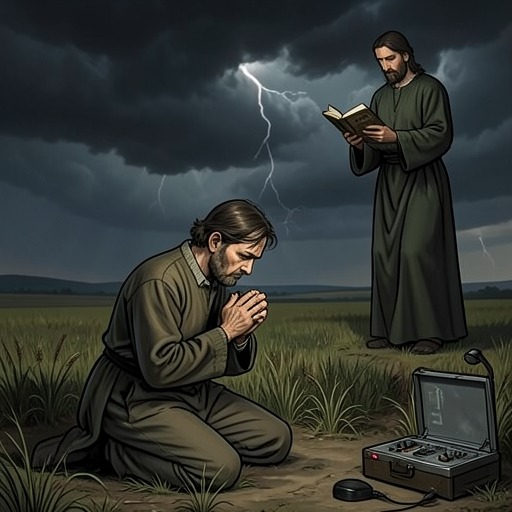
The remembrance continues beyond the church interior. At the graveyard chapel, villagers attend vespers once a year, and Witek later points in fright toward graves near the fence, believing that the Lord Jesus walks the earth. Kuba kneels among the neglected graves and recalls his family’s history: his father’s land passed to his uncles, he was sent to tend pigs and later drive horses for the manor, and war and violence left his mother and others dead. The sunken, unmarked graves give his account a setting of physical erasure; prayer and recollection preserve what the bare ground no longer records.
Weddings and the parish community
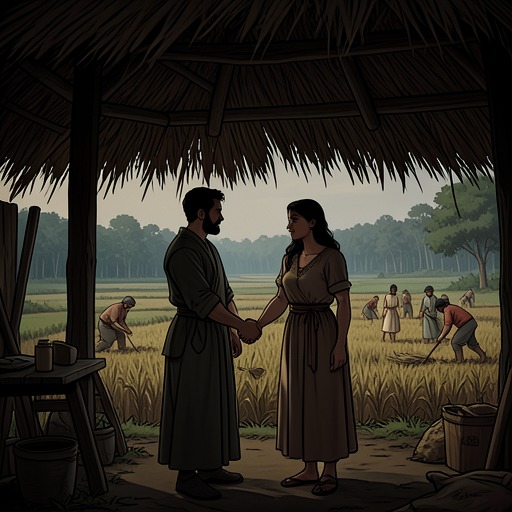
The church also marks a change in family and social status. Before her wedding, Jagna receives her mother’s blessing and holy water at home, asks forgiveness, and takes leave of the assembled family and women. The party then walks to the church. There, Ambrozy lights the altar candles, the guests arrange themselves in pairs, and the Parish Priest of Lipce conducts the marriage service.
The ceremony is brief because the priest is hurrying to a sick man. On leaving the church, the wedding party hears the organist play lively dances, and the music nearly draws the gathered villagers into song. The church therefore stands between a household’s intimate farewell and the public celebration that follows: the marriage is solemnized at the altar, then carried back into communal life through music and procession.
Processions and the church through the seasons
During a major procession, the church’s doors open onto a spectacle that draws the village into motion. Banners come out first, followed by the priest beneath a red baldachin, carrying the monstrance. The procession moves slowly around the church’s white walls amid bells, incense, candles, and singing. The assembled people, who had been kneeling in the heat, rise and follow; the ritual transforms a still, drowsy gathering into a collective act of devotion.
Across these different occasions, the church’s role is not confined to its altar or walls. All Souls’ prayer joins the living to the dead; the wedding service carries a household transition into public recognition; and the procession turns the church’s perimeter into a shared route. Its importance lies in this recurring movement between private and communal experience, between remembrance and celebration, and between the sacred interior and the village outside.