Lipce School Order and Tax
The PeasantsLipce School Order and Tax is an administrative directive to establish a school in Lipce for the surrounding villages and finance it through an additional land-based levy. Presented as public assistance, the order also makes education a matter of imposed taxation and administrative authority: the villagers are expected to approve a charge whose terms are read aloud in a language they say they do not understand, and the Prefect ultimately insists that they comply.
The Order and Its Costs
The Notary reads that a school is to be established in Lipce and will also serve Modlica, Przyłęk, Rzepki, and smaller villages. He describes the school as beneficial and the authorities as intent on helping, enlightening, and protecting the people. The practical provisions, however, place a clear financial obligation on the villagers. They must approve an additional tax of twenty kopecks per morgen, with the money covering a plot with a field, the school building, and its upkeep, including a teacher’s salary.
The order therefore combines a proposed public service with a locally borne cost. Its reach extends beyond Lipce, but the tax is presented to the assembled villagers as a charge they must authorize. The Notary promises that, if they approve it that day, construction can begin within the year and children can attend school the following autumn. The promised timetable gives the measure an immediate consequence: the decision is framed not only as whether to pay, but whether to enable a school to open soon.
Reading and Comprehension
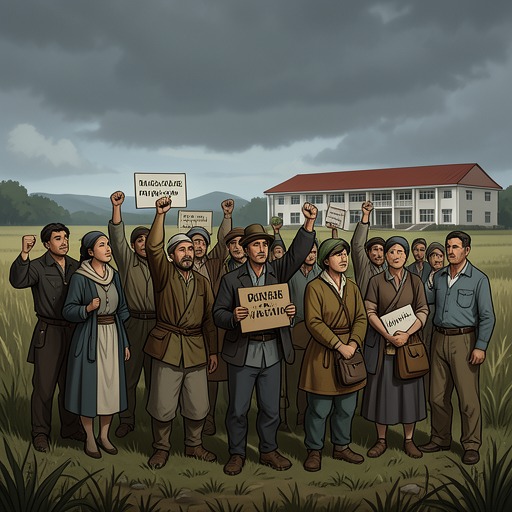
The procedure falters as soon as the Notary begins reading. He speaks slowly and clearly, but after listening in silence for a time, someone calls out that they understand nothing. Others demand that the document be read in their own tongue. The scene makes comprehension a political issue: the order is formally explained, yet the assembly cannot treat the explanation as meaningful consent if its members cannot understand the words in which it is delivered.
The gap is sharpened by the contrast between the Notary’s official account of benevolent authority and the villagers’ experience of the meeting. His reading describes the school’s benefits and specifies the tax, but the crowd’s immediate response is not assent; it is a demand for language they can understand. The text does not establish that the villagers oppose education itself. It shows that the terms and authority behind this particular measure are being presented through a procedure that excludes them linguistically.
Compulsion and the Vote
After the reading and explanation, the villagers hesitate, each weighing the proposed tax. The meeting grows disorderly as disputes over the school mingle with other grievances, including arguments about Antek and the previous day’s rain. The Prefect interrupts the confusion with an unequivocal command: there must be a school, and the villagers are to approve it. When he later orders silence and again tells them to approve, the crowd falls quiet, frightened and apparently unable to continue its opposition openly.
The vote is then conducted individually. An assistant calls each person forward, and the Notary records a mark for those in favor and a cross for those against. The recorded result is two hundred votes for the school and eighty against. Grzela’s supporters immediately cry that the vote has been manipulated and demand another. The account thus records a numerical majority but also preserves the challenge to the count; it does not make the meeting’s legitimacy feel settled simply by reporting the result.
Significance in Village Life
The order places institutional schooling inside a community already shown to face severe economic pressures. In winter, hired workers lack employment and income, some households have lost potatoes to frost, and poor families struggle to find food or credit. Against that background, an added tax is more than an abstract contribution: it is another claim on land and resources in a village where the capacity to pay is unequal. The directive’s per-morgen basis makes land the measure of the charge, even as the meeting reveals how difficult it is for the poorer and less powerful to shape the decision.
The school meeting also brings together two competing forms of authority. The Notary’s reading, the recorded marks, and the Prefect’s command represent administration operating through documents and official procedure. The villagers’ insistence on hearing the order in their own tongue, and Grzela’s challenge to the vote, assert that procedure cannot automatically command understanding or trust. The order’s significance lies in this tension: a school is promised for several villages, but the process for establishing it exposes how an ostensibly communal decision can be directed from above and contested from below.