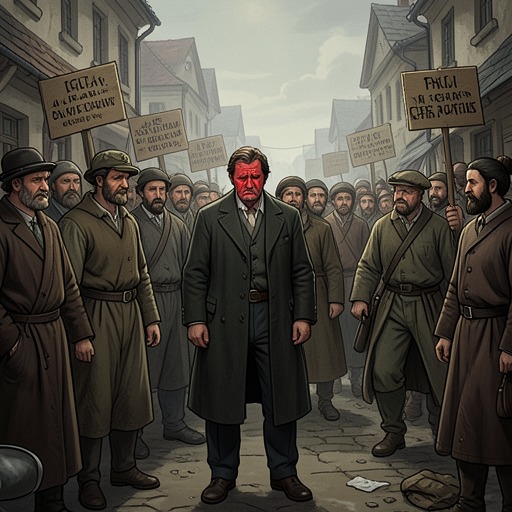
Lipce peasants
The PeasantsThe Lipce peasants form a village community rather than a formal organization: farmers, hired hands, women, and young people whose common claims to land and livelihood can bring them together, but whose circumstances and interests are not identical. Their collective action reaches its most forceful expression in the resistance to the manor’s felling of the forest. There, a local dispute over customary rights becomes an open contest over who may decide how the village’s resources are used—and what risks its people will accept to defend them.
Community and shared claims
The community’s cohesion rests in part on practical claims to land and pasture. In one dispute, villagers complain that land they regard as theirs is recorded in the register, yet people are repeatedly driven from it; the loss of a cow and injuries to a boy make the conflict materially immediate. The grievance is not simply that the manor possesses more power, but that formal records and local understandings of rightful use appear to contradict one another. The possibility of appealing to a court or commissioner is raised, even as the villagers doubt whether such recourse can restore what they have lost.
The forest carries an even wider significance. Maciej Boryna looks over its trees and counts his own four morgs alongside Jagusia’s one, seeing the disputed woodland through the lens of landholding and family claims. For other villagers, the forest also represents access to work and a resource they believe should not be taken from them without agreement. Their shared opposition therefore joins different stakes: property, customary use, employment, and the security of households already close to want.
Mobilization against the felling
The immediate crisis begins when news spreads that the manor has started cutting the peasants’ forest. The report moves rapidly from cottage to cottage. Instead of erupting at once into disorder, the village falls into a tense quiet: people whisper, watch the roads, and weigh what should be done. Farmers gather at Kłąb’s cottage while others wait outside, unable to hear the elders’ deliberations. When that gathering moves to the inn, Antek Boryna speaks against the manor. His warning is forceful, but his earlier conduct and the priest’s rebukes make some villagers hesitate to follow him.
By dawn, Antek is ringing the bell tower bell to summon the village, despite attempts by Ambrozy and the organist to stop him. The crowd grows until it fills the square outside the inn. Villagers wait for Maciej Boryna, whose standing among the farmers makes him the expected leader. When he arrives, he presents the felling as the latest in a series of wrongs: the manor has refused village men employment, driven them toward ruin, and ignored complaints and legal action. He calls on Christian Poles, farmers, and hired hands alike to defend what is theirs together.
The assembly’s decision becomes action with striking speed. People return home to change clothes, harness horses, and bring out sleighs, carts, and whatever weapons are at hand. Farmers and farmhands set off alongside women and older children; some ride, while many walk. Poles, rusty pitchforks, flails, and an occasional scythe rise above the moving crowd. Maciej leads from his sleigh, and the group sets out in solemn, ordered formation. Antek, who had hidden in the tavern when his father appeared, takes a shotgun and makes his way separately toward the forest.
The forest confrontation
When the villagers reach the clearing, they confront the woodcutters, who have come from outside the community, including people from Modlica and Rzepki. The villagers demand that they stop and leave. Maciej appeals directly to the workers before the manor steward arrives with farmhands and begins whipping the women. As the crowd scatters under the attack, Maciej calls them back. He takes up a wooden stake and charges the manor’s men; the villagers close ranks behind him, striking with their own improvised weapons.
The confrontation leaves people on both sides injured and turns the community’s claim into a dangerous physical challenge to the manor’s authority. In a later account, an old woman describes Maciej returning with his head split, Szymek Pacześ with a broken leg, Mateusz Gołąb badly beaten, and Stach Płoszka with a head wound. She says Antek beat the woodsman to death in retaliation for what had been done to his father. The villagers nevertheless return singing and celebrate through the night, bringing vodka to those most severely injured. Their rejoicing does not erase the cost; it shows how a violent encounter could be experienced locally as a victory for a claim the villagers believed had otherwise gone unheard.
Arrests and the cost to households
The authorities arrive days later, in wet snow and bad weather. Officials question villagers and take the men into custody; more than fifty are driven to prison. The arrest of so many men removes labor from households just as spring work is beginning. Fields need ploughing and sowing, but the remaining workers include only the Voyt, the man identified as the village blacksmith, older men barely able to work, and one farmhand described as weak-minded. The collective act of resistance is thus followed by a collective labor crisis.
The burden falls especially hard on poor families. Hanka hears of a child weakened by hunger in a freezing cottage where the windows are stuffed with straw, the household has sold its quilt, and potatoes are gone. Another family faces a birth while its mother is ill, without savings, help, or milk for the newborn. The suffering exposes a limit of village solidarity: people share the same settlement, but farmers with food and resources do not necessarily relieve the poor. The arrest of the men intensifies hardship that was already present, while appeals to divine order can serve as an excuse for leaving neighbors unaided.
A continuing, divided political force
The forest resistance gives the Lipce peasants a model for collective pressure, but not a guarantee of lasting unity. Later, as the purchase of Podlesie by German settlers is discussed, a speaker proposes approaching them together and threatening to prevent sowing, building, or access to the fields if they proceed. The proposal echoes the forest action: villagers would use coordinated presence and refusal rather than rely only on individual complaints. It remains a proposal in the evidence here, not proof that the same mobilization follows.
The community also confronts authority in less violent settings. At a meeting about the proposed school, the notary calls for someone to run an errand to the manor, and no one moves; a villager answers that they did not come to deliver messages. Later, when gendarmes stand among a crowd, the peasants close ranks around them and then surge after them toward the prefect. These moments show a collective capacity to refuse deference, even where they do not establish a single permanent organization or a settled political program.
The Lipce peasants are therefore neither a uniform bloc nor a crowd defined only by violence. Their solidarity is built from shared exposure to dispossession and economic insecurity, and can bring together people of different ages, occupations, and standing. Yet poverty, unequal resources, distrust, and the consequences of repression continually test that solidarity. The forest march reveals both sides of their collective power: a community able to assemble and act as one, and a community whose most vulnerable households bear much of the price afterward.